Sunday, May 29, 2022

"Hands on" – My latest article for Catalonia Today magazine


[Erika Lust_Pic: Monica Figueras]

On a crisp but sunny early afternoon last month, I took myself to (lower) Sant Gervasi-Galvany, part of Barcelona city. I had volunteered to be interviewed for a documentary and before stepping through the door of the rented film studio on the building’s 8th floor, a young woman asked me and two other participants to speak in a whisper and only when necessary.


Filming had already started. The hushed silence inside only added to the strangeness of the experience. I was there – only for research purposes of course – to answer questions about masturbation for what was apparently “a non-explicit video to celebrate self-pleasure.”


As we came in, we were asked to sign several legal documents, including one that confirmed we did not have Covid. I was given (here’s a piece of full disclosure) an envelope with 50 euros cash inside. Then we were taken by a different woman (who repeatedly told me how exciting it all was) across the bare, wide concrete studio floor and into a separate area.


A young man began to put makeup on the face of the next interviewee. I waited on a sofa with a guy with a North American accent. He was avoiding eye contact and only mumbled something unclear when I made a friendly observation, suggesting we were doing something very different today.


On the other side of the thin wall, I could hear talk from the middle of the room. I could make out some questions I’d probably be asked and from the woman answering I was also able to get a sense of what I might say. That helped.


I chatted to the curly-haired Argentine who painted and patted makeup over my nose, eyes, and cheeks. Paris wasn’t to his liking but Barcelona was, so far. Then I was up: it was my turn to sit on a stool in front of an especially bright light. A microphone was clipped onto my shirt and an assistant reminded me that I wasn’t obliged to try and answer any questions that I wasn't “comfortable with.”


The person asking the private questions and getting answers for her public, was the owner of the company. She uses Erika Lust as her business name and her website states she is “an award-winning filmmaker, producer, and writer [whose] focus on female pleasure, cinematic values and ethics in adult cinema have helped to change how pornography is consumed.”


I quickly found Erika to be a skilled interviewer partly because her questions were thoughtful and related specifically to the answers I gave. She was a good listener, that rare quality. The session seemed exploratory, not a dry run-through of a list or a pre-prepared line of interrogation. Instead, it quickly became a more open ended, fast-moving quarter of an hour. I was impressed, for example that she also wanted to know how I educated my son about sex and bodies. Her intelligence was obvious. I later discovered she was named as one of the BBC’s 100 Most Influential Women of The Year in 2019.


As her press kit states, “Erika defends the importance of having women, BIPOC, and LGBTQ+ people behind the camera in all key positions.” Her all-female production crew – young, efficient, English-speaking, and keen – were working a 9-hour day.


Finally, Erika asked me to wish the viewers “Happy Masturbation Month”. I was more than okay to do that and hammed it up, waving my arms and added with a laugh, “Go for it!” On the way out, I nibbled on the free lunch provided then headed back outside to Carrer Arribau with the sense that I’d done something good. And surely so was everyone else there.


(The end result...https://www.youtube.com/watch?v=lfppLfTomd0)


[This article was first published in Catalonia Today magazine, May 2022.]


Tuesday, May 24, 2022

Spain's Basque country and Richard Burton: a tenuous connection but a very real one


In this dramatic and poignant speech-like reply to an interview question [between 3:11 - 6:00] the Welsh actor talks about his miner father's unique relationship with The Great Atlantic Fault (or "dark artery"): a  famous coal seam that "starts in the north of Spain and goes under The Bay of Biscay and comes up in northern Wales then goes under The Atlantic and comes up in Pennsylvania."

Everything he has to say is as compelling as any political speech or piece of writing. Even more so because it's dense with authentic feeling.

(But just in case...Here's the equivalent on paper: George Orwell, "Down the Mine.")


Saturday, May 21, 2022

New fiction book from (English/Catalan) author Matthew Tree


"In Saint James' Park, London, the police apprehend a young man who is carrying a bag full of high explosives in one hand and a collection of letters sent to his grandfather by the writer Malcolm Lowry in his inside pocket. 

In the course of the following interrogation, we discover the strange past and secret phobias of the detainee, and the emotional link between his actions and the Lowry letters. (The book's author really did have a grandfather to whom Lowry wrote on a regular basis)."

From the Back Cover:

Originally published in both Catalan and Spanish, 'If Only' now appears in a revised edition in English for the first time.

'This is a technically competent book with the force of a lashing gale. There is no question that it deserves an English language readership'. 
Times Literary Supplement.

'A work of literature which has received praise from many different sources, as well as the first Columna Award' 
El Punt newspaper.

'In short, a brilliant and innovative novel...you won't be able to put it down'. The poet Daniel Ruiz-Trillo in  
El Punt newspaper.

'This extraordinary novel, which I read in one sitting...interesting, caustic and technically remarkable.' 
El Periódico de Catalunya.

'One of the most surprising, unusual and ambitious books of recent years' 
El Temps magazine.
'Tree creates an atmosphere which convinces the reader and plunges him into the world of the story'. El País.

To read more click here.

Wednesday, May 11, 2022

In London: a highly-deserved tribute to Peter Bush


Not before time, one of the very finest translators of Catalan, Spanish, Portuguese and French is being honoured next week. (See above for details.)

His brilliant work on The Memoirs of Juan Goytisolo is still one of the best pieces of translation I've ever read.

A genuine literary great and master of languages.

Monday, May 9, 2022

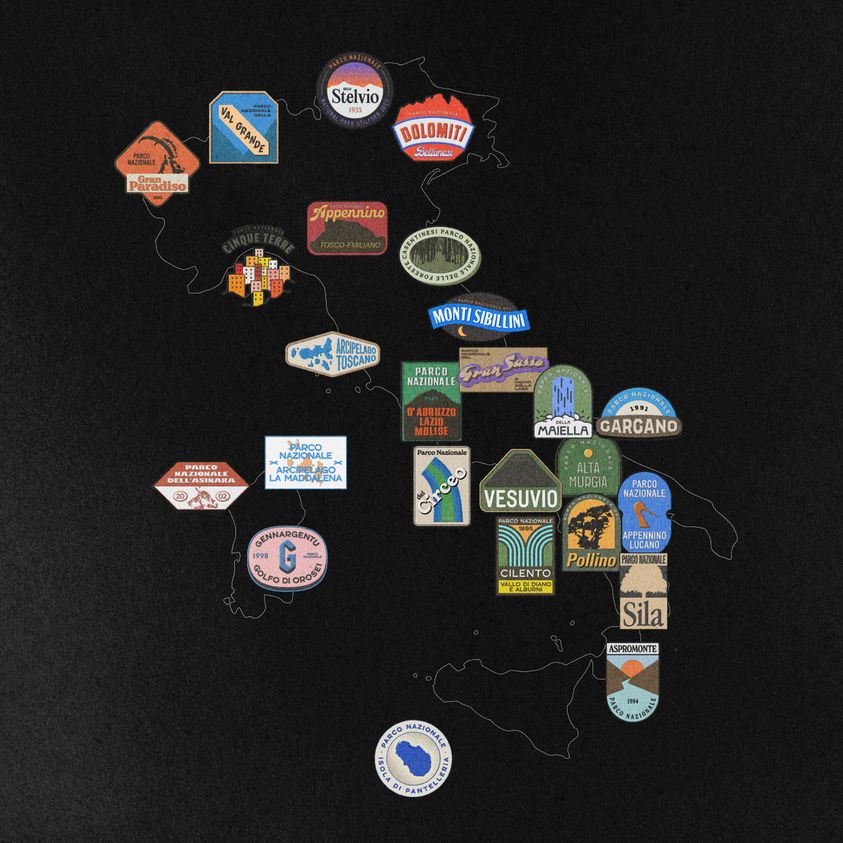
Italian National Parks...

I just love how all their symbols (still) look like they were designed and made before about 1984. Never been updated: there's something innocent in that.


Tuesday, April 26, 2022

“There is only one race: the human race.” -- Rita Levi Montalcini


I


Marking her 100th birthday, my 2009 translation of a manifesto by eleven Italian anti-racist scientists that begins with the words:

“There is only one race: the human race.”

These were the words of scientist Rita Levi-Montalcini (also attributed to Gandhi and Satyendranath).

My English translation (from a Spanish version) can be read below:

I.  Human races do not exist. The existence of human races is an abstraction that has come about from a false interpretation of the small physical differences that we feel we perceive. It comes from mistaken “psychological” associations: differences interpreted from a basis of secular prejudice. These abstract subdivisions are founded on an idea that humans are made up of groups that are, biologically and hereditarily, greatly varied.

This is pure invention that has always used arbitrary classification between men and women as better and worse and in this way discriminates against those at the extreme (always the weakest) after having blamed them for being the key to all evil in every moment of crisis.


II.  Humanity is not made up of large and small breeds. It is above all a network of connected persons. Certainly, human beings come together in groups of individuals, communities, ethnic groups, nations and civilizations. But this does not happen because we have the same genes but because we share life stories, ideas and religions, customs and behaviour, lifestyles and cultures.

These groupings are never established from the same DNA; in fact they are subject to profound historical changes. They are formed, changed, mixed, fragmented and dissolved with a speed that is incompatible with the lengths of times required by the processes of genetic selection.


III.  The concept of race has no biological meaning for the human species. Analysis of DNA has shown that genetic variation in our species – less than that of our ‘cousins’ the chimpanzees, gorillas and orang-utans – is represented above all by differences between people from the same population, whereas they are less than the differences between populations and different continents.

The genes of two individuals of the same population are, on average, slightly more similar than those of people who live in different continents. Precisely because of these small differences between populations even racist scientists never defined how many races make up the human species. They made estimates ranging between two and two hundred races.


IV.  There is a fake and deadly myth that has already been forged: the identification of the “Aryan race” with the image of a warlike people, the winners, ‘pure’ and ‘noble.’ Along with this, there is the theory that much of EuropeIndia and central Asia is the homeland of the basis of Ind-European languages.

History makes it apparent that it is extremely difficult to identify Aryans as a people in addition to the notion of an Indo-European language that stems from conventional classification. But on the other hand, modern archaeological data indicates that Europe was inhabited in the Palaeolithic era by a population of African origin and in Neolithic times other immigrants came over from the Middle East.

The foundation of present-day Italians is from the same southern African immigrants who today constitute the enduring fabric of life in Europe. Despite the dramatic originality of fascist racism the Italians allied themselves with the Nazi’s due to their identification with “Aryans.”


 V.  It is a legend that sixty million of today’s Italians are descended from families that lived in Italy a millennium ago. These same Romans built their empire by welcoming people from diverse backgrounds, giving them the status of Roman cives.

The phenomena of social and cultural mixing, which marked the history of the entire peninsula - also including Greeks, Jews, Africans, Hispanics and those seen as "barbarians" - produced the hybrid we call Italian culture. Even though they were dispersed throughout the world and living in small Italian states, Italians continued to be identified with this culture that was global, varied, humanistic and scientific.


VI.  There is no Italian race; there is only one Italian people. Italy was only unified as a nation in 1860. Many millions of Italian emigrants in the past often concentrated in foreigner areas. They were considered as, and are, Italian. One of our greatest assets is being mixed with so many people and our exchanges that "cross" physically and culturally.

"Purity of blood" and the "nobility" of the "Nation" have been ascribed to a country that has never existed. It has meant reducing the homogeneity of an alleged biological element in addition to the current populace of Italy’s thousand years of heritage and spreading of cultures.


VII.  Racism is at the same time both homicidal and suicidal. Empires became empires due to the coexistence of diverse peoples and cultures, and collapsed when fragmented. That has happened and is still happening in nations with civil wars. To cope with this crisis, they used minorities as scapegoats.

Racism is suicidal not only because it hits those belonging to different peoples but because it also strikes the same people who practice it. The trend of indiscriminate hatred that fuels racism is spreading infectious ideas about any “foreignness” or strange “otherness.” This comes from an increasingly narrow definition of "normalcy".

There are those that do not match up to standard human types. They are "out of line", the "mad", the "weak spirited," gays and lesbians, poets, artists, and alternative writers. All of them are attacked, though it is they who are actually allowed to live and incessantly transform mankind. Every living system is capable of continuing only if it is capable of change, and we, human beings, change with fewer genes and always more with the inventions of our generously disordered brains.


VIII.  Racism discriminates, denies relationships, and it introduces fear into various thoughts and behaviours. To defenders of the Italian race, Africa appears as a terrifying threat. The Mediterranean Sea simultaneously separates and unites. From this, the racists claim that there is no "common Mediterranean race."

To reject Africa even further, racist scientists put up a barrier against "Semitic" and "camitas". Science indicated that there is a clear distinction between the genetics of Mediterranean Europe (occidentals) and on the other side, Oriental and African. From the paleontological and genetic point of view the theory that earth’s people originate from Africa is absolutely proven: we are all together in a single race.


IX.  Italian Jews are both Jews and Italians. Like all migrant peoples (nobody migrates from free choice, but many do so from necessity) Jews have been spread across the World and have been part of diverse cultures. At the same time they have still retained their people’s identity and religion.

So as in the cases of the Armenians, or the same Italian immigrants: the same thing is happening with migrants from now: African, Filipino, Chinese, Arabs from various countries, peoples belonging to Eastern Europe or South America, and so on. All these people had the painful need to emigrate, but also the luck in the best cases, of enriching themselves by combining their culture with those who gave them hospitality. All were equally enhanced, and where possible, neither one nor the other cancelled out each other.


X.  The ideology of the racist bigot is based on fear of "disruption" of their own race. This is totally blind to the fact that many societies recognize that getting married outside their community, even with their own enemies, is fine because they know that partnerships are more valuable than barriers. In addition, human physical characteristics are altered a great deal by the particular living conditions, just as the psychological characteristics of peoples and individuals are not written in their genes.

Cultural mixing is the foundation and basis of hope for progress stemming from the European Union constitution. A racist Italy fragmented into "ethnic" separation, as has happened in the former Yugoslavia, would be devastating now and in the future.

The consequences of racism are the loss of culture and self-expression, homicide and suicide, fragmentation and implosion. These end results are uncontrollable because they are caused by an indiscriminate revulsion towards those who are considered the "other" and not "us".


Signatories:

Enrico Allevi, Professor of Ethics, Istituto Superiore di Sanita, Rome
Guido Barbujani, Professor of Genetics of Populations, University Ferrara
Marcello Buiatti, Professor of Genetics, University of Florence
Lauradalle Ragione, Psychiatrist and Psychotherapist, Perugia
Elena Gagliasso, Professor of Philosophy and Science of Living, University La Sapienza, Rome
Massimo Livi Bacci, Professor of Demography, University of Florence
Alberto Piazza, Professor of Human Genetics, University of Torino
Augustine Pirella, Psychiatrist, Co-founder of Democratic Psychiatry, Torino
Francesco Remotti, Professor of Cultural Anthropology, University of Torino
Philip Temple, Professor of Physiology, University of Torino
Flavia Zucco, Director of Research, Association President of Women in Science, Institute of Molecular Medicine, CNR, Rome


Original version of the Manifesto in Italian.

Wednesday, April 20, 2022

My book signing/sales location on St Jordi's Day (April 23)


I'm happy to say I'll be doing a signing and sales session of Slow Travels in Unsung Spain with Barcelona's Come In bookshop's stand on the international day of books and Catalonia's St Jordi's Day, Saturday, April 23.

Time: 5pm-6pm

Place: Paseig de Gracia between C/-Provença and C/- Mallorca

Maybe I'll see you there!


Sunday, April 10, 2022

"Let's Cook:" A recommendation


Here's a rare thing: me endorsing something. And I only do it when I believe something is really worth supporting.

Let's Cook do a damn good job at making your lunch or dinner easier without sacrificing any quality.

[Disclaimer:] The food I selected from their wide menu and was sent as a trial I did not pay for. I agreed to review their service only if it it satisfied me and my wife.

And it did!

We both chose the organic tofu burger "kit" with guacamole and the freshness of the ingredients was excellent. The size of the portions was more than generous and the delivery was also convenient. They have weekly menus which change, reflecting seasonal produce.

So, for you my readers there is a special offer: Sign up with a 10€ discount. LETSCOOK1265 . I'm confident you'll enjoy Let's Cook as much as I did.


Sunday, April 3, 2022

I still love books


On the other side of the planet, visting Australia a few years ago. 

This photo was taken in suburban Canberra, outside a house two doors away from where I grew up. 

I was holding a free/exchange copy of "God is an Englishman" by Donald Horne. 

A great read too.

Sunday, March 27, 2022

Business Over Tapas


Highly recommended by me. 

Brilliant, concise current affairs summaries: done every week. I couldn't do without it.

Read for free only this week here.

Sunday, March 20, 2022

"My Catalonia" -- My latest opinion column for Catalonia Today magazine


[Photo: C.Morell]


When I think of Catalonia what immediately comes to mind is the word ‘home’. I see the wide view across rows of vineyards, the mountains of the Penedès in the distance, the tops of Montserrat further away, only able to be seen in winter when the leaves on the bare trees allow it. That, from our back terrace.

I have to think about our house too. A narrow but tall and modern ‘adossat’ terrace that has been ours to enjoy (and pay off back to the bank) for the last eleven years. The nighttime light from the old church tower across the street still angles in across our lowly bed. Its bells still ring every fifteen minutes to remind me I rise and sleep in Europe, not Australia, England or Japan.

I am also compelled to recall the splendours of the food here. Discovering the joy in simple ‘pa amb tomàquet’ and the savoury wonder of salt cod, ‘suquet’ seafood stew or the earthy richness of ‘calçot’ green onions cooked on a wood fire.

In Catalonia too, I found the pleasure of chewing the sweet, scant flesh on rabbit bones and diving into a bowl of snails ‘a la llauna’ hot from a tin tray, freshly out of the oven. We still drink the co-op white wine from Covides (an unfortunate name in these times.) Good, cheap stuff pressed from Xarel·lo, Macabeu and Parellada grapes.

Of course, Catalonia is so much more than just that. It’s where we’ve worked. I’ve written, taught and travelled thousands of kilometres to do these things. It’s an hour-long seat on RENFE trains, it’s driving the hills up and down the single-lane N340 running past Vallirana.

Equally, this place has sustained us and drained us; given so much but also taken so much energy and expense. It’s where our son went to school and learnt to use two languages. Catalan is his second language and as he makes his way as an independent young adult he still uses it every day in his work and study, I’m immensely happy to say.

Catalonia gave him superb teachers all through primary and secondary school. Every one of them were caring and dedicated women, apart from a handful of young men and they too were the exact kinds of male anyone could hope for as role models for him.

As well, my thoughts can’t go much further than to the selfless people who work with such heart and humanity in the public health system here. I owe a great deal to them all and so does my wife.

And there’s always The Big Smoke, the capital that brings tourists from everywhere. I was first one myself almost 25 years ago and now as a local I love to busy myself in the crowds on the streets. Every part of Barcelona is a gift, even the least attractive corners.

My Catalonia continues to spur the imagination. (I once had the idea of a book of photos of every rambla in every town where they could be found across the land).

Now, in my more optimistic times, I see somewhere I’d never want to leave. As it is, I don’t want to live anywhere else. Here is as good as it gets.


[This article was first published in Catalonia Today magazine, March 2022.]


Sunday, March 6, 2022

Yet another new ⭐⭐⭐⭐⭐ reader review for my latest book


"What counts are [his] encounters with the locals..."

"This narrative integrates history without overburdening the text..."

"He's done a great job of immersing himself."

https://www.amazon.com/dp/B07NJG91W7/#customerReviews

Sunday, February 27, 2022

Under time and feet


A street manhole from the Catalan town of Sant Cugat Sesgarrigues (where l've lived for more than a decade) with its altered former Spanish name under the dictatorship.

The date of 1970 is when running water was installed, I suspect.

Wednesday, February 23, 2022

"Barcelona Deep Collage"


"On 9 and 10 October 2021, the BSC hosted the Barcelona Deep Collage Festival, as part of the festivities in the Les Corts District and on the occasion of the inauguration of the centre’s new building..."

Sunday, February 20, 2022

"Catalonia pardons women accused of witchcraft 400 years ago"


[Since 1997, the town of Viladrau has been shedding light on its history of witch trials. Several streets were named in honor of the women killed.Credit: Lucía Benavides/The World]


"About 400 hundred years ago, in the small Catalan village of Viladrau, 14 women were accused of witchcraft, tortured and hanged. At the time — between 1618 and 1622 — there were fewer than 10

“We’ve gone down in history for being the town with the biggest witch hunt in Catalonia,” said Noemí Bastias, the town’s mayor. “But they weren’t witches — they were marginalized women like widows, immigrants and herbalists.”

Last month, the regional Catalan government in northeast Spain passed a resolution to pardon up to 1,000 people executed for witchcraft in Catalonia 400 years ago...

Witch hunts relied heavily on accusations from neighbors who were desperate for scapegoats whenever bad luck struck the town — such as crop failures, sudden diseases or natural disasters."

Read more from source at PRI and listen to story here.  


Sunday, February 13, 2022

"More Borics please" -- My latest opinion column for Catalonia Today magazine


[Photo: EFE]

Was it sexism?

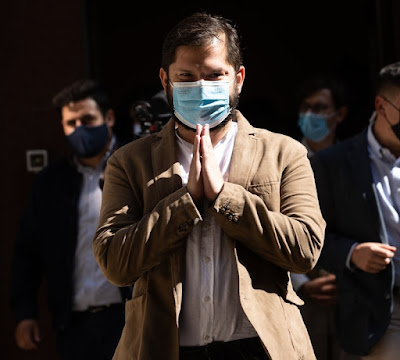
It wasn’t widely reported in the English language media but Gabriel Boric, the new leftist President of Chile has a Catalan mother, María Soledad Font Aguilera, who was originally from the working class area of Badalona bordering Barcelona

Instead, his father’s Croatian heritage was emphasised and I suspect this is not only because of the single family name.

A graduate of The British School in Punta Arenas, 35 year old Boric is the youngest holder of his nation’s most prized office, having gained just under 56% of the vote in Chile’s second round of elections last December. He defeated the right-wing José Antonio Kast, son of a veteran of World War II and militant in the German Nazi Party.

Boric’s party was able to earn a victory even after “a sudden blackout of bus services in Santiago and across the country forced voters to endure long commutes in the summer heat to express their basic right to a free and fair vote.

But against these efforts at voter suppression, the people of Chile offered their cars, vans, and motorcycles to assist their neighbours to get to the polls.” Most apparent was his support from younger voters and millennials, tired of the usual divisive political rhetoric.

Irina Karamanos Adrian, the new President’s “first lady,” has said she doesn’t want to be the country’s first lady, at least in a traditional sense. As a writer, anthropologist and militant feminist originally coming from Greek and German immigrants out of Uruguay, in her own right, she has also appeared on TV political debates before the presidential campaign.

(To me, if the new president had been a woman then we would have certainly seen a great deal of scrutiny of her life-partner/husband/wife/significant other, or whatever term you want to use. I have a distinct memory that just over a decade ago when Australia had its one and only female prime minister, Julia Gillard, there was a big hooha from conservatives about how she was partnered, not even married (!) to a man who had the supposedly “effeminate” job of a hairdresser.)

Boric himself came to wider attention after his message on Twitter following the independence consultation in Catalonia on October 1, 2017. He posted the words: “Images of police violence in Catalonia are shocking. A firm embrace from Chile to the Catalan people. More democracy, less repression”.

An electoral dark-horse and surprise victor, Boric is to be sworn into office this March in just one of the Latin American countries that have recently opted for left-wing presidencies; other examples being Argentina, Bolivia, Honduras, Mexico and Peru.

Boric was swept into power on an ambitious platform of practical changes like raising the minimum wage, reducing the cost of education, expanding the social safety net, fighting climate crisis and extending rights to indigenous people and gay and transgender individuals. He has even talked about creating a British-style national health service that is universal across Chile.

The big test for any progressive leader in power is what they do, not what they say, but if his manifesto is any indication then Europe too could do with plenty more like him.


[This article was first published under the title "Was it sexism?" in Catalonia Today magazine, February 2022.]

Sunday, February 6, 2022

How southern Europe will be hotter than the rest of the planet


This is an alarming, even disturbing video.


"The speed and magnitude of the climate change we are facing today is unprecedented. Heatwaves, droughts, floods... We are feeling its effects on our daily lives, year after year. Its impacts will increase at least until 2050 and every region of Europe will be affected.

Based on the results of the latest available studies, and in particular, on the 6th IPCC report, this film, produced by scientists in the framework of the European project EUCP, aims to present to the general public the climate changes expected in Europe in 2050. The researchers explain in an accessible way the variations in temperature and precipitation as well as the extreme climate events that European inhabitants will have to face. This film provides the keys to understand how climate will reshape our landscapes and lifestyles over the coming decades. ... and to enable us to better anticipate the need for human societies to adapt to this partly inevitable climate change."

Sunday, January 30, 2022

Pandemic poem

Cut down
Cut down to bone
Cut off to spite it and
Cut off from
Cut away to put away
Stay away
Cut out
Cut out your needy

Cut me down I'm
Not cut out for it