Showing posts with label modernity. Show all posts

Wednesday, December 8, 2021

"Translating 'modern slavery' around the world"


"The Freedom United community around the world [was asked] to take part in our survey Translating ‘Modern Slavery’ to better understand  how terms such as “human trafficking,” “forced labor,” “modern slavery,” etc. are discussed, framed, or translated in languages besides English. Language is complex and we recognize how local cultural contexts and linguistic nuances shape local advocacy and public understanding...


SPANISH:

Lara Chiavarini:
One of the main problems I see and read when talking about human trafficking in my native language (Spanish) is the difference between “trata de personas” (human trafficking) and “tráfico de personas” (smuggling of migrants). I dare to say this has its origins in “bad” translations. Forced labour could be said “trabajo forzado” or “trabajo forzoso”, forced marriages can be said in both ways as well “matrimonios forzados/forzosos”. Debt bondages is generally found linked to modern slavery: “esclavitud por deudas” and finally modern slavery could be found as “esclavitud contemporánea” more than “moderna”.  When talking about “human trafficking” and “modern slavery”, depending on who is writing and who is their audience, people chose one word or the other. Modern slavery may be more shocking so it is generally found (at least in my country, Argentina) in newspapers and articles. Nevertheless it is also true that people usually say that they are slaves of their work, of the system, etc.

Michael Solah:
Esclavitud, tráfico de personas/humanos (Spanish – Ecuador). There are a lot of signs in travel places (airports/border crossings) with warnings about human trafficking, including penalties. Unfortunately child trafficking is a big issue and I feel it is not discussed enough, it disproportionately affects those in poverty in Ecuador. The implications are similar to English, though in Ecuador it is often assumed the people being trafficked are children.

Elsa Grimaldi:
In Argentina, where we speak Spanish, those terms are translated into: tráfico de personas, trabajos forzados, matrimonios forzados, dependencia de la deuda, esclavitud moderna. What comes to mind with these issues is the humiliating, pain-inflicting ways in which humans treat other human beings, usually based on religious or cultural motivations but many a time for economic motivations, e.g. to make profit out of selling or enslaving other people (women, children, men). "


Read more here.


Sunday, October 6, 2019

"The Pickpocket Slaves of Europe"


"The pickpocket slaves of Europe have prompted a major international investigation by the Netherlands regarding the...forced child pickpockets in Europe…

In Eastern Europe, children are living what the Dutch press calls a modern Oliver Twist story.  

Some of the children are being held against their will and forced to beg and steal their way around Western European cities.

According to the findings of an international investigation called Operation 13Oceans, these young thieves, as young as 8 years old, are picking pockets and involved in other petty crimes in the Netherlands, Austria, Belgium, Germany, and Spain.

Several kids appeared on the radar of the Dutch police when they saw the same faces over and over again, with different names each time. They had picked them up, booked them, and let them out on the streets again, in a never ending cycle. 

Eventually, as the cops ran their faces through the databases of Europol and other international organizations, a list of around 300 kids emerged. 

The children are invisible victims because it is hard for society to see the sinister hand of organized human trafficking that lies behind the petty thievery that afflicts so many European cities, helping to stoke the anger against “migrants,” many of whom are Roma, but many of whom are not.

A Dutch prosecutor said, “What you see is often not what it appears. When you see a mother begging with a child, for instance, you don’t necessarily think about the infant being forced to serve as a prop for a woman who is not its mother at all.”

Another member of 13Oceans added, “As the children get older, they are forced to steal for a criminal organization. We are actively watching four international criminal networks.” More specifics were not given, since the investigation in ongoing.  But the ages of the children range from 8 to 16, he said.

In the past, investigators tended to look at this issue as pickpocketing or so-called mobile banditry offenses…but now in this case the children are considered victims rather than offenders.  Some of the victims are demanded to steal up to [$1,115] a day."
Read more from source here.

Saturday, April 13, 2019

"Blurred lives" -- My latest opinion column for Catalonia Today magazine

[Photo: Quim Puig]
Without barely noticing it, we are routinely doing two things (or even more) at the same time. 

I don’t mean having the TV on in our houses, as Juan Goytisolo called it, “Spanishing on” in the background like in a typical bar here.

What I continually notice is that our daily lives are an action movie of driving while texting, texting while watching TV, watching while screen-scrolling, scrolling while not listening to our companions.
Without questioning, our species silently changes what we do. Only 25 years ago, the phone had a fixed place in the hallway. Now it’s wherever we go. Some use it to shop at midnight or gamble and simultaneously watch sport. 
We experience a collective near-addiction to the stimulation that technology provides and this means that we are caught in our own man-made bubble of fixation, at work, at home and in between.
Piled on top of this, personal identities are more and more undefined. The more fashionable among us are flexitarian, pan-sexual. What was private is now openly public. We are selfie-supermodels: silicon titty down-shots and dick-picks for the under 30s. 
Even what was someone else’s body can now be yours. There are women you can find wearing hair extensions from an unknown Chinese stranger.
Some do the opposite and cling to identity. I’m my race, let’s leave Europe, get out of MY country, “walls are good things, barbed wire can be beautiful” says Trump, “eat my shorts” says Homer Simpson.
And who still has a 20th century-style job? The blurring of life-lines has of course crossed over into the world of employment. Oh, you’re a consultant? He’s freelance, she’s a temp/intern/trainee and that kid makes big money from playing computer games. The rest of them all have zero-hours contracts.
In fact at this moment in time, my own income comes from seven different sources. I’m a teacher/journalist/translator/author and occasional recipient of parental financial help...at age 50. 
I currently go to how many different work locations? 
Apart from my own home, which is also a workplace, the answer is: 10. That is over five days. Imagine, too, how many more it would be for a truck-driver, a Deliveroo bike-rider, a home-shopping deliverer or an Amazon door-to-door courier.
Added to creeping uncertainty and the old ways being so far gone, across this fragmented society there are “a million mutinies now,” as the author VS Naipual once wrote. 
To unconsciously fight against the disappearance of any real certainty in our lives, internal reactions are made into actions. Gay bashing, wife-bashing, woman-hating, immigrant-hating, Muslim-hating, Jew-bating, tail-gating, restaurant-rating, bomb-making, piss-taking, muck-raking, reality-faking. 
All with the momentum of a mudslide that doesn’t want to stop.
And what are we now scared of? Not the bullies. Plenty of people are frightened of the failed-economy’s victims. People with next-to-nothing: refugees, the homeless, beggars. 
We are not afraid of the unknown (giant multinational companies, faceless billionaires. They are all too abstract). We are fearful of The Other.
One of the ironies here is that as a result of this ‘loss of separation’ and things being so indistinct (possibly because of it) we are probably further away from each other emotionally and physically, even when we eat.
The French are continuing to be an exception to this trend but research has shown that more than one in five [British] families “only sit down to eat a meal together once or twice a week. 40% of them only sit down together to have a meal three times a week.” The average American eats one in every five meals in a car!
All this has made me tired now. I suspect you are too.

[This article was first published in Catalonia Today magazine, April 2019.]

Sunday, February 24, 2019

"Slavery 2.0" -- Exploitation in the tech industry to be uncovered in Barcelona this week

 "The Mobile Social Congress (not to be confused with the anti-Mobile World Congress or the socialist side of congress) is coming to Barcelona next week hell bent on promoting citizen awareness

This is to be the fourth ever Mobile Social Congress and is to focus on the working conditions and environmental impact of the electronics industry.


“We want to denounce labour exploitation and the exploitation of natural resources stemming from this predatory model of production and technological consumption,” said Laia Fargas, member of the NGO Setem Catalonia which is organizing the event. 
The title of the event Esclavatge 2.0. De la mina a l’abocador (Slavery 2.0: from the mine to the dump) sends a clear message about the objectives of the event, which include: adopting a global perspective on the production and consumption chain through round table talks, workshops and the projection of a documentary at the Pati Manning in Barcelona on March 26 and 27 in the afternoons.
These events will explore how working conditions reminiscent of slave labour appear in factories in European countries like Hungary and the Czech Republic as well as in China. There will also be presentations on repairing and recycling electronic products and data protection."


Sunday, March 25, 2018

"Antonio Muñoz Molina: “Our legacy will be a pile of garbage”

[Photo: 

"The award-winning Spanish author Antonio Muñoz Molina is a modern-day flâneur. 
In his new novel Un andar solitario entre la gente (or, A solitary walk among people), Muñoz Molina followed the path of writers such as Thomas De Quincey, Charles Baudelaire and Walter Benjamin, and aimlessly roamed the cities of Madrid, Paris and New York, recorder, notebook and pencil in hand. With these tools he captured life’s peculiar mix of the lowly and  the sublime. 


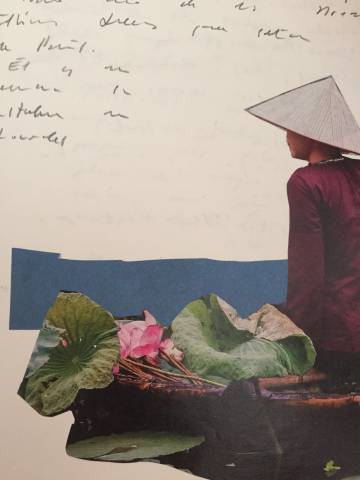
Collage by Antonio Muñoz Molina.ampliar foto
Collage by Antonio Muñoz Molina.


“The great poem of this century can only be written with waste materials,” reads a line from the book. “I was looking,” it continues, “for a transparent music that can be breathed in like air.”
EL PAÍS spoke with Muñoz Molina about his writing experiences and beliefs about modern-day society."
Read interview (in English translation) here.