Showing posts with label socialism. Show all posts

Wednesday, January 4, 2023

Yanis Varoufakis: Crisis, Recession, the Left & the state of the world economy


"Yanis Varoufakis is an economist, professor and left-wing Greek politician. Yanis has taught at several universities in Britain, Australia, Greece, and the United States.

He became the finance minister of Greece in 2015, when the coalition of Radical left- Progressive alliance came to power. In March 2018, he founded MeRA25, the "electoral wing" of DiEM25 in Greece.

In the 2019 legislative election, MeRA25 was the sixth most voted-for party, amassing nine parliamentary seats, with Yanis himself returning to the Hellenic Parliament. He is currently serving as a Member of Parliament in Greece.

Sunday, February 13, 2022

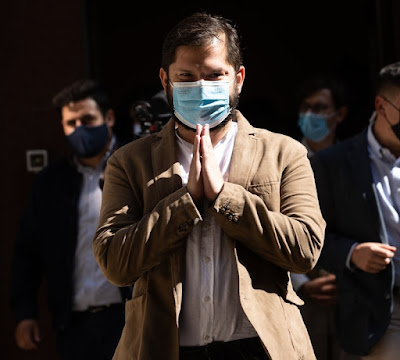
"More Borics please" -- My latest opinion column for Catalonia Today magazine


[Photo: EFE]

Was it sexism?

It wasn’t widely reported in the English language media but Gabriel Boric, the new leftist President of Chile has a Catalan mother, María Soledad Font Aguilera, who was originally from the working class area of Badalona bordering Barcelona

Instead, his father’s Croatian heritage was emphasised and I suspect this is not only because of the single family name.

A graduate of The British School in Punta Arenas, 35 year old Boric is the youngest holder of his nation’s most prized office, having gained just under 56% of the vote in Chile’s second round of elections last December. He defeated the right-wing José Antonio Kast, son of a veteran of World War II and militant in the German Nazi Party.

Boric’s party was able to earn a victory even after “a sudden blackout of bus services in Santiago and across the country forced voters to endure long commutes in the summer heat to express their basic right to a free and fair vote.

But against these efforts at voter suppression, the people of Chile offered their cars, vans, and motorcycles to assist their neighbours to get to the polls.” Most apparent was his support from younger voters and millennials, tired of the usual divisive political rhetoric.

Irina Karamanos Adrian, the new President’s “first lady,” has said she doesn’t want to be the country’s first lady, at least in a traditional sense. As a writer, anthropologist and militant feminist originally coming from Greek and German immigrants out of Uruguay, in her own right, she has also appeared on TV political debates before the presidential campaign.

(To me, if the new president had been a woman then we would have certainly seen a great deal of scrutiny of her life-partner/husband/wife/significant other, or whatever term you want to use. I have a distinct memory that just over a decade ago when Australia had its one and only female prime minister, Julia Gillard, there was a big hooha from conservatives about how she was partnered, not even married (!) to a man who had the supposedly “effeminate” job of a hairdresser.)

Boric himself came to wider attention after his message on Twitter following the independence consultation in Catalonia on October 1, 2017. He posted the words: “Images of police violence in Catalonia are shocking. A firm embrace from Chile to the Catalan people. More democracy, less repression”.

An electoral dark-horse and surprise victor, Boric is to be sworn into office this March in just one of the Latin American countries that have recently opted for left-wing presidencies; other examples being Argentina, Bolivia, Honduras, Mexico and Peru.

Boric was swept into power on an ambitious platform of practical changes like raising the minimum wage, reducing the cost of education, expanding the social safety net, fighting climate crisis and extending rights to indigenous people and gay and transgender individuals. He has even talked about creating a British-style national health service that is universal across Chile.

The big test for any progressive leader in power is what they do, not what they say, but if his manifesto is any indication then Europe too could do with plenty more like him.


[This article was first published under the title "Was it sexism?" in Catalonia Today magazine, February 2022.]

Sunday, April 18, 2021

Noam Chomsky trending on Twitter in Spain

Astounding that #Chomsky can be #TrendingNow in Spain on Twitter.

It's also encouraging that a progressive, democratic Socialist can do that anywhere on the planet.

Considering that the mainstream media has a virtual ban against him for telling the truth about capitalism and corruption it's even more surprising.

Sunday, January 12, 2020

"Spain’s New Left[-ish] Government"

 .


A 19 year-old friend of my son's was crying with relief and happiness when he found out about the new government plans for welfare the other day. 

It's difficult to know how progressive the new left coalition will be, given the Socialist party's previous move to the right but there are some encouraging signs already...

"Today Spain elected its first left-wing coalition since the civil war in the 1930s. Already, it is under siege from the country's elite - but if it succeeds, it can improve the lives of millions...

Before last weekend, it had been decades since the Spanish parliament had seen such a powerful challenge to the rhetoric of “defending the homeland.” Countering the rising politics of nationalism, Podemos leader Pablo Iglesias told a heated Congress that the real “betrayal” of Spain was “attacking workers’ rights, selling off public housing to vulture funds, and privatising the welfare state and public services.”
For the far-right forces whom Iglesias was addressing, he and his allies were simply a band of “communists, populists” and regional nationalists run amok. In the view of Spanish-nationalist parties like Vox, the Podemos leader is figurehead of an “anti-Spanish” rabble, entertained by a power-hungry “sociopath” in the form of Prime Minister Pedro Sánchez.
At the heart of this debate was the prospect of a historic coalition agreement between Sánchez’s centre-left Socialist Party (PSOE) and Iglesias’s Unidas Podemos — on January 7 sworn in as Spain’s new government. Supported by Catalan and Basque regionalists, along with a mishmash of independents, after years of false starts the two parties are finally forming what they call a “progressive coalition” — for its critics, a “Frankenstein’s government.”
Such an arrangement is long overdue, after a decade of post-crash austerity and Spain’s most serious constitutional crisis since the 1970s transition to democracy. Since Podemos smashed open the two-party system almost five years ago, no such coalition with the PSOE has proven possible, even when the parliamentary arithmetic allowed it.
Yet all this changed with the November 2019 general election. As the left-wing parties dropped some 1.5 million votes (with the PSOE itself losing 800,000) Sánchez found himself unable to make a deal to his right, and was finally forced to commit to the “progressive” agenda he had hitherto only gestured toward.
After the previous general election in April 2019, the long summer of coalition talks between the PSOE and Podemos were polarised and often conducted in bad faith by Sánchez’s party. Yet November’s electoral setbacks for both the PSOE and Podemos — in a climate of rising nationalist tensions, fed by the Catalan issue — instead rapidly drew them into a coalition.
In a period of retreat for the European left, this government will arguably constitute the most left-wing administration across the entire continent. Yet, beyond its lack of international allies, this administration will also be forced to work within the challenging confines imposed by Spain’s constitutional crisis, EU budget rules, and the virulent opposition not only of the Right but also Spain’s major economic and media powers.
For years, these same forces have succeeded in blocking a PSOE-Podemos coalition. Today, we can be sure they will waste little time in looking to neutralise — if not do away entirely — with this government and its paper-thin majority.
Yet despite the clear challenges that lie ahead, there are also positive signs. This administration will also see Pablo Iglesias’s formation assume cabinet positions — the government posts it has long believed necessary if it is to hold the flip-flopping PSOE to its promises of social reform and democratic renewal.
Beyond Iglesias’s own appointment as Deputy Prime Minister, there will also be substantial portfolios for Podemos’s Yolanda Díaz as Labor Minister and Irene Montero as Minister for Equality. Izquierda Unida (United Left) leader Alberto Garzón will be its Consumer Minister — the country’s first Communist minister in over eighty years. This weekend it was also announced that renowned sociologist and social-movement theorist Manuel Castells will become the fledgling government’s Universities Minister, after being put forward for the role by Podemos’s Catalan affiliate, En Comú Podem.

Read more from source here