Showing posts with label Holocaust. Show all posts

Sunday, July 31, 2022

Claude Lanzmann: "Life at its widest"

[This article was first published under the title "Summer at its widest" in Catalonia Today, July 2022.]

15 summers ago (my first full one here) the CCCB, or Centre de Cultura Contemporània de Barcelona showed French-Jewish filmaker Claude Lanzmann’s “extraordinary diptych of the Holocaust.”

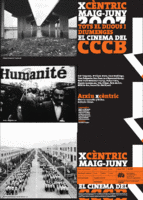
Coming after the critically acclaimed, monumental 9 and a half hour documentary, Holocaust [or “Shoah”] of 1985, the Barcelona screening was titled “Variations of what is real.” It was part of their Xcèntric program for 2006-7.

Led by the academic Jorge Seca, the films were subtitled in Castilian Spanish by a group of translators from the UAB, Autonomous University in Barcelona.

In the first offering, Un vivant qui passe (1997), Lanzmann tells the story of Maurice Rossel, the only representative of the Red Cross to visit the Terezin death camp and wrote a report stating that he had seen “no atrocities.”

In 1944 Rossel reported that it was in fact a “model ghetto” and noticed “nothing terribly wrong”. He also freely and repeatedly expressed his view that Jews had “a passivity that I couldn’t stomach.” 

In the longer follow-up reel, “Sobibor” (2001) Lanzmann examined another episode of the Holocaust: the attempted escape of 600 Jews (also including some Red Army prisoners of war) from a Polish extermination camp.

He did this “through the story of Yehuda Lerner [one of only 60 survivors] who was seventeen years old, when in a meticulous plan of rebellion he ordered a Nazi officer to smash his head with an axe.”

The film “ends with the triumph of the Jews’ murder of their Nazi guards and their succesful flight from Sobibor, but he does not follow the survivors [return] where some were killed.”

Lanzmann himself (who died 4 years ago this July) was often simply called a director.

In truth, he was a film producer in the widest sense of the word.

According to journalist Julia Pascal he was even “the movie-maker-as-spy, the Jew who pretended to be pro-Nazi in order to film the guilty.

In one long sequence, he posed as a Nazi sympathiser and secretly filmed an SS officer who confided his past.” In fact, after their subterfuge was discovered he and a female accomplice were badly beaten and it could have been much worse before they got away. 

Lanzmann created from his will, as a stranger to brevity, stapling it well below accuracy or exhaustive detail.

The memoir he wrote, titled The Patagonian Hare, was no exception. If you’re like me and an hour on the beach (or maximum two) is only doable with a good book and you want something different from the standard lighter or narrower reading, then this book is the polar opposite.

It’s a kind of stretched agony in many places. His battle with what becomes his life’s purpose, the telling of the most stomach-churning truths, is clear.

What shines too from the lines of his memory in top gear is his determination to never be resigned to a great silence, to never taste the poison of passivity. 

His is a reverence for life itself. Seemingly never belittled by doubt, he has made much of the crucial importance of Nazi victims being treated so that in contemporay times “they haven’t died alone.”

My hope for everyone reading this in a season of pure heat is that you find time to relax and enjoy all that you can, living with the spirit of a Lanzmann.

Sunday, February 16, 2014

"New project honors thousands of Jews who braved Catalan Pyrenees to escape Holocaust"


"The Lleida Provincial Council is promoting a project entitled ‘Persecuted and Saved’ that aims to identify and mark the principal paths through the Catalan Pyrenees taken by 80,000 fugitives, 20,000 of whom were Jewish, in order to escape the Nazi horror during the Holocaust. 

They will also show the prisons and concentration camps set up to hold those who were caught. The project has already received a good deal of interest from Israel, with Alon Bar, Ambassador of Israel to Spain, visiting the key sites.

Furthermore, Walter Wasercier, CEO of Israel’s principal airline, EL-AL, and Joan Reñé, President of Lleida’s Provincial Council, have met in order to discuss setting up weekly chartered flights between Israel and Lleida-Alguaire Airport.
 
Reñé claims that the project is an opportunity to “recover the historical memory and publicize the little-known events that occurred here during the Holocaust.”  Bar summarized the importance of the project with a Hebrew saying, “to save a soul is to save an entire world”. 

He also expressed thanks to the Catalan people, many of whom risked their lives to help save Jews and other refugees who were fleeing from Nazi barbarism.

A chance for Jewish people to find their ‘roots’

Bar believes that many Jewish people may find their roots while exploring the sites that their relatives used to escape tyranny and certain death. Over 20,000 Jewish refugees are believed to have passed through the Pyrenees, often taking the harshest and most difficult routes in order to avoid capture by Nazi soldiers patrolling the area.

Better Catalan understanding

Reñé also believes the project is a good chance for Catalans to better understand and appreciate the history of the area and the role that their parents and grandparents played by helping the starving and freezing survivors that made it over the mountains."

Source: Vilaweb here.

Sunday, November 17, 2013

Claude Lanzmann and "The Last of the Unjust" in Seville

Lanzmann, left, with Benjamin Murmelstein in 1975, in a still from The Last of the Unjust
French producer-director Claude Lanzmann, author of the singularly penetrating memoir “The Patagonian Hare” visited Seville this week.

As the creator of Shoah, the 9-hour documentary (which was the result of over ten years of research and filming testimonies of survivors from the Nazi's extermination of Jews across Europe) Lanzmann was honoured yesterday at the Andalucian city's film festival.

His new movie is titled “The Last of the Unjust.” It is about Benjamin Murmelstein, the Jewish Council president in Theresienstadt ghetto, the concentration camp in the city of Terezín (in the modern-day Czech Republic.) who collaborated with the Nazis, a man who Lanzmann said he actually “grew to love.”

“The Last of the Unjust” will be released in Spain on January 10.

Thursday, June 24, 2010

What Franco did for the Holocaust

The reality wasn’t just that the dictator’s propaganda was entirely untrue. He had in fact been very tempted to play his part in resolving the “Jewish problem in Europe.”

At the end of World War II, Franco largely succeeded in convincing the world that he had contributed to saving thousands of Jews from extermination at the hands of the Nazis.

Thanks to the patient work of a Jewish journalist, Jacobo Israel Garzón, the only document addressing the issue that still survives has surfaced in the National Archive’s collection. It was originally issued by the regional government of Zaragoza. It has since been published in the history magazine Raíces. This is the story behind it
[in Spanish from El Pais.]