[This article was first published under the title "Summer at its widest" in Catalonia Today, July 2022.]
15 summers ago (my first full one here) the CCCB, or Centre de Cultura Contemporània de Barcelona showed French-Jewish filmaker Claude Lanzmann’s “extraordinary diptych of the Holocaust.”
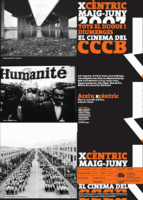
Coming after the critically acclaimed, monumental 9 and a half hour documentary, Holocaust [or “Shoah”] of 1985, the Barcelona screening was titled “Variations of what is real.” It was part of their Xcèntric program for 2006-7.
Led by the academic Jorge Seca, the films were subtitled in Castilian Spanish by a group of translators from the UAB, Autonomous University in Barcelona.
In the first offering, Un vivant qui passe (1997), Lanzmann tells the story of Maurice Rossel, the only representative of the Red Cross to visit the Terezin death camp and wrote a report stating that he had seen “no atrocities.”
In 1944 Rossel reported that it was in fact a “model ghetto” and noticed “nothing terribly wrong”. He also freely and repeatedly expressed his view that Jews had “a passivity that I couldn’t stomach.”
In the longer follow-up reel, “Sobibor” (2001) Lanzmann examined another episode of the Holocaust: the attempted escape of 600 Jews (also including some Red Army prisoners of war) from a Polish extermination camp.
He did this “through the story of Yehuda Lerner [one of only 60 survivors] who was seventeen years old, when in a meticulous plan of rebellion he ordered a Nazi officer to smash his head with an axe.”
The film “ends with the triumph of the Jews’ murder of their Nazi guards and their succesful flight from Sobibor, but he does not follow the survivors [return] where some were killed.”
Lanzmann himself (who died 4 years ago this July) was often simply called a director.
In truth, he was a film producer in the widest sense of the word.
According to journalist Julia Pascal he was even “the movie-maker-as-spy, the Jew who pretended to be pro-Nazi in order to film the guilty.
In one long sequence, he posed as a Nazi sympathiser and secretly filmed an SS officer who confided his past.” In fact, after their subterfuge was discovered he and a female accomplice were badly beaten and it could have been much worse before they got away.
Lanzmann created from his will, as a stranger to brevity, stapling it well below accuracy or exhaustive detail.
The memoir he wrote, titled The Patagonian Hare, was no exception. If you’re like me and an hour on the beach (or maximum two) is only doable with a good book and you want something different from the standard lighter or narrower reading, then this book is the polar opposite.
It’s a kind of stretched agony in many places. His battle with what becomes his life’s purpose, the telling of the most stomach-churning truths, is clear.
What shines too from the lines of his memory in top gear is his determination to never be resigned to a great silence, to never taste the poison of passivity.
His is a reverence for life itself. Seemingly never belittled by doubt, he has made much of the crucial importance of Nazi victims being treated so that in contemporay times “they haven’t died alone.”
My hope for everyone reading this in a season of pure heat is that you find time to relax and enjoy all that you can, living with the spirit of a Lanzmann.


