Showing posts with label catalonia.. Show all posts

Wednesday, September 7, 2022

"Unlimited Barcelona" -- 360 degree views that show the city from on high


Enjoying the great views (and later a glass of cava sparkling wine) at Unlimited Barcelona in Plaça Urquinaona.

Highly recommended! 

(Full disclosure: We were given a free visit and drink because of my journalism work.)
Sunday, July 31, 2022

Claude Lanzmann: "Life at its widest"

[This article was first published under the title "Summer at its widest" in Catalonia Today, July 2022.]

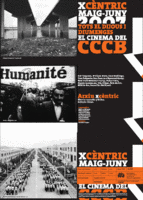
15 summers ago (my first full one here) the CCCB, or Centre de Cultura Contemporània de Barcelona showed French-Jewish filmaker Claude Lanzmann’s “extraordinary diptych of the Holocaust.”

Coming after the critically acclaimed, monumental 9 and a half hour documentary, Holocaust [or “Shoah”] of 1985, the Barcelona screening was titled “Variations of what is real.” It was part of their Xcèntric program for 2006-7.

Led by the academic Jorge Seca, the films were subtitled in Castilian Spanish by a group of translators from the UAB, Autonomous University in Barcelona.

In the first offering, Un vivant qui passe (1997), Lanzmann tells the story of Maurice Rossel, the only representative of the Red Cross to visit the Terezin death camp and wrote a report stating that he had seen “no atrocities.”

In 1944 Rossel reported that it was in fact a “model ghetto” and noticed “nothing terribly wrong”. He also freely and repeatedly expressed his view that Jews had “a passivity that I couldn’t stomach.” 

In the longer follow-up reel, “Sobibor” (2001) Lanzmann examined another episode of the Holocaust: the attempted escape of 600 Jews (also including some Red Army prisoners of war) from a Polish extermination camp.

He did this “through the story of Yehuda Lerner [one of only 60 survivors] who was seventeen years old, when in a meticulous plan of rebellion he ordered a Nazi officer to smash his head with an axe.”

The film “ends with the triumph of the Jews’ murder of their Nazi guards and their succesful flight from Sobibor, but he does not follow the survivors [return] where some were killed.”

Lanzmann himself (who died 4 years ago this July) was often simply called a director.

In truth, he was a film producer in the widest sense of the word.

According to journalist Julia Pascal he was even “the movie-maker-as-spy, the Jew who pretended to be pro-Nazi in order to film the guilty.

In one long sequence, he posed as a Nazi sympathiser and secretly filmed an SS officer who confided his past.” In fact, after their subterfuge was discovered he and a female accomplice were badly beaten and it could have been much worse before they got away. 

Lanzmann created from his will, as a stranger to brevity, stapling it well below accuracy or exhaustive detail.

The memoir he wrote, titled The Patagonian Hare, was no exception. If you’re like me and an hour on the beach (or maximum two) is only doable with a good book and you want something different from the standard lighter or narrower reading, then this book is the polar opposite.

It’s a kind of stretched agony in many places. His battle with what becomes his life’s purpose, the telling of the most stomach-churning truths, is clear.

What shines too from the lines of his memory in top gear is his determination to never be resigned to a great silence, to never taste the poison of passivity. 

His is a reverence for life itself. Seemingly never belittled by doubt, he has made much of the crucial importance of Nazi victims being treated so that in contemporay times “they haven’t died alone.”

My hope for everyone reading this in a season of pure heat is that you find time to relax and enjoy all that you can, living with the spirit of a Lanzmann.

Monday, July 18, 2022

Wednesday, April 20, 2022

My book signing/sales location on St Jordi's Day (April 23)


I'm happy to say I'll be doing a signing and sales session of Slow Travels in Unsung Spain with Barcelona's Come In bookshop's stand on the international day of books and Catalonia's St Jordi's Day, Saturday, April 23.

Time: 5pm-6pm

Place: Paseig de Gracia between C/-Provença and C/- Mallorca

Maybe I'll see you there!


Sunday, May 26, 2019

Latest review on 'Slow Travels in Unsung Spain'

[Photo: Cornelia Kraft]

"...This is a book for readers interested in areas beyond the coasts and in small glimpses on the reality of daily life in Spain.

The author uses a personal style to give the readers an insight into different places...and culture, similar in style to articles of  The New Yorker..."


Read more from source at Literary Rambles blog.


Saturday, April 6, 2019

Now available: "Slow Travels in Unsung Spain" -- my latest non-fiction book


I'm very happy to say that my new non-fiction book is now available here.

"a compelling and eclectic narrative full of the unexpected" 
-- Nick Inman, Rough Guides

Slow Travels in Unsung Spain is a warts n’ all trip through some of Spain’s hidden gems: towns, cities, landscapes and cultural highlights that are typically overlooked by foreign tourists but which the Spanish often keep to themselves. 

Saturday, December 1, 2018

My next book soon to be published by Apocryphile Press

[Photo of  abandoned building in Catalonia: probable book cover by John French]
Very happy to say that "Slow Travels in Unsung Spain," my next non-fiction title will be published by Apocryphile Press (USA) some time in 2019.


​Partly from a desire to remind myself why I live here, the book is a very personal exploration of parts of the Iberian peninsula that are typically overlooked by foreign tourists, including the regions of 
Extremadura and Asturias, the urban areas of Zaragoza, Cordoba, Ecija, Jaen and Ubeda, as well as Catalonia.

Sunday, May 20, 2012

Why I Write (and) What Tom Wrote


I bother to write blogs for a number of reasons but one motivation is communicating with readers about Catalunya/Spain/Europe and related subjects.

Recently I received a comment from Tom (an architect in London) and we exchanged a few emails.
 
His description of Barcelona as a" fabulous seedy, ancient, proud, buoyant place" is as accurate a string of adjectives I have ever read about the city, and pleasingly free of clichés. In fact what he wrote about Spain was certainly as insightful and well put as anything I can do and his connection with this country intrigued me.

With Tom's  permission, I quote from him verbatim below:

"My mum was a refugee there during the Nazi period. My childhood in suburban Bristol in the west of England was improved by her experience. Our Christmases were always marked with turron de jijona which I still love. But it has to be good. The second-rate stuff is an insult.

The architectural scene in London isn't great. We can't rely on booms to fuel our economy anymore. The edge isn't as sharp as it is in Spain. Perhaps a social movement will coalesce out of the Spanish experience.

I found myself reading Saul Bellow's Letter from Spain the other day which is dated around 1948. The picture is of pure suffering. The indignados are referred to again.

The story of Spain is of suffering. The biography of Picasso describing decrepit flats in Madrid tells the same story of poverty.

We were in Galicia this summer. Of course, the suffering has been put to one side by material improvements exactly the same as anywhere else in Europe. And one sees on the beaches how well the Spanish play, how good-natured the young are with each other.

I love the bird-like clatter of their fast tongues. I would dearly love to convert my tourist Spanish to something better.

Spain is really something. The whole construction boom, the corruption, the political ignorance, the cynicism of the wealthy - none of that detracts from the wonderful country - Los Picos, Galicia, Madrid, Barca, Menorca, the Pyrenees, the pines, the sea . None of it detracts from Barcelona's gothic Cathedral - a remark which applies a thousand times over. Or the food.

One hopes the poisons of cheap wealth will not alter defeat what's great about the country.

It has not been blessed with great politics. Yet it is seems a country at home with the modern condition. It has embraced change
."

Friday, February 4, 2011

Attacks on Catalan reporters in Egypt

Joan Roura, a correspondent for TV3, a Catalan public television station, was attacked [yesterday] by men who tried to steal his mobile phone while he was conducting a live broadcast for the 24 hours news channel.

Assaults were also reported against Sal Emergui, a correspondent for Catalan radio RAC1 [and] Gemma Saura
(amongst more than 30 other members of the international media.)

Source: here.

Friday, April 23, 2010

CONGRATULATIONS!

1st anniversary of the Casal Popular Okupat [squatter’s workshop] in Vilafranca del Penedès.

I talked to a spokesman, took a few photo’s and wrote this article on their activities when they had just started a year ago.

Saturday, February 20, 2010

Barcelona: capital of protest

The act of publicly demonstrating in the streets is alive and well in Catalonia’s biggest city. There is an average of four protest events every day in Barcelona, one of the highest in the world.

Although there were 1,300 officially-noted rallies in 2008, 60% of these were illegal as their organisers did not ask permission from the police.

Freedom to protest in community space is one encouraging indication of the level of democracy in a country.

Unfortunately, some the groups who organise demonstrations are doing so routinely because of a lack of success with their causes. The Black Workers meet on the 11th of every month at Plaza de Sant Jaume in a seemingly forlorn attempt to raise wider understanding of their plight.

A neighbours association in the Vall d'Hebron area of the city have got together every week for months in their campaign to stop injecting rooms being set up there. These efforts included trying to block one of the major roads in Barcelona, the Ronda de Dalt.

We can be thankful though that we live in a part of the world that allows public demonstration,…even if the results of protesting in the open air are not always what is hoped for.