Sunday, April 10, 2022

"Let's Cook:" A recommendation


Here's a rare thing: me endorsing something. And I only do it when I believe something is really worth supporting.

Let's Cook do a damn good job at making your lunch or dinner easier without sacrificing any quality.

[Disclaimer:] The food I selected from their wide menu and was sent as a trial I did not pay for. I agreed to review their service only if it it satisfied me and my wife.

And it did!

We both chose the organic tofu burger "kit" with guacamole and the freshness of the ingredients was excellent. The size of the portions was more than generous and the delivery was also convenient. They have weekly menus which change, reflecting seasonal produce.

So, for you my readers there is a special offer: Sign up with a 10€ discount. LETSCOOK1265 . I'm confident you'll enjoy Let's Cook as much as I did.


Sunday, April 3, 2022

I still love books


On the other side of the planet, visting Australia a few years ago. 

This photo was taken in suburban Canberra, outside a house two doors away from where I grew up. 

I was holding a free/exchange copy of "God is an Englishman" by Donald Horne. 

A great read too.

Sunday, March 27, 2022

Business Over Tapas


Highly recommended by me. 

Brilliant, concise current affairs summaries: done every week. I couldn't do without it.

Read for free only this week here.

Sunday, March 20, 2022

"My Catalonia" -- My latest opinion column for Catalonia Today magazine


[Photo: C.Morell]


When I think of Catalonia what immediately comes to mind is the word ‘home’. I see the wide view across rows of vineyards, the mountains of the Penedès in the distance, the tops of Montserrat further away, only able to be seen in winter when the leaves on the bare trees allow it. That, from our back terrace.

I have to think about our house too. A narrow but tall and modern ‘adossat’ terrace that has been ours to enjoy (and pay off back to the bank) for the last eleven years. The nighttime light from the old church tower across the street still angles in across our lowly bed. Its bells still ring every fifteen minutes to remind me I rise and sleep in Europe, not Australia, England or Japan.

I am also compelled to recall the splendours of the food here. Discovering the joy in simple ‘pa amb tomàquet’ and the savoury wonder of salt cod, ‘suquet’ seafood stew or the earthy richness of ‘calçot’ green onions cooked on a wood fire.

In Catalonia too, I found the pleasure of chewing the sweet, scant flesh on rabbit bones and diving into a bowl of snails ‘a la llauna’ hot from a tin tray, freshly out of the oven. We still drink the co-op white wine from Covides (an unfortunate name in these times.) Good, cheap stuff pressed from Xarel·lo, Macabeu and Parellada grapes.

Of course, Catalonia is so much more than just that. It’s where we’ve worked. I’ve written, taught and travelled thousands of kilometres to do these things. It’s an hour-long seat on RENFE trains, it’s driving the hills up and down the single-lane N340 running past Vallirana.

Equally, this place has sustained us and drained us; given so much but also taken so much energy and expense. It’s where our son went to school and learnt to use two languages. Catalan is his second language and as he makes his way as an independent young adult he still uses it every day in his work and study, I’m immensely happy to say.

Catalonia gave him superb teachers all through primary and secondary school. Every one of them were caring and dedicated women, apart from a handful of young men and they too were the exact kinds of male anyone could hope for as role models for him.

As well, my thoughts can’t go much further than to the selfless people who work with such heart and humanity in the public health system here. I owe a great deal to them all and so does my wife.

And there’s always The Big Smoke, the capital that brings tourists from everywhere. I was first one myself almost 25 years ago and now as a local I love to busy myself in the crowds on the streets. Every part of Barcelona is a gift, even the least attractive corners.

My Catalonia continues to spur the imagination. (I once had the idea of a book of photos of every rambla in every town where they could be found across the land).

Now, in my more optimistic times, I see somewhere I’d never want to leave. As it is, I don’t want to live anywhere else. Here is as good as it gets.


[This article was first published in Catalonia Today magazine, March 2022.]


Sunday, March 6, 2022

Yet another new ⭐⭐⭐⭐⭐ reader review for my latest book


"What counts are [his] encounters with the locals..."

"This narrative integrates history without overburdening the text..."

"He's done a great job of immersing himself."

https://www.amazon.com/dp/B07NJG91W7/#customerReviews

Sunday, February 27, 2022

Under time and feet


A street manhole from the Catalan town of Sant Cugat Sesgarrigues (where l've lived for more than a decade) with its altered former Spanish name under the dictatorship.

The date of 1970 is when running water was installed, I suspect.

Wednesday, February 23, 2022

"Barcelona Deep Collage"


"On 9 and 10 October 2021, the BSC hosted the Barcelona Deep Collage Festival, as part of the festivities in the Les Corts District and on the occasion of the inauguration of the centre’s new building..."

Sunday, February 20, 2022

"Catalonia pardons women accused of witchcraft 400 years ago"


[Since 1997, the town of Viladrau has been shedding light on its history of witch trials. Several streets were named in honor of the women killed.Credit: Lucía Benavides/The World]


"About 400 hundred years ago, in the small Catalan village of Viladrau, 14 women were accused of witchcraft, tortured and hanged. At the time — between 1618 and 1622 — there were fewer than 10

“We’ve gone down in history for being the town with the biggest witch hunt in Catalonia,” said Noemí Bastias, the town’s mayor. “But they weren’t witches — they were marginalized women like widows, immigrants and herbalists.”

Last month, the regional Catalan government in northeast Spain passed a resolution to pardon up to 1,000 people executed for witchcraft in Catalonia 400 years ago...

Witch hunts relied heavily on accusations from neighbors who were desperate for scapegoats whenever bad luck struck the town — such as crop failures, sudden diseases or natural disasters."

Read more from source at PRI and listen to story here.  


Sunday, February 13, 2022

"More Borics please" -- My latest opinion column for Catalonia Today magazine


[Photo: EFE]

Was it sexism?

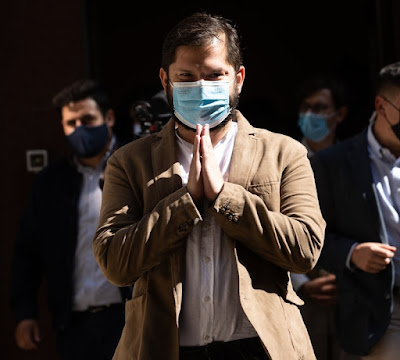
It wasn’t widely reported in the English language media but Gabriel Boric, the new leftist President of Chile has a Catalan mother, María Soledad Font Aguilera, who was originally from the working class area of Badalona bordering Barcelona

Instead, his father’s Croatian heritage was emphasised and I suspect this is not only because of the single family name.

A graduate of The British School in Punta Arenas, 35 year old Boric is the youngest holder of his nation’s most prized office, having gained just under 56% of the vote in Chile’s second round of elections last December. He defeated the right-wing José Antonio Kast, son of a veteran of World War II and militant in the German Nazi Party.

Boric’s party was able to earn a victory even after “a sudden blackout of bus services in Santiago and across the country forced voters to endure long commutes in the summer heat to express their basic right to a free and fair vote.

But against these efforts at voter suppression, the people of Chile offered their cars, vans, and motorcycles to assist their neighbours to get to the polls.” Most apparent was his support from younger voters and millennials, tired of the usual divisive political rhetoric.

Irina Karamanos Adrian, the new President’s “first lady,” has said she doesn’t want to be the country’s first lady, at least in a traditional sense. As a writer, anthropologist and militant feminist originally coming from Greek and German immigrants out of Uruguay, in her own right, she has also appeared on TV political debates before the presidential campaign.

(To me, if the new president had been a woman then we would have certainly seen a great deal of scrutiny of her life-partner/husband/wife/significant other, or whatever term you want to use. I have a distinct memory that just over a decade ago when Australia had its one and only female prime minister, Julia Gillard, there was a big hooha from conservatives about how she was partnered, not even married (!) to a man who had the supposedly “effeminate” job of a hairdresser.)

Boric himself came to wider attention after his message on Twitter following the independence consultation in Catalonia on October 1, 2017. He posted the words: “Images of police violence in Catalonia are shocking. A firm embrace from Chile to the Catalan people. More democracy, less repression”.

An electoral dark-horse and surprise victor, Boric is to be sworn into office this March in just one of the Latin American countries that have recently opted for left-wing presidencies; other examples being Argentina, Bolivia, Honduras, Mexico and Peru.

Boric was swept into power on an ambitious platform of practical changes like raising the minimum wage, reducing the cost of education, expanding the social safety net, fighting climate crisis and extending rights to indigenous people and gay and transgender individuals. He has even talked about creating a British-style national health service that is universal across Chile.

The big test for any progressive leader in power is what they do, not what they say, but if his manifesto is any indication then Europe too could do with plenty more like him.


[This article was first published under the title "Was it sexism?" in Catalonia Today magazine, February 2022.]

Sunday, February 6, 2022

How southern Europe will be hotter than the rest of the planet


This is an alarming, even disturbing video.


"The speed and magnitude of the climate change we are facing today is unprecedented. Heatwaves, droughts, floods... We are feeling its effects on our daily lives, year after year. Its impacts will increase at least until 2050 and every region of Europe will be affected.

Based on the results of the latest available studies, and in particular, on the 6th IPCC report, this film, produced by scientists in the framework of the European project EUCP, aims to present to the general public the climate changes expected in Europe in 2050. The researchers explain in an accessible way the variations in temperature and precipitation as well as the extreme climate events that European inhabitants will have to face. This film provides the keys to understand how climate will reshape our landscapes and lifestyles over the coming decades. ... and to enable us to better anticipate the need for human societies to adapt to this partly inevitable climate change."

Sunday, January 30, 2022

Pandemic poem

Cut down
Cut down to bone
Cut off to spite it and
Cut off from
Cut away to put away
Stay away
Cut out
Cut out your needy

Cut me down I'm
Not cut out for it

Sunday, January 23, 2022

The real cost of avoiding tax

The cost of tax evasion in Spain is approximately 70,000 million Euros a year, about 23 % of the nation's total production. 

This is equivalent to the entire budget of the Spanish health system, according to an analysis by the consultants one i2 Integrity.

This report highlights the fact that the most popular forms of fraud are to avoid VAT sales tax, to create invoices for false sales, to contract workers and pay them cash "in the black," to receive undue subsidies and to carry out fraudulent international buisines operations.

(The above is a repost from Jan, 2012. I wonder what's changed in the last decade. Seemingly nothing...)

Source here.

Saturday, January 15, 2022

"Rewilding the Pyrenees" -- My latest book review for Catalonia Today


Here’s a book about nature that is neither an impassioned rant nor a lecture. 

Instead, over a period of years, Steve Cracknell spoke directly to the horses’ mouths and with great empathy and balance, he lets us learn about the various sides of the issues. 

His central question in a new release titled The Implausible Rewilding of the Pyrenees is whether native animals should be reintroduced to these mountains, along with selected non-native animals.

According to Cracknell, rewilding comes from the idea that traditional conservation has failed to slow or even stop a decline in biodiversity in Catalonia, parts of Aragon and the border country across Spain and France. 

This is a trend that could be reversed by reintroducing key species ‘and creating suitable habitats for them. “What is most important,” he says, “is not the presence of the animal but the effect it has on its environment” and here the most controversial predators are the bear and the wolf.

With the fitness of a young goat, the author climbs up to isolated summer pastures, freezing his extremities in the quest to see a bear for the first time. He also spends hours and days with farmers doing the seasonal ‘transhumance’ where cattle or sheep are herded overland to new feeding grounds.

He interviews shepherds, ecologists and wild boar hunters, among others. In the process, he’s not afraid to get dirt under his fingernails and also (I suspect) end up reeking of sheep dung. The sadness and gore of sheep who’ve been attacked by bears is also something he doesn’t avoid.

He asks all the best questions to gently test the claims and experiences related by those who have a lot to lose and those who take an interest for non-economic reasons. I was happy to see he never made the appalling choice of calling anyone “stakeholders in the debate”.

The details in the book are often exact and surprising. For example, bears are known by the name across the region. One of them named “Goiat” (meaning boy or lad) is a 10-year-old, 205 kg male (born in Slovenia) and the only bear to have been released in the southern part of Catalonia in Pallars Sobirà in 2016. 

A remarkable camera trap photo shows another (possibly scratching his belly) against a tree in Vall d’Aran. (The author mentions that wolves from Italian stock arrived in Catalonia in 2006 after a century’s absence.)

One shepherd who Cracknell spends time with is Mustapha, originally from a sheep farm in the Atlas Mountains of Morocco. With his legal status now fully regularised (and with wife and young child who joined him later) he had previously crossed over the sea to the Canary Islands from Western Sahara. Thanks to funding grants from the EU’s Project Catalunya PirosLIFE programme, conditions for those like Mustapha have greatly improved in the past four years.

He has a young assistant named Josep, when in the past he’d had to exist for over three months with only his dog for company. As well, he’s been lucky enough to enjoy the relative comfort of portable cabins helicoptered into his area at the start of summer.

Steve Cracknell is the author of two other titles on nature but apart from his extensive wildlife knowledge and deep affection for the Pyrenees, what comes across in this book is a genuine respect for individuals who work and live up there. As a long time resident, his final words sum it all up better than I could: “Exit pursued by a bear.”

Wednesday, January 5, 2022

"Spanish should eat less meat to limit climate crisis, says minister"

[Photograph: Denis Doyle/Getty Images]

  I completely agree with him...

"Alberto Garzón wants public to recognise impact of megafarms on the environment and change its eating habits.

Eating less meat will play a key role in helping Spain mitigate the effects of the climate emergency, slow the process of desertification, and protect its vital tourism industry, the country’s consumer affairs minister has said.

Alberto Garzón said people in Spain needed to realise the huge impact that eating meat – particularly beef raised on industrial megafarms – had on the environment, and to change their eating habits accordingly.

“People here know about the part that greenhouse gases play in climate change, but they tend to link it to cars and transport,” Garzón told the Guardian.

“It was only very recently that everyone started to look at the impact of the animal consumer chain and, especially, at the impact of beef. Other countries were pretty advanced on that but in Spain it’s been a taboo.”

The minister said that the country’s geography made it profoundly vulnerable to climate change, adding the Spain people know and love is in danger of disappearing forever.

“If we don’t act, it won’t just be climate change we’re dealing with – it’ll be the triple crisis: the loss of biodiversity; pollution, and climate change,” he said.

“It would be the end for a country like Spain. Spain is a country in the Mediterranean basin – it isn’t the UK or Germany – and desertification is a very serious problem for our country, not least because it depends so much on tourism. Visiting a desert isn’t quite as attractive as visiting the Costa del Sol.”

Read more from source at The Guardian here.

Friday, December 31, 2021

In 2022: "Spain's beaches are now smoking free zones"


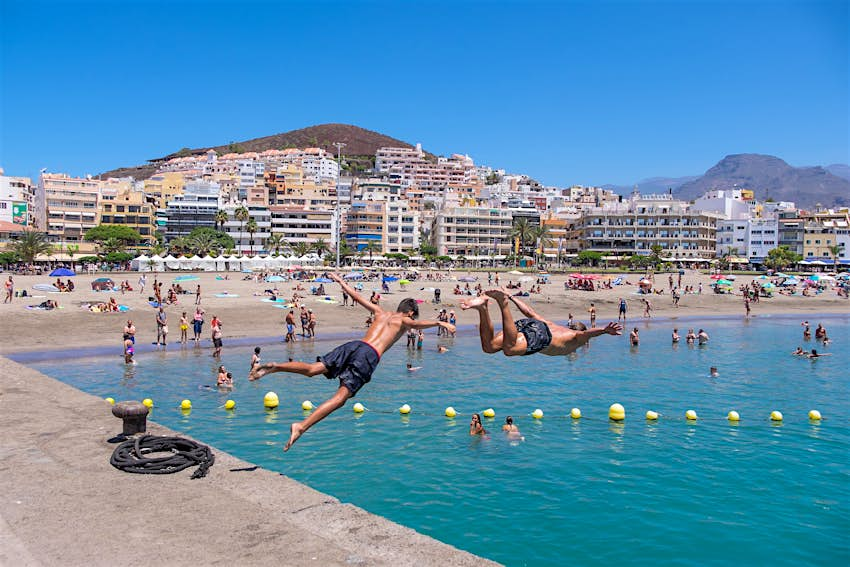
[A beach in Sanxenxo, Galicia © Xurxo Lobato / Getty Images]

"Spain is the first country in Europe to ban smoking on all of its beaches after the government passed a new law following a public petition.  

From now on, anyone caught lighting up on a beach is set to be hit with a hefty €2000 ($USD 2258) fine. A ban is already in place in Barcelona and the Canary Islands, where smoking on popular tourist beaches is prohibited.

A petition in Spain that led to the smoking ban 

The move comes in a bid to clean up pollution on the country’s 3000 miles of coastline. The new law passed on December 23 followed a petition of 283,000 names demanding action on beach pollution was handed to the Spanish government. Cigarette butts are a hazard on many beaches, as they contain non-biodegradable plastic polymer. The European Environment Agency found cigarette butts among the most common items littering Europe's beaches. As well as contaminating the soil, they are also extremely harmful if swallowed by sea life. Sardinia in Italy and some areas in southern France have already banned smoking on their beaches.

shutterstockRF_1465537337.jpg
 [Los Cristianos in the Canary Islands where smoking is already outlawed on beaches © Salvador Aznar / Shutterstock]

Spain's other bans on smoking

In 2020 in a bid to curb the spread of COVID-19, Spain banned smoking in outdoor public spaces where people can't maintain a social distance of at least six feet. Galicia, in northwestern Spain, first introduced a ban on smoking in streets, bars and restaurants and this was adopted by the country’s health minister and brought in nationally.  

Read more from source at Lonely Planet here.

Friday, December 24, 2021

A new "book town" in Catalonia: Calonge


"Calonge, a small town on the Costa Brava (Wikipedia), aspires to become an official member of the International Organisation of Book Towns (official website), and thus attract sustainable culture tourism to its medieval center.

 The local culture councilor was inspired by Montolieu in France.

With this aim in mind the local government offered empty spaces to potential booksellers, and after a relatively short selection process, on 10 Dec. 2021 seven new bookstores were officially inaugurated in a town of 10,000 inhabitants.

Some of these are specialized ones, such as Calonge CòmicsLa Viatgeria (travel), Orient (the East, classics, Africa), Llibooks (children), and Cocollona (spirituality, esoterica). 

What’s missing of the original concept of book town are the second-hand shops – with online stores without physical outlets dominating the market and the Spanish and Catalan booksale volumes being relatively low, these might be even more difficult to set up and operate profitably than regular bookstores."

SOURCE: La Vanguardia, 11 Dec. 2021, pp. 38 – 39 [printed edition; online with pictures]            Found at Literary Rambles here.

Saturday, December 18, 2021

"The Game" -- My latest opinion column for Catalonia Today magazine

[Photo: Andreu Puig]

Millions of people are now playing it. 

Plenty are as desperate and traumatised as the competitors in The Squid Game, but if you live in L’Hospitalet de Llobregat or Santa Coloma or Sant Roc or La Mina your battle for survival has no entertainment value.

In fact, the game has already started in your sleep, where you are having dreams of persecution and chronic failure. 

Now you are out of bed early to take advantage of the cheapest electricity before the costs jump at 8am. You are in a freezing winter kitchen, dressed in your thin but warmest puffer jacket. 

Of course the heating cannot be put on. Don’t be ridiculous. 

Here is your routine breakfast: pappy supermarket bread and instant coffee with long life milk.

Soon you are standing on a RENFE line 4 train from Manresa heading away from Barcelona out to the industrial areas. 

Then, against the slow-rising December dawn, you are one of the still bleary-eyed passengers who get off at Sant Feliu. 

With the cold knifing into your ears even through your woollen beanie, you and a dozen others trudge along the rough pebbles on the side of the tracks. This means you don’t need a valid ticket. You’ve saved one euro. Something learned in this part of the game years ago. 

Of course, you could have been closer to your destination if you’d got off at Cornella but sometimes ticket inspectors are there, as you found out to your cost: a 100-euro fine that made you cry when you got home.

Today has a new twist. You have a job interview. 

You don’t know the pay rate because it wasn’t specified in the ad. It never is anymore. Was it always like that? The unknown. 

It has so many fingers around your throat. The day feels like it should already be over but you have a half hour march past bland square box buildings and fences. 

The air smells like a sewer but only when the breeze blows the wrong way.

Yes, the game is afoot. It is never not. 

You know there will be different versions of it to navigate. 

There is the one where you learn where the speed cameras are on all your local roads where you reluctantly drive because of the cost of petrol. 

Another is using back roads without roundabouts because your car is not registered any more and the police routinely stop drivers to check. You can’t even drive it in Barcelona in the low emissions zone because it’s too damn old.

The game is getting to the end of the month. 

The games within the game: self-haircuts, self-dentistry, and self-denial: not eating meat and never spending on other travel outside your area. 

And shopping for the cheapest fruit and vegetables where you usually end up buying them from corner shops. Suspiciously, there’s no country of origin label for their produce.

The game is the guilt when every blue moon you buy a beer in a bar, just to remind yourself that you’re human. 

It’s knowing that next month, next year cannot be any better. It is always worse, so it always will be. 

And there will be no Christmas for your child. That is the worst of it.

[This article was first published in Catalonia Today magazine, Dec. 2021.]


Wednesday, December 8, 2021

"Translating 'modern slavery' around the world"


"The Freedom United community around the world [was asked] to take part in our survey Translating ‘Modern Slavery’ to better understand  how terms such as “human trafficking,” “forced labor,” “modern slavery,” etc. are discussed, framed, or translated in languages besides English. Language is complex and we recognize how local cultural contexts and linguistic nuances shape local advocacy and public understanding...


SPANISH:

Lara Chiavarini:
One of the main problems I see and read when talking about human trafficking in my native language (Spanish) is the difference between “trata de personas” (human trafficking) and “tráfico de personas” (smuggling of migrants). I dare to say this has its origins in “bad” translations. Forced labour could be said “trabajo forzado” or “trabajo forzoso”, forced marriages can be said in both ways as well “matrimonios forzados/forzosos”. Debt bondages is generally found linked to modern slavery: “esclavitud por deudas” and finally modern slavery could be found as “esclavitud contemporánea” more than “moderna”.  When talking about “human trafficking” and “modern slavery”, depending on who is writing and who is their audience, people chose one word or the other. Modern slavery may be more shocking so it is generally found (at least in my country, Argentina) in newspapers and articles. Nevertheless it is also true that people usually say that they are slaves of their work, of the system, etc.

Michael Solah:
Esclavitud, tráfico de personas/humanos (Spanish – Ecuador). There are a lot of signs in travel places (airports/border crossings) with warnings about human trafficking, including penalties. Unfortunately child trafficking is a big issue and I feel it is not discussed enough, it disproportionately affects those in poverty in Ecuador. The implications are similar to English, though in Ecuador it is often assumed the people being trafficked are children.

Elsa Grimaldi:
In Argentina, where we speak Spanish, those terms are translated into: tráfico de personas, trabajos forzados, matrimonios forzados, dependencia de la deuda, esclavitud moderna. What comes to mind with these issues is the humiliating, pain-inflicting ways in which humans treat other human beings, usually based on religious or cultural motivations but many a time for economic motivations, e.g. to make profit out of selling or enslaving other people (women, children, men). "


Read more here.


Sunday, December 5, 2021

A (pre) X-mas story in Catalonia

(Photo: Mané Espinosa)


"The sad news for many health workers is that their temporary contracts fell due and they lost their jobs. Now Catalonia has picked up some 600 Andalusian health workers who say they now get better hours and a better contract."

[This story from La Vanguardia originally found at excellent news service Business Over Tapas.]