Showing posts with label memory. Show all posts

Saturday, December 24, 2022

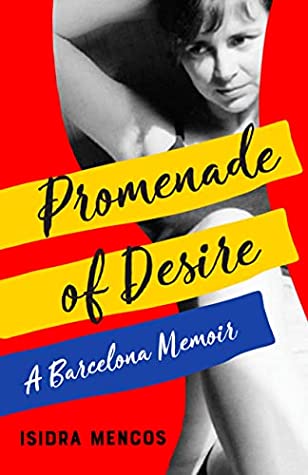
"Promenade of Desire" – My latest review for Catalonia Today magazine


[This article was first published in Catalonia Today magazine, Dec. 2022 under the title “Promenade of multitudes”]


A really good book is a universe away from its marketing.

One vibrant new piece of nonfiction, “Promenade of Desire, A Barcelona Memoir” is being promoted as “a sensual coming of age story: From Catholic virgin to Mata Hari as Spain moves from dictatorship to democracy.”

All true enough, but as well as getting a grip on the massive changes in Barcelona from the 1960s until just after the Olympic games in the early 1990s, the author Isidra Mencos charts a deeply internal arc.

Apart from the apparent honesty, what I like most about this raw account of an individualist’s first few three decades is the richness of self-discovery it contains.

The author’s sexual desire is undeniable but so is her lust for experience itself.

With an equally powerful bravery, she plunges into a subculture of horny squatters, for a while, finding herself most at home with the homeless.

We also witness other improvised or adapting versions of her: as an uncertain teenager and then young adult, still racked with a punishing guilt.  

Born to an affluent, emotionally-cold lawyer family (from the city’s high up Sant Gervasi-Bonanova area) who slowly fell on hard economic times, Mencos tellingly relates how her closest childhood at home was with their housekeeper/childminder/cook.

Quica, a semi-literate Andalusian woman who’d lost a husband and ten of her fourteen children during their infancy, was an anchor for the inquisitive young girl even during night-time bad dreams.

Mencos’ pure affection for this kind of person (who makes it possible for the rich to live like the rich) is touching.

It’s a clear sign that she transcended at least a snobbery of neglect. The words, ”I bawled at her death as I had not done for my lost grandparents,” poignantly ends one section in the book.

Looking at wider themes, identity is a major one. The author puts herself in the category of a “good girl,” even a “girlie girl” with “a quiet demeanor that dissolved with the ice cubes at the bottom of [her] second drink. Out came a fearless woman who declared her literary opinions with confidence and subjugated a man with a swing of her hips.” 

In fact, alcohol became a major problem for her and some of the men who were her live-in lovers. Violence and abuse followed.

The details are harrowing but also somehow instructive and a kind of balance comes in the shape of a new half-American half-Japanese female friend. “A role model for me because I still lived at half speed, with a split personality,” writes Mencos.

As Barcelona remodeled and replenished itself for the 1982 Olympics, the author herself was doing something similar as a part-time translator of articles for the official games committee. Then she set a routine for passing TOEFL and SAT exams so she could do a PhD in the USA.

Ultimately, she is healed: by herself, by quality therapies, probably too by discovering a genuine, transporting passion for the “unique vocabulary and no fears, no confusion” of salsa music and dance.

Here, we see a Barcelona that would’ve even been foreign to many locals, an immigrant/latin underworld of afflicted aficionados and slaves to a beat that was new to these European shores.

One of the great qualities in this book is that we also see a person who is now unafraid of so much she had been. 


Thursday, November 11, 2021

"Death cafes" -- An interview with Catalonia convenor Jordi Abad Lalanza

[This article was first published in Catalonia Today, Nov. 2021]


Q. What do you think is the most important thing people should know about Death Cafes?


They are informal gatherings where we talk about death related topics. It is a space of complete trust. It’s non-therapeutic and we let our thoughts and emotions flow.


Q. This year is the tenth anniversary of Death Cafes at an international level, with the first one in London. How many have been held in Catalonia and when did they start?


It is my personal initiative. I started in February 2019 and we had 12 meetings up to March 2020, when we stopped due to the pandemic. Subsequently, I have held 7 more virtual meetings.


Q. Why did you decide to organise these meetings?


My personal story is that I’ve had several losses that have marked my vision of life and death. From 2007 to 2015, I’ve been attending oncology patients at the end of life in their homes. Then in 2015 I finished my Social Worker studies and later I did a Masters in palliative care. I am currently working in end of life care. My major concern is that this society does not talk about death. It’s a taboo and I want to break this taboo, inviting people to do that.


Q. What kind of people come to death cafes and for what reasons?


Usually the average age is 40 and up, but we have also had young people. There are many reasons, mainly just curiosity, but also there’s interest in talking about death and not being judged for it. It’s not a grief management group, but people find that they’re respected with the freedom to talk about death and everything related to it.


Q. How do you run your cafes?


As an organiser, you should have questions or topics prepared to be presented. That makes the session more dynamic. The role of the moderator is to ensure that the conversation is safe and that everyone can participate, and the most important thing is to never be judged for your thoughts or emotions.


Q. At last count there have been 13,099 Death Cafes in 80 countries, why do you think they have been so popular? 


There is always an interest in everything to do with death, as the last taboo. It is true that in British and American culture, these encounters are easier. In Mediterranean culture I think there is much more reticence.


Q. One attendee at a meeting in the US said that "most of the sessions are full of people laughing and having fun.... You meet strangers and talk about an intimate topic that most people can't even talk about with their family." Do the meetings in Catalonia actually include fun?


There are moments of everything, of attentive listening, of seriousness, but there can also be moments of humour and positive expression. People also enjoy themselves and share joy as well as funny situations about death.


Q. In a broader context, what do you think have been the impacts of the pandemic on bereavement, grief and funerals, and the effect of these changes on mental health and well-being?


I think that not being able to say the usual goodbyes to our loved ones will make grieving more complicated to manage. Death has been visualised, but in the end if it hasn't happened to you, it will be statistics. I think it affects our mental health and wellbeing, but I think society penalises people who have suffered a loss and bereavement will be poorly managed.


Q. Do you think there’s really such a thing as the much-talked-about “closure” after death? Is a good death possible?


A good death is how you want it to happen, so it is important to think, talk and write down how you want it to be if the time comes (advance directives). It’s a very personal thing and can be confusing but for me it’s being able to be with my loved ones, to have them respect my decisions, to have control of the situation and to be able to leave with everything spoken about and with a lot of love. There is never closure if we truly have love for that person. At the beginning it is an intense pain but as time goes by, this person remains in our memory, not with pain but with gratitude for having known and enjoyed him or her.

Sunday, January 31, 2021

Covid, Brando and Moore what's more


[Colour-blind Covid warning]
Imagine...6 months from now the Covid-19 virus is able to breed in the air. 

   We are all scrabbling suddenly on the internet to buy "virus- safe" filters for the windows and air conditioners in our houses after another full lockdown/confinement/quarantine/international panic. 

   Imagine...There's the above possibility (or "potential", the word I keep hearing everywhere on mainstream media and the Twittersphere.) 

Somehow in my mind this is connected with a brilliant documentary I watched yesterday ("Listen to Me Marlon") on that most authentic of humans, Brando. He was one of the first males to use the power of suggestion in body and face language and movement, all coming from his harvesting and harnessing of childhood memory of his mother and a solitary upbringing in the open air and nature. 

He realised the primacy and goodness of Tahitians, indigenous first nation Americans, and was one of the few celebrities who put his body on the line in the early proto-BlackLivesMatter public protests in the late 1960s. 

He was with Martin Luther King around the time he was assassinated and years later still felt moved enough that he could still recall the sound of that brave soul's voice. Brando seemed to work and live his life as an expression of pure authenticity. 

One of the few writers who is doing the same today is Suzanne Moore. She just reeks of it: the unabashed openness of being herself. In a highly unfashionable act, she wrote recently about the importance of Freud, remembering him as he understood the babyish primacy of memory, childhood, want and nakedness.

Saturday, April 6, 2019

Now available: "Slow Travels in Unsung Spain" -- my latest non-fiction book


I'm very happy to say that my new non-fiction book is now available here.

"a compelling and eclectic narrative full of the unexpected" 
-- Nick Inman, Rough Guides

Slow Travels in Unsung Spain is a warts n’ all trip through some of Spain’s hidden gems: towns, cities, landscapes and cultural highlights that are typically overlooked by foreign tourists but which the Spanish often keep to themselves. 

Saturday, December 1, 2018

My next book soon to be published by Apocryphile Press

[Photo of  abandoned building in Catalonia: probable book cover by John French]
Very happy to say that "Slow Travels in Unsung Spain," my next non-fiction title will be published by Apocryphile Press (USA) some time in 2019.


​Partly from a desire to remind myself why I live here, the book is a very personal exploration of parts of the Iberian peninsula that are typically overlooked by foreign tourists, including the regions of 
Extremadura and Asturias, the urban areas of Zaragoza, Cordoba, Ecija, Jaen and Ubeda, as well as Catalonia.

Saturday, June 4, 2016

"A stretched agony" - My latest book review for Catalonia Today magazine

small children trade the world for distraction
deal in statements with the grammar of a road sign
they’re happy to put the sun in the top corner of the page
count backwards from 9 and arrive at the end of this sentence
These lines from Nathan Shepherdson’s newly-reprinted “Sweeping the Light Back Into the Mirror” are an example of what this award-winning poet does so well: he uses memory to compress sentiments that are without sentimentality and gives us self-revelations that are not self-obsessed.
In one moment he is inside the mind of himself as a child: innocence, naivety and then using exact nuances of expression to capture that uncomplicated kiddy outlook. On another page you get the distinct impression that he is having a (one-sided) talk with his dead mother. The author not only dedicates the book to Noela Mary Shepherdson (who died in 2003) but he also continually shows a deep understanding of women in general, including an appreciation of women’s clothes and ‘finery.'

But this poet’s skills go much further than mere observation. His brilliantly gothic portrait of two crows near his mother’s grave is sixteen lines of the best poetry I have ever read, and his use of personification is equally as deft because it never seems forced or misplaced. Shepherdson also has a way of reminding us of what he calls the ‘tribunal of memoryand how it can make the settings of people we have been fond of so poignant and emblematic.


I too share his obvious fascination with the insect world (especially ants) and enjoy his regular references to plants, animals and nature in general. It would be wrong though to say that this book is in any way a breezy affair. There is barely a moment of lightness. When it appears it is the bleakest of dark humour (remindeding me of an episode with a waitress in Bob Dylan’s song Highlands.) Shepherdson recalls his mother this way: "you drew a straight line on the wall/laughed and turned/and declared it a self portrait"


Every parent would surely like to be revered with such devotion by a son or daughter, though for this poet it has come at a price. Here, he is filleting his nerves: "this is where I murder truth/cut the bowels out of the clock /this is where you pay the bill/the one you kept under your left breast for years/you had faith/i had you"

The final part of the book is a like a doctor’s chart that puts graphic images on top of one another. It gives snapshots of the brutal physical and mental decline of an emotionally-generous woman, and is a kind of stretched agony. I found tears stinging my eyes while reading the last pages of this book:

take a marking pen
and draw infinity around the eyes of one just departed
you have just created two black holes
marked them out with a warning for light to turn away…
i wish i could draw your fingerprints from memory
exhume entire landscapes from an archive of touch

[This article was first published in Catalonia Today magazine, June 2016.]

Saturday, February 14, 2015

"First impressions of the Djemaa el Fna at night, Marrakech" - Matt Hetherington

"A bit smaller than I expected (seves me right for expecting!), but wonderful in a dark, random, melancholy, chaotic kind of way -- "The Assembly of the Dead" / "The Mosque of Nothing", as the name translates after all. Within sight (i.e. 500 m) of the massive Koutoubia minaret, on a site that was a place of execution apparently well into the 19th century -- a pagan, almost lawless place. Part cheap-thrill carnival, part nuthouse, part music festival, part anit-Islam release-valve, part gay cruise, part pickpocket paradise, part tourist trap, part country fair. And more. I found it mildly predictable after 10 minutes, slightly sad, kind of inspiring, a bit frightening, strangely instructive, otherworldly, and tiring. But Ill be back there tomorrow night."
[Matt Hetherington]


Saturday, March 1, 2014

New York through the eyes of a Spanish great

[In the Big Apple, 1990. Source: antoniomunozmolina.net]
His insight and acute powers of observation always make his journalism worth reading (as well as his fiction.) Spanish maestro Antonio Muñoz Molina writes in El Pais about his adopted home of New York city as a "nostalgia factory." (Article in English.)

"Nowadays when there are banks and Starbucks on every corner of the yuppied-up Village, and glass towers full of the predatory oligarchs of Russia and China, even nostalgia has a flavor of political protest."