Showing posts with label australia. Show all posts

Saturday, January 14, 2023

In the best of company


Humbled and honoured to be found next to the brilliant Robert Hughes at independent Come In bookshop in Barcelona. 


(Thanks to Leigh for photo.)

Monday, July 18, 2022

Sunday, April 3, 2022

I still love books


On the other side of the planet, visting Australia a few years ago. 

This photo was taken in suburban Canberra, outside a house two doors away from where I grew up. 

I was holding a free/exchange copy of "God is an Englishman" by Donald Horne. 

A great read too.
Sunday, February 13, 2022

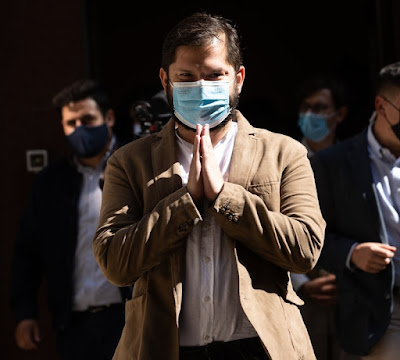
"More Borics please" -- My latest opinion column for Catalonia Today magazine


[Photo: EFE]

Was it sexism?

It wasn’t widely reported in the English language media but Gabriel Boric, the new leftist President of Chile has a Catalan mother, María Soledad Font Aguilera, who was originally from the working class area of Badalona bordering Barcelona

Instead, his father’s Croatian heritage was emphasised and I suspect this is not only because of the single family name.

A graduate of The British School in Punta Arenas, 35 year old Boric is the youngest holder of his nation’s most prized office, having gained just under 56% of the vote in Chile’s second round of elections last December. He defeated the right-wing José Antonio Kast, son of a veteran of World War II and militant in the German Nazi Party.

Boric’s party was able to earn a victory even after “a sudden blackout of bus services in Santiago and across the country forced voters to endure long commutes in the summer heat to express their basic right to a free and fair vote.

But against these efforts at voter suppression, the people of Chile offered their cars, vans, and motorcycles to assist their neighbours to get to the polls.” Most apparent was his support from younger voters and millennials, tired of the usual divisive political rhetoric.

Irina Karamanos Adrian, the new President’s “first lady,” has said she doesn’t want to be the country’s first lady, at least in a traditional sense. As a writer, anthropologist and militant feminist originally coming from Greek and German immigrants out of Uruguay, in her own right, she has also appeared on TV political debates before the presidential campaign.

(To me, if the new president had been a woman then we would have certainly seen a great deal of scrutiny of her life-partner/husband/wife/significant other, or whatever term you want to use. I have a distinct memory that just over a decade ago when Australia had its one and only female prime minister, Julia Gillard, there was a big hooha from conservatives about how she was partnered, not even married (!) to a man who had the supposedly “effeminate” job of a hairdresser.)

Boric himself came to wider attention after his message on Twitter following the independence consultation in Catalonia on October 1, 2017. He posted the words: “Images of police violence in Catalonia are shocking. A firm embrace from Chile to the Catalan people. More democracy, less repression”.

An electoral dark-horse and surprise victor, Boric is to be sworn into office this March in just one of the Latin American countries that have recently opted for left-wing presidencies; other examples being Argentina, Bolivia, Honduras, Mexico and Peru.

Boric was swept into power on an ambitious platform of practical changes like raising the minimum wage, reducing the cost of education, expanding the social safety net, fighting climate crisis and extending rights to indigenous people and gay and transgender individuals. He has even talked about creating a British-style national health service that is universal across Chile.

The big test for any progressive leader in power is what they do, not what they say, but if his manifesto is any indication then Europe too could do with plenty more like him.


[This article was first published under the title "Was it sexism?" in Catalonia Today magazine, February 2022.]

Sunday, May 2, 2021

LAUNCH EVENT: Spanish-English edition of Clive James' poetry


A bilingual Spanish-English volume of Australian Clive James' poetry has just been published.

Title: "Fin de Fiesta. Últimos Poemas". (Publisher, Pre-Textos.) Launch: 4 May, 19.00h, bookshop, Pau Claris, 144 Barcelona.

Reservations (Max. 20 people:) Email correu@documenta-bcn.com ... OR follow event on Instagram:

Wednesday, February 10, 2021

"Pandemic as Polemic" ' -- Online seminar from the University of Barcelona


 "The Covid-19 pandemic has been a great challenge for everybody, individually and socially, and has raised many questions about lifestyle, environment, social and economic inequality, health policies, science and especially governance and politics. 

Covid-19, its development, impact and effects form the basis of most current debates in our media and politics, and the illness has therefore become a rich interface of conflict that exacerbates contemporary inequalities and creates new ones. Yet, polemic can also be the source of renovation and construction, and as such, Covid-19 needs and deserves to be discussed from a multidisciplinary, global perspective. 

The Barcelona November 2021 seminar Australian and Transnational Studies Centre│Fac. of Philology│U of Barcelona│Gran Via, 585│08007 Barcelona, Spain 

Pandemic as Polemic aims to provide such a floor for open-minded discussion. 

We invite scholars to submit proposals for panels, posters and papers on the topic, from whatever point of view or discipline. • Submissions should include an abstract of 200-300 words in the language of the paper (choose one of the nine languages listed below) as well as in English, together with a brief biography in English. All should be sent to the scientific committee no later than 15 May. • Acceptation of proposals will be informed by 15 June. 

The seminar will be held ON LINE on Thursday 4th and Friday 5th November, and is free of charge, but registration is needed at the e-mail address ceatubenrolment@gmail.com. 

The CEAT will send the information and links for the Seminar to the registered participants. English, Catalan and Spanish will be the languages of the Seminar, but participants can submit ad give their communications in German, French, Italian, Portuguese, Galician and Basque as well. No translation will be provided. 

For further information and submission of proposals contact us at ceatsubmissions@gmail.com Scientific committee: Dr. Isabel Alonso Breto, Dr. Montserrat Camps-Gaset, Dr. Maria Grau-Perejoan, and Dr. Martin Renes. "


Sunday, September 20, 2020

Why do the poor suffer more from Covid19 in Spain? Interview with ABC TV.


Author of "Slow Travels in Unsung Spain" Brett Hetherington talks to Fauziah Ibrahim of ABC TV in Australia about the connection between poverty and Covid 19 in Spain.


Tuesday, July 28, 2020

Tuesday, June 16, 2020

"Weightless" -- My latest article for Catalonia Today magazine

What is wrong with this scene?


Excited children playing together in a Barcelona street, their parents standing nearby watching, chatting, smiling.
Of course, only a few months ago, there was everything natural, normal and perfectly ‘right’ about this everyday picture. 
Now (at least at the time of writing) the responsible adults in the scene are breaking the law and can be fined for it. Something that was as wholesome as a summer day suddenly became an awful sin.
So, how are people in our part of the world dealing with this and other similar flips of fate?
One person who has a sharp insight into how Catalonia is coping at the moment is Australian psychologist Leigh Matthews [pictured above,] owner and founder of Therapy in Barcelona. In mid-March, flying back to Barcelona after visiting the Alhambra for her 43rd birthday, she travelled from the pleasures of Granada into a city under lockdown.
Leigh believes that Covid-19 has all the ingredients of the kind of collective, traumatic crisis that she routinely deals with on a personal level in her work: the element of surprise, a threat to essential aspects of life and loss of control.
She says she is able to bear witness to the stories of her international colleagues and clients. In her opinion, they bring expat powers of adaptability and a comfort with ambiguity to difficulties that are firsts for everyone here.
As a comparison, the current number of infections in Spain stands at 264,663 and deaths at 26,620 whereas Australia’s are at 6,941 and 97. “This disparity is great,” Leigh says. “Here we are tormented with a huge toll and suffocating restrictions, but Australians, with their elaborate economic rescue package and comparatively mild threat, are also gripped with uncertainty, grief and exhaustion from groundhog days of confinement.”
To Leigh, the pandemic reminds her of the engineers charged with saving the lives of the astronauts in the Apollo 13 space capsule almost exactly 50 years ago. They solved the crucial problem of making a square filter fit into a space that had only been designed for a round filter. 
In her view, what governments in Catalonia and Spain have to face is something very similar to the Apollo 13 scenario.
She believes the question for the authorities is essentially the same one for many people: doing what is possible. “Identify a problem. Throw the resources you have to deal with it onto the table and figure out how to manage the problem. Variation in contagion and death rates aside, we all face the “Apollo 13 exercise” daily – fumbling for solutions to working from home while crisis schooling, mastering the Virabhadrasana pose in online yoga and simultaneously managing stress, grief, trauma and death anxiety with the menace of infection and economic impairment looming over us,” she says.
“As a psychologist I can give you the shopping list of coping strategies. I can tell you there is resilience to celebrate, but resilience is intersected by privilege and the domestic, political and economic theatres we inhabit. The cohort of people in my life are well resourced, but the pandemic is as multitudinous as each story of every person living it. Many stories won’t have an Apollo 13 finale. They came up with something adequate and so can we, even if it’s just wearing a mask to take care of others or writing a “new normal” that embraces everyone.”
Personally speaking, some days I feel the gravity of the situation holding me down. On other days, like the Apollo 13 crew, I am weightless. I almost float.
[This article was first published in Catalonia Today magazine, July 2020.]

Sunday, February 16, 2020

"Australia’s burning questions" -- My latest opinion column for Catalonia Today magazine

[EFE]

The great tragedy of the Australian bushfires -- that even after several months are still consuming huge parts of the country -- is that so much of the destruction is entirely avoidable.
How can this be? Why have more than 1 billion animals perished? Why have over 2,000 thousand homes been destroyed? Why have 23 people died and how is it possible that a total area of land bigger than Portugal or Hungary has already been burnt out?
The simplest correct answer is that Australia has always suffered from these kinds of wild blazes but that this time around the ‘fire season’ started much earlier and the spread of the fires was much wider than usual, with hundreds of them burning out of control at any one time.
Firefighters (most of whom are unpaid volunteers) have been almost completely powerless to stop the hydra-headed infernos because of continued fierce winds and the extreme high temperatures that the fires themselves have partly made worse.
Another major cause of the devastation can be accurately put down to state and federal governments underfunding emergency services for year after year.
ln an attempt to push any responsibility away from his own ultra-conservative party, Prime Minister Scott Morrison has used all kinds of political trickery and lies across the mainstream media (which fully supports him). He has also been widely condemned for choosing to go on holiday to Hawaii during the crisis, as did the relevant state minister from his party.
As well as that, Morrison has repeatedly argued that the global climate crisis is not a factor in this disaster, despite overwhelming scientific evidence showing it undoubtedly is.
As a fundamentalist Pentecostal Christian, he has instead maintained it is all the fault of arsonists or “greenies” who oppose targeted ‘back-burning’ to stop fires spreading. (The Green Party has always supported it, in fact.)
Accusations of climate denial against Morrison have come as thick and fast as the air that has choked the populations of Australia’s big cities of Canberra, Melbourne and Sydney over periods of weeks and months.
Even several former leaders of the PM’s own party have called for rapid action against carbon emissions and emergency policies to combat the years-long drought across the nation.
In many Australians’ experience, these fires have come on top of continuing and severe tap water shortages in many of Australia’s rural towns. Some, such as the small rural village of Murrurundi (located in a once relatively fertile area) have already run out of water and are having to buy in supplies privately. An increasing number of towns are expected to follow this disturbing practice soon.
Of course, water running low in Australian drought periods is nothing new.
What is causing outrage though amongst groups as diverse as farmers and environmentalists, is the massive (and often unmeasured) amounts of natural water from rivers, lakes and underground sources that are being sold off to private companies.
The Indian (multi-national) mining company Adani (which has the absurd, double-speak slogan of “Growth with Goodness”) extracts coal from the earth, among other things. It runs a business that is a major cause of global warming through carbon emissions and it requires large amounts of water in the coal cleaning process.
Adani -- which has paid not one cent of company tax in Australia -- will be allowed to siphon off 12.5 billion litres of local river water up until the year 2077. Another of its mines is being given $4.4 billion in public subsidies from the government. An open secret muddies the waters here: mining industries have been major financial donors to the conservative political parties in Australia for many years.
Corruption? You bet it is. For the governing parties, it’s raining money. This at a time when both rain and money are what’s really needed across a land that is dying of thirst and from fires on a biblical scale that Morrison had only ever read about.
[This article was first published in Catalonia Today magazine, Feb. 2020.]

Sunday, January 5, 2020

"‘High likelihood of human civilisation coming to end’ by 2050, report finds"

[Pic. Maja Hitij/Getty Images\
"Human civilisation as we know it may have already entered its last decades, a worrying new report examining the likely future of our planet’s habitability warns.
The increasingly disastrous impacts of the climate crisis, coupled with inaction to tackle it are sending our planet down a bleak path towards an increasingly chaotic world which could overwhelm societies around the globe, the report’s authors contend.
The paper, produced by the Melbourne-based think tank the Breakthrough National Centre for Climate Restoration, is presented by the former chief of the Australian Defence Forces and retired Royal Australian Navy Admiral Chris Barrie."
Read more from source here.

Sunday, December 15, 2019

"Generation Precarious" -- My latest opinion column for Catalonia Today magazine

[Photo: Oriol Duran]

I saw the best minds of my generation being dog-walkers or asking ’Would you like fries with that?’”

This may well be the sentiment of plenty of young people under the age of 30 across the developed world. 
Certainly, I include Catalonia, and especially those who camped across Barcelona’s main street of Gran Via and into the public square in front of the University of Barcelona.
Yes, they had other issues too that are important to them: the jailing of independence movement leaders, police brutality against protesters, increasing legal restrictions on free expression, but one of their other three stated aims was “a dignified future.”
It’s worth considering what this means. I see no reason why we should simply ignore the different groups who made up the “encampment”. 
When I visited the area in early November I saw groups of surprisingly youthful-looking kids being politically active. Some were in their mid-teens but were confident and obviously happy to be there. One young woman I spoke to had a makeshift stall that was all about a red plastic rubbish bin and her own writing I read was a vague and confusing attempt at satire. Another group were encouraging tweets as a method of expression where you could win a prize.
It’s difficult to argue though, with much of what the main section of the Gran Via campers have said. 
Calling themselves the ‘October 14 Generation’, their manifesto states, “We are a generation without a future. The generation of precariousness. The one that does not have access to housing, the one that is the victim of a system that threatens the very existence of our planet. We are a generation that has been robbed of the most basic social and labour rights.”
To me, that is all clear and true. Only someone living with their eyes closed could dispute it and in fact the far right continue to dishonestly and selectively use these young people’s sense of frustration and alienation for their own political benefit all across Europe.
Of course, it’s easy to write off the street-campers as just some university student vandals and fire-starters who are abusing the privileges that they’ve been given. 
Sadly, even a great writer and thinker such as Antonio Muñoz Molina (considered to be progressive) did this in a recent article for El Pais newspaper. His comments seem to have at least partly come from jealousy when comparing his own strict upbringing compared to “the academic authorities’ paternal and maternal indulgence” over these students’ postponed exams.
To make a comparison, I originally come from a part of the planet (Australia) where the level of political interest in most of the population, but especially the young, could best be described as minimal. In fact, apathy rules. 
I’m filled with optimism (rare for me) when I see young people taking a strong interest in anything outside their own narrow lives, even if I don’t happen to agree in all cases with everything they are on about. If any protester anywhere uses violence against people or private property then I naturally condemn it.
History has taught us that for protest to gain enough popular support to cause meaningful, long-term, lasting change it has to be non-violent. If that means camping out in a public square and main street, then that is a far more humanitarian option than us attacking each other with sticks. It might even help to foster a future that is less unstable.

[This article was first published in Catalonia Today magazine, December 2019.]

Thursday, July 25, 2019

"From Cairns to Madrid:" The first female Australian Indigenous ambassador goes to Spain

"Julie-Ann Guivarra was the first in her family to go to university. She was the first Indigenous person to serve as a senior executive in the Australian Foreign Ministry. 

Last year, she became the first Indigenous woman to represent Australia as its highest-ranking diplomat in Spain.


“Certainly I’ve never set out necessarily in life to be a trailblazer, but I do think that being the first Indigenous female ambassador is a huge honor. It’s an honor for myself, you know, I know that my family back in Australia are very proud of this achievement."
Ms Guivarra was posted to Spain, the country where her Basque surname originated. Ms Guivarra's Spanish connection dates back to one of her great-grandfathers, of Indigenous and Filipino origin: a combination not all that unusual, given the ancient maritime trade routes between Asia, Europe and Oceania reached the Torres Strait islands."
"My last name is Spanish because my great-grandparents were from the Philippine islands. It was only when I got this position that I started learning the language," the ambassador explains.
Read more from source here.


Sunday, July 14, 2019

"Who are The English?" --- My latest article for Catalonia Today magazine

This summer while we on the continent of Europe are enjoying doing whatever we can afford to do under the Mediterranean sun, we should all spare a thought for the English and their other Brit cousins.

They will be living through the continuing economic and social disaster created by Brexit and other agonies that are certain to multiply and crowd around like flies at a July barbecue.
A large slice of the pain of modern England comes from its identity and Brexit is only one symptom of this disease. 
I recently read an exceptional book titled ‘God is an Englishman’ published exactly 50 years ago, and all the way through it the Australian author Donald Horne, (who also wrote the well-known book ‘The Lucky Country’ about his own homeland) shows as much penetrating insight into who exactly the English are as anyone else I know of.
Using his book as a measuring stick against the past, it’s remarkable how little England seems to have changed (especially for the better) in that half a century that I have now lived through.
Facing up to the coming instability of the 1970s, Horne found that Britain’s history meant that it too deserved to be called a fortunate country. As he saw it though, “what gets on British people’s nerves is that they no longer know who they are.” (Loud echoes of today’s Brexit confusion?)
He saw a culture where people “find reality in excitements of..fashion and the entertainment businesses.” This led to an emptiness and general dissatisfaction with their lot. For him, it meant too that almost half of young British people alive then were fantasizing about emigrating. Of course, many did or already had (including my father.)
Some of Horne’s other best observations come from his clear understanding of the social class system that still operates deeply all through life there. He recognised that all Brits essentially operate to serve the comfort and ease of the “Upper English” but that a visitor who stayed for years might not notice that England is genuinely one of the world’s most working class nations.
Here, the author, who did in fact marry an Englishwoman and live for five years on a farm in Cornwall, west England, relates a truth that few Brits would have liked to admit, even in the unlikely event that they knew it. Twice as many manual workers as white-collar workers went out to their jobs in this “antique economy”; one that directly made it possible for the queen to stay happy in her castle.
The average Brit was in fact a relative of a peasant who had been tossed by need into the provincial towns or London, just like so many ’internal immigrants’ who arrived in Catalonia from (other) parts of rural Spain in the 1950s and ‘60s.
Soon after the time that Horne was writing though, it was estimated that at least half of England’s land was entirely unregistered: a hotchpotch of inherited wealth. Today we now know that this half a nation is owned by just 1% of its population: 25,000 landowners – typically members of the aristocracy and corporations.
These crucial numbers of course ignore the ironic title of the book. It refers to the 16th century monarch Elizabeth’s bishop of London who specifically claimed that “God is English” and “His nation was to be the New Jerusalem” of the British Isles.
The very English genius George Orwell warned against the “habit of assuming that human beings can be classified like insects” but if we think about today’s English people I’d compare them to that little desert lizard who hops from foot to foot to avoid getting its feet burnt on the hot sand. 
Here I mean the political and social temperature, not that from the sun.

(This article was first published in Catalonia Today magazine, July 2019.)

Friday, January 18, 2019

"The author's mouthpiece" -- My latest review for Catalonia Today magazine


Elizabeth Costello is that very rare thing: a commercially successful writer of fiction from Australia – the far end of the world that has typically given very little attention (or much else) to people who use words for their living and plenty of attention to those who are professionals in sports or make big bucks some other way.


It’d be an exaggeration to say that someone like this author would have to be invented in fiction because she simply couldn’t exist in real Australian life, but this is almost a forgivable exaggeration, given the interests of the populace there in mainly competitive activities.
Being in the creative fields in Australia is often a bit like being labelled as a poser. In that wide, brown land the word “intellectual” is sometimes used as a type of insult.

At one point in JM Coetzee’s novel, Costello apologises to her audience: “I usually take care to conceal the extravagances of the imagination.”
Costello though, as the author sets her out at least, is as good as a polemicist in the public lectures where she is invited to speak.
Within a few paragraphs of her first long monologue about the philosophy of vegetarianism, I wondered whether I was actually listening to Coetzee’s real opinions because the arguments the character makes are so heartfelt. (A glimpse at the Acknowledgments section placed on the final page confirms that several of the chapters called “Lessons” were in fact published as non-fiction previously).
Later in the book, after Costello publicly compares abattoirs with the Nazi’s murder camps, we read variations on the first meat-free-living theme. “A sparrow knocked off a branch by a slingshot [or] a city annihilated from the air: who dare say which is worse?” a narrator asks on Costello’s behalf. 

Even the smell of a boiled egg “nauseates her” and this extreme Buddhist-like respect for the sacredness of all life swings between wholly convincing and repetitive ranting. It takes up large parts of the book, as does a dry examination of Greek myths.
In one of the most moving sections though, Costello talks about what she ultimately believes in when she has to justify herself. In lovely images she explains where frogs live during Australia’s long dry spells. 

Oddly, it is here that she seems to be speaking for the writer in general, saying this “is a story I present transparently, without disguise.”
The book is lifted and somewhat lightened by the contents of a letter that Costello writes to her sister, who is a nun. In a surprisingly erotic scene, she tells of her lack of inhibition and displays of “humanity” one afternoon in her younger years.
Religion plays a key part in the book and a clever analysis of “The Virgin” Mary is a highlight. Costello ultimately has a strange belief in the devil but not in god and this forms a counterbalance with her sister and another author she battles with.
I also speculated about the possibility of Costello having been modelled on the great writer, VS Naipaul, clearly also a real arrogant doo-dah and a highly selective eater but undoubtedly deserving of his Nobel Prize for titles such as “A House for Mr Biswas”. Costello is best known for her novel “The House on Eccles Street”.
JM Coetzee’s semi-autobiographical “Boyhood” is a tighter, more consistent book than “Elizabeth Costello” but this book about a strong-minded woman is still certainly worth a read.

(This article was first published in Catalonia Today magazine, January 2019.)

Friday, October 19, 2018

Australian poet reading at the University of Barcelona


The Australian poet, Peter Bakowski, will be doing a public reading from his work at the University of Barcelona in Gran Via on:

Monday 22 October 9.30-11 a.m. in Room 107;

Wednesday 24 October 4.00-6.30 p.m. in Room 102b.


Saturday, July 14, 2018

"Work, money, machines" -- My latest opinion column for Catalonia Today magazine

My twin brother is a poet. Usually when I tell my adult English students this they ask me how he is able to survive economically.

They are always surprised when I say that Australia has an unemployment benefit paid monthly by the government and that this benefit does not stop after six months, as it does in Spain.

Of course my brother, just like all the other recipients of 'the dole,' as it's called there, have to jump through bureaucratic hoops and many have recently been victims of all sorts of horrific stuff ups by a system that is being privatised.


Yes. Soon the payments the poorest live on will be controlled by businesses that put making a profit from their 'clients' as their biggest interest. In Australia these unemployment benefits are only just enough to live on if they are combined with other government payments such as rent assistance.


I have a friend living in Barcelona who is a very talented graphic artist and is also a photographer with a unique eye. Like me, he teaches to pay the bills because his creative work does not get him and his family consistent income. Also like me, he enjoys his classes but would ideally like to be spending more time on using his talents to make new 'products' as our consumer society would insist on calling them.

But there is a wider question for every society here. Is a form of guaranteed basic income a good idea?


Some people argue that the public purse should not pay people to do what non-creatives believe to be just hobbies but this is missing a vital point. Practically every industry is now using greater numbers of robots  and other types of automation and mechanisation.

When I was leaving university in the early 1990's a guaranteed job for life was working in a bank. We now know this rapidly became not the case and branch closures across the world have meant the loss of most banking jobs.


Mainly this has been because machines now do the jobs that people used to do and the finance sector is only one place where this type of change is marching on. At Amazon for example, every job that can be done by a mechanical device is being done by one.

The people who work there have to keep up with the productivity of machines (even if it costs them their nervous systems) or they are simply fired and replaced with another very low paid worker who works long, long shifts almost exactly as a robot does.


Not long ago, I myself once worked in a full-time job for one of the world's largest smartphone companies (sitting at a computer) until one day my right arm completely froze-up after months of tendinitis problems caused by using a mouse at a high speed.

I was sacked the same day I came back to the office after being on medical leave for this problem. My body just would not work as a machine does.


The question that has to be asked and answered is what do our societies do to deal with increasingly significant numbers of people who don’t have enough paid work or even any paid work.

Economic survival can be close to impossible. In much of Mediterranean Europe the family unit has typically helped out, as have charities but this has created an uneven coverage of the basics of life for many people.

The obvious solution is a universal basic income for every individual in society. Europe’s newest progressive political party DiEM25 believes that the funding for this “should come from a dividend, financed from the returns on all capital; a 'public' percentage of companies’ profits, especially for companies that commercialise technology developed from public funding.”

In other words, “Technological progress should not simply serve capitalism.”

The great benefit from this is that it would allow creativity to flourish and people who prefer paid work at a higher income can do that too.

No automatic alt text available.
[Image: Nacho Diaz]


[This article was first published in Catalonia Today magazine, July 2018.]