Showing posts with label youth. Show all posts

Sunday, January 1, 2023

Safia El Aaddam’s “Immigrants’ daughter” (2022)


"Lunja is brave. A warrior. Born in a small Catalan village, of Amazigh origin, an indigenous [group] of North Africa, from childhood she confronts racism, poverty,...sometimes even her own culture." 

With this YA novel, the author puts mental health on the table and how it gets worse due to being an immigrants’ daughter and racialized as of African origin."

First found at Literary Rambles.


Friday, December 31, 2021

In 2022: "Spain's beaches are now smoking free zones"


[A beach in Sanxenxo, Galicia © Xurxo Lobato / Getty Images]

"Spain is the first country in Europe to ban smoking on all of its beaches after the government passed a new law following a public petition.  

From now on, anyone caught lighting up on a beach is set to be hit with a hefty €2000 ($USD 2258) fine. A ban is already in place in Barcelona and the Canary Islands, where smoking on popular tourist beaches is prohibited.

A petition in Spain that led to the smoking ban 

The move comes in a bid to clean up pollution on the country’s 3000 miles of coastline. The new law passed on December 23 followed a petition of 283,000 names demanding action on beach pollution was handed to the Spanish government. Cigarette butts are a hazard on many beaches, as they contain non-biodegradable plastic polymer. The European Environment Agency found cigarette butts among the most common items littering Europe's beaches. As well as contaminating the soil, they are also extremely harmful if swallowed by sea life. Sardinia in Italy and some areas in southern France have already banned smoking on their beaches.

shutterstockRF_1465537337.jpg
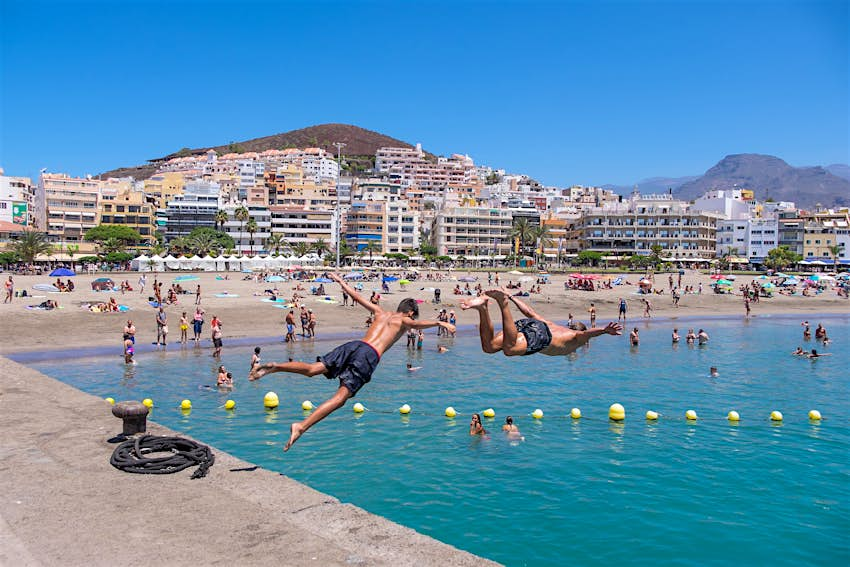
 [Los Cristianos in the Canary Islands where smoking is already outlawed on beaches © Salvador Aznar / Shutterstock]

Spain's other bans on smoking

In 2020 in a bid to curb the spread of COVID-19, Spain banned smoking in outdoor public spaces where people can't maintain a social distance of at least six feet. Galicia, in northwestern Spain, first introduced a ban on smoking in streets, bars and restaurants and this was adopted by the country’s health minister and brought in nationally.  

Read more from source at Lonely Planet here.

Saturday, March 20, 2021

"A bigger hassle" -- My latest opinion article for Catalonia Today magazine

[Pic: JOSEP LOSADA: Protesters in Barcelona]

Riots, disturbances, protests, brutal human rights violations, night-time shenanigans or “police-community liaison?”

The events that began immediately after the election here in Lleida, Barcelona and Girona (as well as Valencia and Madrid) can be called whatever you like.

But anyone who thinks that it’s all about something as abstract as freedom of expression is fooling themself.

Young and not so young people are marching, chanting, smashing shop windows, looting and doing the now routine burning of rubbish hoppers for much wider-ranging reasons than just the imprisonment of yet another rapper. That was merely a trigger.


Quite appropriately the other day, I was standing, for a change, not sitting, in my lounge room when I watched a young Catalan on Euronews TV intelligently selected by the editors possibly to give a more comprehensive explanation for why he and his friends ventured out into the cold and put themselves at risk of arrest or worse. (At the time of writing, another citizen had lost an eye from a rubber bullet.) 


The young man in a black face mask with both his eyes still good enough to show on camera, made a point that is entirely absent from most media reports and commentary. While all the action was going on behind him, he was intent on saying that Spain is the worst in Europe for youth unemployment, currently still over 40%. He could also have commented on under-employment as a chronic symptom here since the 2009 economic “crisis.” 


It’s no coincidence that some demonstrators focused their aggression and frustration on banks, destroying furniture and equipment after breaking in. As a symbol of capitalism’s failure for the average person there is no better target of what to smash up.


The pandemic has not created record cases of house evictions or already low salaries unchanged for more than a decade. It has simply made the system we live under more punishingly extreme.


One of the most relevant facts also in the background to the latest episode of “hit the streets and get hit” now applies to at least two generations of people.


Those who are my son's age (late teens, up to early 30s and my generation in our 50s) who are available to be “gainfully employed” simply are not put to good or fair use. This too breeds frustration. 


In my own case, for the last 9 months or so of the pandemic, the best that hyper-capitalism is offering to someone like me with two university degrees and two decades of experience in classrooms with adults and teenagers is that all we can hope for is a patchy timetable teaching little kids in China. Online for 10 euros or less an hour. 


In other words, anyone in a job is supposed to consider themselves lucky and be thankful for getting paid peanuts. Especially if you live in Barcelona, peanuts simply don’t pay the rent or the mortgage. That is also why huge numbers of adults under 30 continue to live in the family home.


Equally, there’s one other crucial element that has hardly been reported. The jailed rapper in question (whose name may as well be spelt hassle, not Hasel) has also criticised [alleged] previous torture and death of demonstrators and migrants, aside from his lyrics about the corruption of those higher up our economic and social food chain.


Plenty of local people know that. It motivates them. 


So why is this not being stated in media outlets who can get away with exercising freedom of expression? 


[This article was first published in Catalonia Today magazine, March 2020.]


Sunday, January 24, 2021

Spanish youths' surprising outlooks


[Photo: EFE]
‘Young Spaniards believe that they will live better than their parents, but in another country.

Those aged 15 to 29 are critical of the value of friendship, committed to social causes and sceptical of their political representatives’.

The survey includes a useful graphic. From La Vanguardia but found at Business Over Tapas.


Sunday, December 15, 2019

"Generation Precarious" -- My latest opinion column for Catalonia Today magazine

[Photo: Oriol Duran]

I saw the best minds of my generation being dog-walkers or asking ’Would you like fries with that?’”

This may well be the sentiment of plenty of young people under the age of 30 across the developed world. 
Certainly, I include Catalonia, and especially those who camped across Barcelona’s main street of Gran Via and into the public square in front of the University of Barcelona.
Yes, they had other issues too that are important to them: the jailing of independence movement leaders, police brutality against protesters, increasing legal restrictions on free expression, but one of their other three stated aims was “a dignified future.”
It’s worth considering what this means. I see no reason why we should simply ignore the different groups who made up the “encampment”. 
When I visited the area in early November I saw groups of surprisingly youthful-looking kids being politically active. Some were in their mid-teens but were confident and obviously happy to be there. One young woman I spoke to had a makeshift stall that was all about a red plastic rubbish bin and her own writing I read was a vague and confusing attempt at satire. Another group were encouraging tweets as a method of expression where you could win a prize.
It’s difficult to argue though, with much of what the main section of the Gran Via campers have said. 
Calling themselves the ‘October 14 Generation’, their manifesto states, “We are a generation without a future. The generation of precariousness. The one that does not have access to housing, the one that is the victim of a system that threatens the very existence of our planet. We are a generation that has been robbed of the most basic social and labour rights.”
To me, that is all clear and true. Only someone living with their eyes closed could dispute it and in fact the far right continue to dishonestly and selectively use these young people’s sense of frustration and alienation for their own political benefit all across Europe.
Of course, it’s easy to write off the street-campers as just some university student vandals and fire-starters who are abusing the privileges that they’ve been given. 
Sadly, even a great writer and thinker such as Antonio Muñoz Molina (considered to be progressive) did this in a recent article for El Pais newspaper. His comments seem to have at least partly come from jealousy when comparing his own strict upbringing compared to “the academic authorities’ paternal and maternal indulgence” over these students’ postponed exams.
To make a comparison, I originally come from a part of the planet (Australia) where the level of political interest in most of the population, but especially the young, could best be described as minimal. In fact, apathy rules. 
I’m filled with optimism (rare for me) when I see young people taking a strong interest in anything outside their own narrow lives, even if I don’t happen to agree in all cases with everything they are on about. If any protester anywhere uses violence against people or private property then I naturally condemn it.
History has taught us that for protest to gain enough popular support to cause meaningful, long-term, lasting change it has to be non-violent. If that means camping out in a public square and main street, then that is a far more humanitarian option than us attacking each other with sticks. It might even help to foster a future that is less unstable.

[This article was first published in Catalonia Today magazine, December 2019.]

Monday, January 28, 2019

"The new nomads" -- Spain's young people

   "Spanish society has got an outstanding debt with its young people, who can’t construct a personal and professional life..., who don’t have decent jobs and salaries, don’t have adequate housing and can’t start a family.


The last decade has been witness to how the concept of “mileurista” [somebody earning 1,000 € a month] has passed from being derogatory to being an aspiration.


A recent study by [the trade union organization] Comisiones Obreras with the title “#GeneraciónMóvil” [mobile generation], shows the following: unstable and unpredictable personal and career paths, always conditioned by low salaries, unbearable rates of temporality and a rotation that turns the young into nomads in the labor market: from one sector to another, from salaried to self-employed, from victims of undesired partiality to false interns, with imposed stopovers in unemployment or abroad, without safe horizons nor the least capacity to plan life projects in the medium or long term, without security...
In 2017, 66 of every 100 young people had a temporary and/or part time contract; and still worse, 20 of every 100 salaried young suffered from double precariousness (temporary and part-time contract). Only 34 of every 100 had a fixed full-time contract...
Lastly, emancipation: 81% of the young between 20 and 24 years, 53% of those between 25 and 29, and 24% of those between 30 and 34 years still live with their parents. … leading to a lower birth rate, as they have their first child later or can’t afford to have children at all.
[…] many young people are deprived of the opportunities they should have had: the right to live their own life independently has been snatched away from them, to take their own choices, forcing them to accept, in the best of cases, any job, to work at any price, to study what the job market dictates to them and not that for which they had a vocation, or to return again and again to their family’s home, hiding their frustration."
SOURCE: Joaquín Estefanía's article: “Ideas,” El País, Dec. 30, 2018, p. 8 [printed edition] (Originally found as excerpts here at LITERARY RAMBLES blog.)

Friday, July 7, 2017

"Real red: Corbyn, Goytisolo and the rallying of the left" -- My latest opinion column for Catalonia Today magazine

Elections can be strange events. The British one last month produced a mixture of results but one thing it showed was that a genuinely democratic socialist government there is a distinct possibility after the next time the nation goes to vote again.

For the first time since the mid-1940s, the Labour Party in the United Kingdom, led by underdog Jeremy Corbyn is offering a collection of policies that are not a softer, pale imitation of the Conservatives and roughly supporting the economic and social status quo.

This Labour party with its election programme (or ‘manifesto’) was full of plans to tax the richest in society and increase company tax to pay for better public funding of schools, hospitals and social care, all of which have been cut away horrifically by the Cameron and May governments since 2010. In truth, many of these severe austerity policies had actually begun under previous Labour leaders in power.

Corbyn however has moved his party clearly to the left and many of his ideas proved to be popular during the last few weeks of the election campaign. Theresa May lost her majority in parliament but we simply cannot know for sure how much this was due to her bumbling campaign and how much credit Corbyn can rightly claim.

What we do know is that over 70 per cent of young voters in the 18 to 24 age bracket voted for Labour candidates. Partly, this must have been due to Corbyn’s policy of guaranteeing free university places for all, instead of the current system which demands exorbitant annual fees but it seems that his appeal was wider than just this one promise.

His more concrete and costed commitments to put the rail network back in public control and reverse the creeping sell off of the NHS public health system also appear to have found support from the young to the old. Labour’s pledge to raise the minimum wage to 10 pounds an hour was another vote winner. It showed that they have once again gone back to their red roots and are not afraid of being labelled radical by the establishment-controlled media.

Another progressive iconoclast who has lived by his left-wing beliefs and regularly paid a price for doing so is Barcelona-born writer Juan Goytisolo [pictured above], who sadly died at the age of 86 at his adopted Moroccan home in June of this year. As a critic of General Franco and conservatism in general, he was known across Europe for his books such as “Campos de Níjar,” a travelogue that detailed the harsh social and economic conditions in 1950s Andalucia (translated into English by Peter Bush.)

As a writer, I was also inspired by Goytisolo’s autobiography, “Forbidden Territory”. It is rare to read such brutal honesty about his own evolving sexuality and highly-personal inner landscape. Through creamy prose, he makes a sharp dissection of the “ill-formed universe” of his bourgeois upbringing. We can only hope to see others follow in his wake.


[This article was first published under the title "The rallying of the left" in Catalonia Today magazine, July 2017.]

Saturday, February 18, 2017

"Squatting in Vilafranca" -- My latest column for Catalonia Today magazine

[Graffiti wall in Vilafranca: “Enough speculation! The Penedès is not for sale!]
 If global warming is likely to be the biggest problem facing society in the coming years, it will certainly be competing with housing as an issue of great public concern. 

While the situation is probably most severe in Barcelona, the people of a medium-sized Catalan town such as Vilafranca del Penedès are certainly not free from these pressures.

One group who have acted against what they see as a major cause of housing difficulties is a squatter's collective that supports the politics of the Esquerra Independentista [independent left] movement. Recently, they took occupation of a former industrial building in the north of Vilafranca and have re-named it “El Taller” (The Workshop).

“We have done this to protest against real estate speculation,” says their 21-year-old spokesman, who did not wish to be named or photographed. “But we also want to do productive things with this place. We are converting it into somewhere for people to meet to discuss politics, to drink coffee, and to have concerts and theatre performances. We are even creating a studio upstairs.”

According to the collective, the site they have taken over has been empty for at least four years, and is zoned to be eventually knocked down for redevelopment.

“The local people were happy when we moved in because there was a lot of rubbish lying around the building and no one was cleaning it up. But we did,” says their spokesman. “We're making something good out of a place that had no owner and we are doing it without any help from the Vilafranca town council. It was difficult to get this all happening but we will stay here.”

In a very different position to those who occupy vacant buildings are Vilafranca residents, Teresa and Jose. They have a rural property outside the town that is being lived in by a man without their permission. The couple have tried to avoid legal proceedings with the squatter for several years but have recently changed their approach of attempts at persuasion and conciliation.

“We were told we needed a judge's order to get him out of our house,” Teresa explains. “Our decision was to hire a private lawyer because using a public one takes much more time.”

“The procedure has taken two months to get to court and has cost us two thousand euros, but at the moment he's still there and he has smashed up half the house,” says Jose.

Speaking to some other people over lunch in Vilafranca, it is not difficult to find a common theme. There seems to be an acceptance that the government could not or would not do much to solve problems relating to housing. Apart from one suggestion that taxes should be reduced on houses, there is little genuine hope that improvements were possible coming from elected representatives.

“The introduction of the euro was what started our struggles,” says Silvia. “And the price of houses is the other burden. We pay more than double compared to those in southern Spain. The middle class has shrunk completely. Everything needs to be changed!”

Without knowing it, another woman also agrees with the squatters collective on the subject of profiteering in the real estate industry. She suggests that the high levels of speculation now means that for single people it is impossible to buy a house or even rent a decent apartment.
“Everyone has to live with their parents or share accommodation with at least one other person if they are to afford to have any quality of life,” she argues.

There is something here that is beyond dispute, though. Almost anyone would see the common sense in a group of energetic and optimistic young people making good use of a long-abandoned building, as with the Vilafranca squatters group. However, the question that does remain is: How should this happen, both legally and ethically?

[This article was first published in Catalonia Today magazine, February 2017.]

Sunday, November 6, 2016

Free rail passes for young Europeans?

[©AP Images/ European Union-EP]
"Young Europeans are on track to receive a free InterRail pass on their 18th birthday in the future. Members of the European Parliament [MEPs] discussed the proposal and overwhelmingly supported it during a debate in plenary on 4 October. 

Millions of young European have travelled throughout the continent using Interrail over the last few decades, but the pass itself can cost up to hundreds of euros.

Interrail is a pass allowing people to travel across Europe’s rail network freely. Users can use it to travel wherever they like on the continent.

Some 300,000 people use InterRail passes to travel across Europe every year.   An InterRail pass cost ranges between €20 and €480 for a month-long pass.
"


Read more from source here.

Friday, April 3, 2015

"Easy on the eye" - My latest opinion column for Catalonia Today magazine

Watching my son doing his geography homework the other day I was struck by how much time he was spending on selecting online images to accompany his (minimal) written work.


This activity is now a big part of modern education which I also know because as a (thankfully former) secondary school teacher of History and English I was continually struggling with students to focus on the text they were developing or learning from and to consider the pictorial aspect as secondary, or supportive. 

Students as old as twelve would regularly include a photo of say, Adolf Hitler, with the caption, “Here is a photo of Adolf Hitler,” with no other information about him, as if naming him was all that needed to be said and the real task was to cut and paste an image of him. Some older students would often just plagiarise whatever Wikipedia told them was the truth.


But why should I be surprised about all this? If you are reading this article on a train or metro have a look around right now, or next time. There will probably be more people scrolling through photos on their phones than reading something (apart from chatting by text, perhaps.)


The popularity of social media has given rise to even more use of moving or still pictures as communication. Instagram and YouTube, to name just two, have meant that sharing visuals is easy, fun and almost cost-free. Amateur photography has never been so straight-forward, thanks to camera-phones and digital technology.


Children are obviously some of the major users of their own photos as well as those of their friends. One survey of more than 2,700 young British people aged 13 to 25 found that almost one in six children sends naked photos. Equally, this so-called “sexting” phenomenon in the USA lead investigators from the National Center for Missing & Exploited Children to find that of the more than 130 million images containing child pornography examined since 2002, one in four were initially posted by minors themselves.


It’s natural for young people to have an interest in their bodies and other’s bodies as well. I see no big problem there but an apparent increase in obsession with body image can at least partly be explained by the strong influence of ‘supermodels’ (recently including male ones) and the visual appeal of “skin is in” singers and groups, especially from hip-hop, rap and R&B.


The power of the metrosexual male idol such as David Beckham or Ronaldo has yet to be explored in the mainstream media but this increased emphasis that male-grooming puts on the connection between the visual and the physical is abundantly clear. 

Our society simply values those with “eye candy” appeal more than anything else and that is because a glance takes a split second but conveys so much. It’s for this basic reason that film stars have long been paid absurd amounts of money compared to others in the creative industries including virtually all painters, writers and non-commercial musicians.


Looking is easy. Listening is often hit and miss.Reading needs more concentration or patience.

[This article was first published in Catalonia Today magazine, April 2015.]

Monday, August 26, 2013

Barcelona teens addiction to mobile phones

[Barcelona psychologist, Vega González Bueso]
[This article of mine was first published in Catalonia Today, 20 November 2008. I decided to republish it here because of a similar case with a friend of my 12 year-old son.]


A recent survey in England found that teenagers’ favourite activity during school lunchtimes was not playing a sport or even talking with friends, but sending text messages on their mobile phones.
 
Young people in Catalonia are no less vulnerable to the attraction of mobile phones.
 
Vega González Bueso,a psychologist and assistant medical director at Barcelona's Atenció i Investigació en Socioaddiccions (AIS), (or Organisation for the Research and Treatment of Social Addictions) says that AIS is dealing with a growing number of cases related to this behavioural compulsion.
 
The first patient with a mobile phone addiction was treated at AIS in 2003,” she says. 

“The trouble is that mobile addiction is socially accepted and this makes it more difficult to detect the problem.  
Generally, requests for treatment come from a relative who has, for example seen a very high telephone bill, and they then force the person in question into starting treatment.”
 
While high phone bills are a problem, mobile phone addiction can take a psychological toll, leading to isolation from the user’s social environment. 
 
Ironically, a piece of technology that is supposed to make us more closely connected can instead create mistrust or feelings of separation between an addict and friends. 
 
In one case described by Vega González, 18-year-old Susanna began to use her phone more and more, to the point where she became unable to suppress an impulse to send messages and talk at all hours.
 
She began failing all her subjects in school and her mobile bill climbed to €800 a month.
 “Susanna sold some family jewellery to earn money to top-up the credit on her mobile,” Vega González said.

”She even communicated with people she did not know and ended up losing lots of friends because she was relating less and less to her environment.”

Vega González said the high bills tipped off her family,prompting them to seek help.

After a year of therapy, Susanna is better, but “went through terrible moments when at the beginning she was forbidden to use the cell phone,” she said.

Treatment at AIS includes the family or partner, whose involvement is seen as an important in solving the problem.

One aim is to train the affected person to develop greater social skills so they can relate to people more without the use of a mobile phone.

Infatuation with mobiles is found more among males than females, according to AIS, but those at risk of addiction tend to share similar problems of low self-esteem, communication difficulties, insecurity and emotional instability.

Vega González says an inability to control phone use despite knowing the negative consequences of the behaviour is usually a clear sign of a significant problem.

”If they stop doing important activities such as study or work because of this addictive behaviour or have continuous thoughts about their phone when he or she does not have access to it, this is the time to seek treatment,” she said.

Friday, July 19, 2013

"How Europe's solution for the crisis is actually the problem "


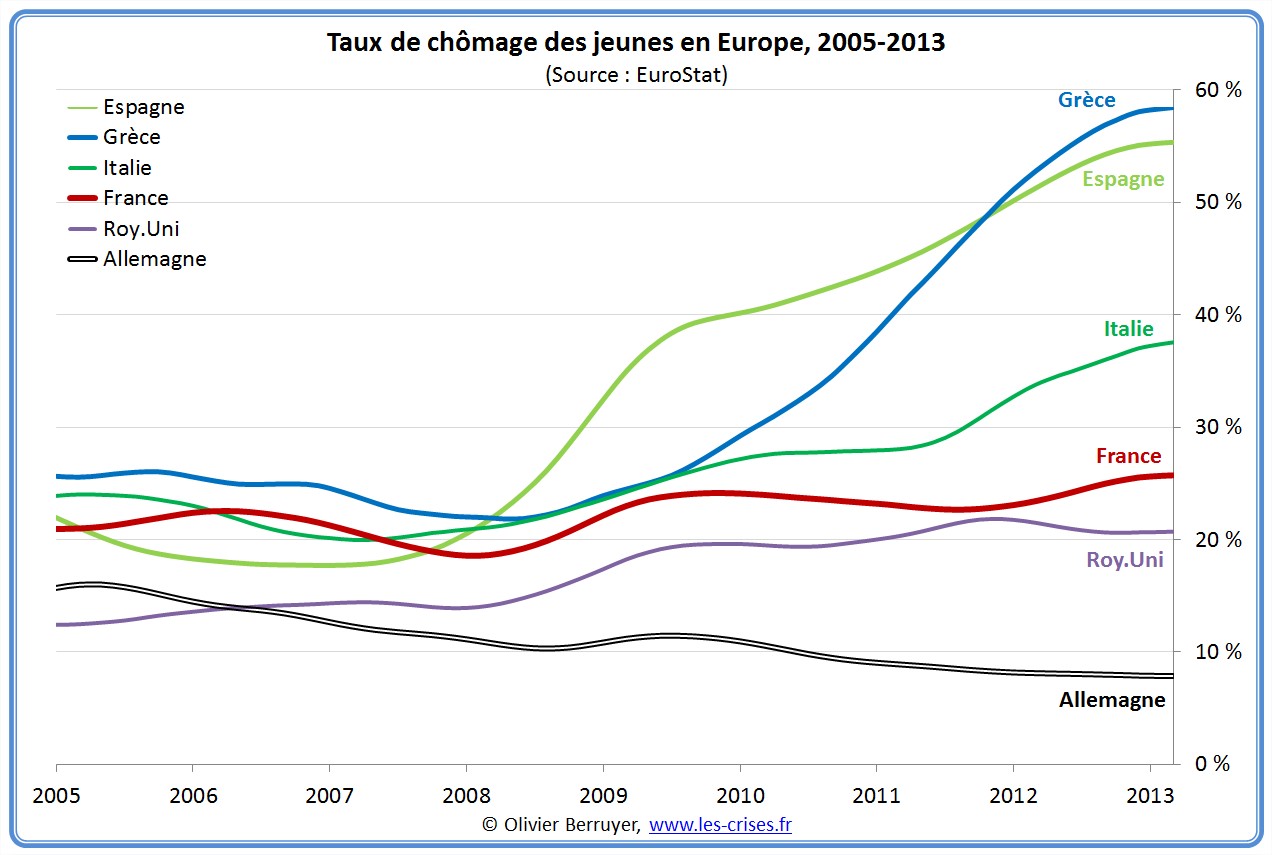
Le taux de chômage des jeunes en Europe de 2005-13 via Les crises, domaine public
[Youth unemployment rate in Europe between 2005-2013 via Les Crises – public domain]

"Europe's current crisis is more than economic. Between the German government advocating a dangerous austerity policy and European authorities lacking any other suggestions, it is clear that the 2008 financial crisis is no longer solely responsible for the downward spiral of Europe.
The GDP for countries in Europe has fallen by a considerable amount: 5.3% for Greece, 3.9% for Portugal, 4.1% for Cyprus, 2.3% for Italy, and 2% for Spain. This is without even mentioning the recession into which France is entering. In the first quarter of this year, the European Union economy contracted by 0.7%, or one percent when only taking into consideration the eurozone."

Read more from this Global Voices article here.


Friday, July 6, 2012

Letter from a young Spaniard

An articulate and thoughtful piece about the past, present and future in this country:

"Spaniards in their thirties have grown up in enviable circumstances: democracy, a generous state, material wellbeing. Now the crisis has returned them to a cruel reality: that they may have to live with less than their parents did. Whether they alter their expectations or try to stop the clock will be decisive, writes Ramón González Férriz."

Read more here.


Saturday, September 25, 2010

The generation that is hoping for Plan B

I have an acquaintance who is a waitress even though she has a high-level science degree. These days some people would consider her to be lucky to have any kind of paid work.

"For Spain’s twenty-somethings, the dream was over before it began. Two years after Wall Street crashed, a crisis that seemed far away has now taken over their lives.

Spain has the highest unemployment rate in Europe, and joblessness is most severe among the under 25s. The question people like Iván Miguel, fired from his job as a waiter the day after Spain won the World Cup, are asking is whether they are doomed to a life without meaningful employment.
"

The first part of an EL PAÍS report on Spain's "Generation in crisis."