Showing posts with label Global Voices. Show all posts

Saturday, October 29, 2022

Friday, September 28, 2018

"Crimes of solidarity’ in Europe multiply -- 11 stand trial in Belgium for helping migrants"

[The September 6, 2018, trial of 11 people who have helped migrants in Belgium has attracted a number of protesters. Photo: Melissa Vida. Used with permission.]
 "Eleven people who had been arrested and charged with human trafficking in October 2017 appeared in court in Brussels on September 6, the first hearing of a trial that activists say is yet another case of “criminalization of solidarity” in Europe.

The defendants have allegedly assisted 95 undocumented migrants, including 12 minors, to travel from Belgium to the United Kingdom last year, either by hosting them in their homes, by lending them phones and thereby indirectly helping them cross the channel.
On the day of the trial, three hundred people protested in front of the courthouse. Demonstrators say this is a political trial, aimed at dissuading people from helping migrants by establishing an intimidating judicial precedent.
The defendants are two Belgian journalists, one Belgian-Moroccan social worker, a Tunisian man who is a legal Belgian resident and seven people who are undocumented migrants themselves. Eight of the defendants have been in jail since the arrest.
Belgian law states that there must be a monetary transaction involved for an act to be framed as human trafficking, something the defendants deny ever happening. However, the relationship between the migrants and their helpers seems to fall into a legal grey area, raising fears that the law's scope is unjustly being expanded to target activists.
Myriam Berghe, one of the two journalists, said in an interview with RTBF (Belgium's public service broadcaster) that she's received money on behalf of a migrant she was hosting. The migrant in question had been sent money from abroad via Western Union, Berghe says, but had no way of collecting it due to having no papers. What for Berghe was simply an act of kindness, in the eyes of the authorities was payment for smuggling.
In the same interview, she explains that despite some of the people she's hosted being smugglers themselves, she wouldn't consider them “human traffickers...”
Read more from source at Global Voices here.

Saturday, July 28, 2018

Video: "One of Europe's last primeval forests crumbles in the hands of the Polish government"


"For two and a half years, environmentalists have waged a war with the Polish authorities for Białowieża Forest, a UNESCO World Heritage Site and one of Europe's last and largest remaining patches of Europe's original primeval forest.


In April 2018, the European Court of Justice, the EU's highest court, ruled that Poland violated EU laws by logging in the forest, imposing fines of a minimum of 4.3 million euros (five million US dollars), potentially rising to 100,000 euros a day, if the felling doesn't stop.
In March 2016, former Polish Environment Minister Jan Szyzko, a member of the [right-wing] Law and Justice party who's backed by forester lobbies, approved tripling the amount of wood that could be harvested from Białowieża, allegedly to combat  an infestation by the bark beetle. 
In July, a handful of Polish environmental organizations filed a formal complaint to the European Commission, which then sued Poland in the EU Court of Justice.
Straddling the border between Poland and Belarus, Białowieża includes extensive undisturbed areas and is home to a rich wildlife of which 59 mammal species, including the European bison. 
But while on the Belarussian side over 80 percent of its extension is circumscribed under a national park, only 17 percent of Poland's forest enjoys a similar level of protection.
Watchdog environmental organizations say at least 160,000-180,000 trees have been felled since Szyzko's 2016 new management plan.
Neglect for the environment is an issue touching all corners of Eastern Europe. In Romania, Greenpeace estimates that three hectares of trees are lost every hour in the Carpathian mountains, also home to one of Europe's last patches of primeval forest. In Slovakia, official declarations that forests are growing undermined by aerial photography.
In Poland, Szyzko was eventually sacked in January 2017, only days after another controversial bill which he had sponsored was approved in parliament. The bill removes the obligation for private landowners to apply for permission to cut down trees or to inform local authorities that trees have been or will be removed.
The new environment minister, Henryk Kowalczyk, agreed to comply with the EU’s decision, but controversy still surrounds his administration. In May, he established a team to envision a long-term plan for the forest, including plans to replant the logged areas, which environmentalists claim could do more harm than good.

The protests

In May 2017, protestors established a permanent camp in the forest, often chaining themselves to harvest machines. The settlement, organized on a bottom-up basis, encouraged the development of online petitions and international awareness.
The situation detonated when some protestors were forcibly removed from the area, in handcuffs, by the Forestry Corps, and a legal ban was put in place to forbid entry to certain parts of the land. By the height of 2017 Summer, the Environment Ministry had declared any opposition to logging would be seen as political opposition.
As Poland’s state media, which had been increasingly subject of intervention by the government of the conservative Law and Justice party, began to attack these protests with vitriol, campaigners decided to season their message with patriotic sentiment, promoting a message of national heritage that is in line with the party's ideas.
A digital 3D model of the forest, produced by a collaboration between Greenpeace and Minecraft, allows players to explore Białowieża complete with biodiversity and weather patterns. Called “To the Last Tree Standing”, the game eventually removes the trees from players’ sight without warning, leaving them scrambling to find the last one."
Source at Global Voices here.

Saturday, April 28, 2018

"In Spain, there is a fear of talking about race"

[Photo by Maité Escarria and courtesy of Lucía Asué Mbomío Rubio. Used with permission.]


Read more from Sandra Abd'Allah-Alvarez Ramírez' original article at Global Voices here.

Wednesday, March 21, 2018

"Why Did Women Journalists Strike in Spain?"

[Photo: Elisa Piñeiro, used with permission. Sign reads “Journalists on strike.”]
  

"Some 8,000 women journalists from Spain, among them the author of this post, recently signed a manifesto called “Journalists On Strike,” which was read during the “Feminist Strike” that took place on March 8 in a dozen cities in Spain.
Neither the manifesto nor the strike were initiated by a union, political party, or media source, as is often the case. For the first time, women television show hosts, radio presenters, and newscasters decided to turn off their microphones in the studio and take their voices to the streets."
Read more from María Luz Moraleda's translated article at Global Voices here.

Saturday, September 3, 2016

"A Little-Known Perspective on the Life of Homeless People in France — Their Own"

(Tents from charity ‘Les Enfants de Don Quichotte’ on the banks of the Canal Saint-Martin, Paris. From Wikipedia Creative Commons 2.0`)


"There are many preconceived ideas about the lives of the homeless in France. The most widespread amongst them are as follows:
  • “It's a declining trend in France.”
The total number of homeless people in France (excluding refugees in the camps in Calais) is difficult to estimate, but the FNARS, a national organisation for social inclusion and re-insertion, estimates the figure to be between 150,000 and 240,000 people. The Fondation Abbé Pierre, a homeless charity based on the benevolence of its namesake, a 20th century Catholic priest, estimates that there are 50% more homeless people in France than three years ago — including 30,000 children.
  • “To be homeless is an active choice.”
A study shows that only 6% of homeless people choose to live on the streets.
  • “The homeless don't work.”
Many homeless people are employed on fixed-term or temporary contracts.

In an attempt to correct the narrative about the homeless, some homeless people in France over the years have told their stories in their own words on social media. Let's meet three of them: Stéphane, Francis and ‘SDF75′, who all have at one point offered insight into their lives on their respective blogs.


‘I am a computer programmer first and a homeless person second’

SDF75 explained why he wanted to create a different blog:


Read more from source at Global Voices here.

Monday, June 27, 2016

"A Children's Book Introduces German Kids to the True Story of Syrian Refugees"

[Credit: Jan Birck]
"There are now more than 65 million people displaced by conflict in the world, the highest level ever recorded. Half of these refugees are children.

Germany has received more than 1 million refugees, mostly from Syria and Iraq. Despite supporters initially celebrating Chancellor Angela Merkel's actions, many Germans have begun voicing concerns about when this acceptance of migrants will come to an end.

But while the adults in Germany have expressed mixed reactions to the refugees, German author Kirsten Boie wants children at least to realize that a refugee child is just like any other kid in the world.

In her latest children’s book, “Everything Will Be Alright,” she writes the true story of Rahaf and her family, who flee Homs, Syria due to bombings by war planes. The family crosses the Mediterranean Sea on a small boat, ultimately choosing a small town near Hamburg, Germany to start their new lives.

The book is published in German and Arabic and is meant to be read at school to both German-born children and their new immigrant neighbors. (An English translation is available online here.)"

Listen to this story on PRI.org »

Monday, July 27, 2015

"More Europeans Migrate to Latin America Than Vice Versa, Study Finds"

[“Leaving” Mural, by Antonio Segui, at Independencia station in the Buenos Aires metro, Argentina.
Photo: Rodrigo Borges Delfim]


"Contrary to popular belief, more Europeans are currently migrating from Europe to Latin America and the Caribbean than in the opposite direction. 

This is the conclusion reached in a study published recently by the International Organisation for Migration (IOM), titled ‘Migratory Dynamics in Latin American and the Caribbean and between Latin America and the European Union’.

The document shows that more than 181,000 Europeans left their countries in 2012, in comparison with the 119,000 Latin Americans moving in the opposite direction. The data show a reduction of 68% in the latter flow compared to 2007, when the number of migrants moving from Latin America and the Caribbean to Europe stood at over 350,000 people, its highest level ever.

Spain is at the top of the list of countries with the highest number of citizens emigrating in search of new opportunities in Latin American states, with 181,166 emigrants to Latin America in 2012. It is followed by Italy, Portugal, France and Germany."

Read more at: Global Voices source.


Thursday, March 19, 2015

Video: "Seeking ‘Brave Journalists’ in Spain to investigate the TTIP Trade Agreement"


"The main concerns for groups that oppose the Transatlantic Trade and Investment Partnership (TTIP) between Europe and North America are the lack of transparency and the way in which the agreement will affect the communities involved. 
 
In Madrid, Spain, the Asamblea Popular de Tres Cantos (Tres Cantos Popular Assembly), a community activist group that is well known for its participation in protests against the economic crisis, is “seeking brave journalists” as part of an appeal to the media to investigate the treaty.

In the video published on the organization's blog and various social networks, members of the assembly appear with photographs of employees from Spain's large media organizations, which have largely ignored the treaty in their coverage, and offer them a challenge:" [see English subtitled video above.]

More from Global Voices Online source article here.

Friday, December 20, 2013

How should we take on the problem of unequal pay in Europe?


Tonight I was involved in an online discussion (through Global Voices) about “How we should we take on pay inequality across Europe.”

The inhumane levels of poverty and joblessness in Catalunya, Spain, and wider Europe demand that more is done to combat these social ills, and now...

"A movement to give every citizen “unconditional basic income”—no work required—is gathering speed in Europe.

For the last 11 months, the European Citizens’ Initiative (ECI) has been spearheading a one-year campaign to gather a million signatures that support "Unconditional Basic Income (UBI)" for all Europeans.

The ECI wants everyone to have a basic, guaranteed wage, which is enough to cover day-to-day expenses.

If they collect one million signatures reaching the minimum requirement from at least 7 European Union (EU) member countries by January 14 2014, the European Commission will have to examine their initiative and arrange for a public hearing at the European Parliament.

 
In the short term, they want to do some “pilot-studies” and examine different models of UBI.
 
In the long run, their objective is to offer to each person in the EU the unconditional right as an individual, to have their material needs met to ensure a life of dignity by the introduction of the UBI.

The Basic Income proposal is being presented by citizens from 15 EU member states (Austria, Belgium, Denmark, France, Germany, Greece, Ireland, Italy, Luxembourg, Netherlands, Poland, Slovakia, Slovenia, Spain, United Kingdom)."


[http://basicincome2013.eu/]


Monday, October 28, 2013

"Spain's wealth divide [now] widest in Europe" while human rights get worse

Some three million Spaniards were living in extreme poverty — or on €307 a month — in 2012, says Spanish charity Cáritas. Photo: xornalcerto/Flickr

The gap between Spain's richest and poorest is now the widest in Europe with some three million people living in extreme poverty, a new study reveals.

Read more from the source here.

Meanwhile, the European Commission reports that human rights in Spain are "deteriorating" due to the economic “crisis.” Read more from Global Voices here.
 

Friday, October 4, 2013

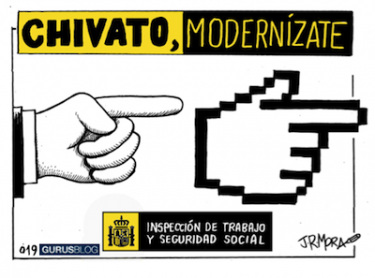
Spanish Government Complaint Box Causes Boomerang Effect

Cartoon by J.R Mora. Used with permission.
"The Spanish Minister of Employment and Social Security,Fátima Bañez, has launched a “complaint box” to combat workplace fraud.
 
The government is encouraging citizens to anonymously report cases of fraud committed by companies and individual workers for further investigation by the Office of Labor Inspection.

The “box” is a publicly accessible online form on the Ministry's website.

The move has sparked controversy in the blogosphere and on social networks, and created a boomerang effect against the Spanish government: the first complaints received through the new system were directed at the government itself and members of the political sphere, not at ordinary citizens as intended. 
 
Once again, the people have demonstrated their wit and humor while responding to government action.

The main criticism of the complaint box is that with it the government aims to make citizens into “snitches,” [or informers] creating an accusatory climate that is more like an authoritarian system than a democracy.
 
Critics also say that its real goal is to persecute the most vulnerable people in society instead of going after the country's wealthiest citizens tax evasion or alleviating unemployment.

The contradiction has not gone unnoticed: that those claiming to combat fraud are part of a government overwhelmed by massive corruption scandals and suspected of illegal financing of its party, the ruling People's Party (PP)."


Read more from Elena Arrontes' article on Global Voices here.

Friday, July 19, 2013

"How Europe's solution for the crisis is actually the problem "


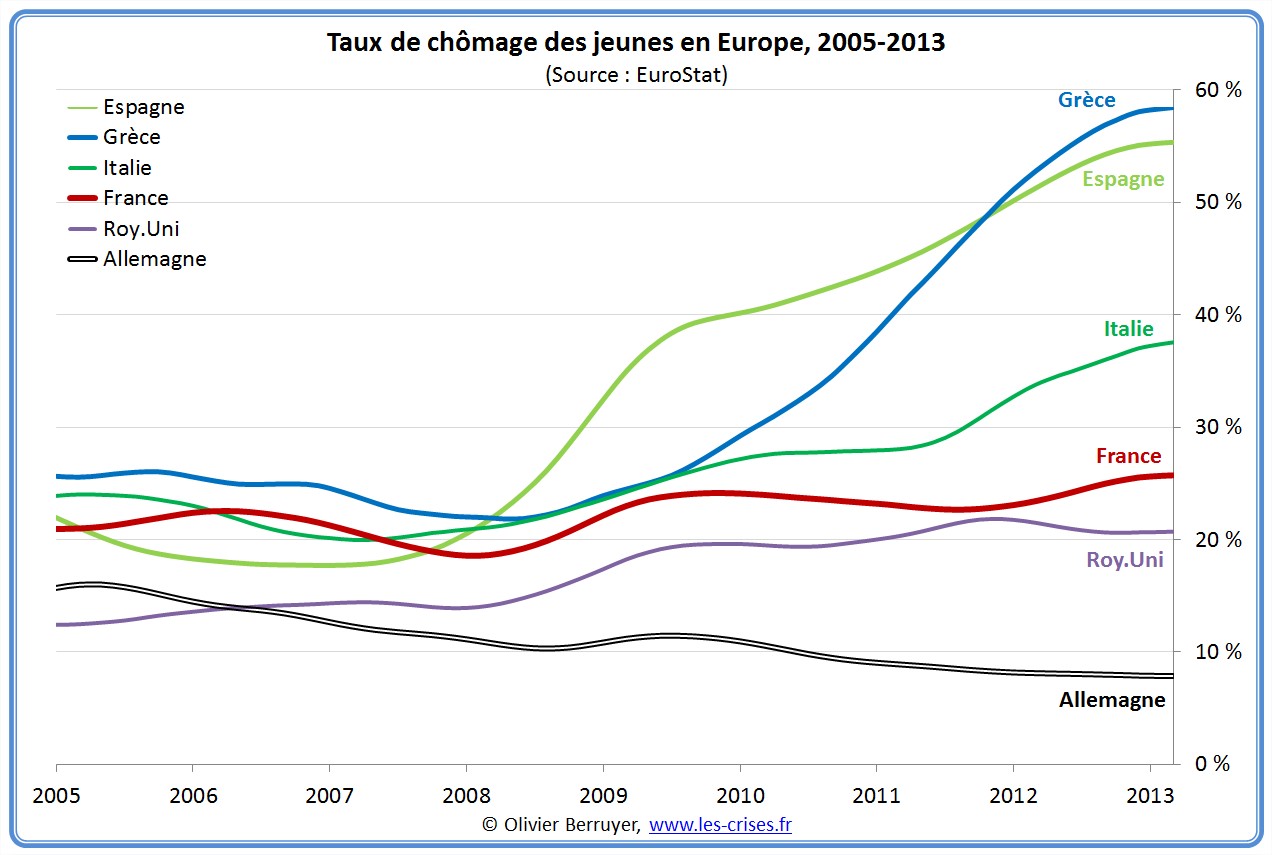
Le taux de chômage des jeunes en Europe de 2005-13 via Les crises, domaine public
[Youth unemployment rate in Europe between 2005-2013 via Les Crises – public domain]

"Europe's current crisis is more than economic. Between the German government advocating a dangerous austerity policy and European authorities lacking any other suggestions, it is clear that the 2008 financial crisis is no longer solely responsible for the downward spiral of Europe.
The GDP for countries in Europe has fallen by a considerable amount: 5.3% for Greece, 3.9% for Portugal, 4.1% for Cyprus, 2.3% for Italy, and 2% for Spain. This is without even mentioning the recession into which France is entering. In the first quarter of this year, the European Union economy contracted by 0.7%, or one percent when only taking into consideration the eurozone."

Read more from this Global Voices article here.


Monday, May 27, 2013

Spanish TV offers parents tips about how to dress their kids without being "provocative"

An astonishing program was shown on public TV recently.

Spain's main public television station channel 1 featured a workshop for parents on “how to teach their children to dress appropriately” in its daily afternoon update on May 14, 2013. Although the report was barely a minute and a half long, it featured soundbites such as “it seems we live in an era when everything must be shown” and “the big question: is my daughter dressing provocatively?”

I don't believe there's actually anything wrong with discussing what kids wear in this country.

I just think there are a lot bigger problems such as use of over-technology, bullying, commercialisation of young people or infantalising them.

This TV program raised the question of “provocative” dressing by young girls. There is certainly a de facto summer-time “uniform” of very short jean-pants for teens and some pre-teens and this is generally conformed to by plenty of this age group.

The issue to me is not so much whether this is somehow provocative but whether girls are simply dressing like other girls because they think they should. Following a fashion because others do is sheep-like and dangerous more because it shows a tendency to act without individuality than it is wrong to show bare legs.

It is so much easier to focus on what we can easily see, rather than investigate deeper, more serious problems that are not so apparent to the eye.

(As is so often the case, the commenters on this Global Voices article are also really worth a read.)


Thursday, May 9, 2013

Catalan aristocrat is "a link between North Korea and the world."

Alejandro Cao de Benós, born in Tarragona, Spain in 1974, is a descendant of the barons of Les in the Aran Valley in northern Catalonia, the earls of Argelejo and the marquises of Rosalmonte. Besides his rather unusual lineage, it is unlikely that his name would be widely known if this 39-year-old Catalonian was not an important foreign spokesperson for the North Korean regime.

Founder and president of the Korean Friendship Association (KFA), he is an honorary special delegate of the country, where he is known as Cho Son-il, meaning “Korea is one”. In an interview with Tribuna Popular he explained the origin of his relationship with the Asian country:

Sunday, April 21, 2013

Catalan outdoes “the majority language” in Spain's Wikipedia entries

Groups of enthusiasts in Catalunya have ensured something truly remarkable.


A study by Mark Graham (@geoplace), researcher at Oxford University...shows that 35,000 [*Wikipedia] articles have been created in Spanish territory with coordinates in Catalan, [compared to only] 19,000 in Spanish.

In other words, there are currently more entries for the whole of Spain in Catalan than in Castillian Spanish.

Also quite impressive is the fact that the Catalan language is ranked “first place in an index compiled by the Wikimedia Foundation, which measures the quality of the thousand most important articles.

The Catalan version of Wikipedia...has become central to the activism around the language...Àlex Hinojo, project manager at Wikimediacat and creator of@CatalanMuseums, says:
Many people say they edit because it's fun, they can provide more information about a topic…and they are building a country. Catalan-speaking civil society always maintains a certain activism in favour of its language, just as it does with other topics.


Note: To my mind, *Wikipedia is a sometimes unreliable source of information and can only be completely trusted when an article's sources are credible.


WikiMarathon at Drassanes Reials (Barcelona), on Wikipedia's 12th anniversary. March 2013. Photo by @Kippelboy.


Monday, April 1, 2013

Has a "European Spring" started?

Press conference in front of the office of the EU in Madrid. Photo from Desmontando Mentiras.

Last month,  "European citizens organized a week of protests against the austerity measures imposed on the countries of the European Union as a strategy for ending the economic crisis. Known as the European Counter Summit, it is [a] response to the European Summit in which European leaders gathered, and an occasion to make the voices heard of those citizens who defend a “Europe for the people and not for the markets“.

In Brussels, the protesters have chosen to bring their discontent to the European Council, while in Spain the Counter Summit week...culminated with a protest in the center of Madrid on Saturday, March 16."

More from Elena Arrontes' article at Global Voices Online here. 

Sunday, March 17, 2013

Immigrant badly injured after assault at festival

Moulaye Ndiaye. Photo by Jesus Cisnes from lasprovincias.es.
"Moulaye Ndiaye, a street vendor and native from Senegal, was thrown from a bridge on the eve of the 2012 Tomatina Festival in Buñol, Valencia, Spain. 


Moulaye was selling his products at the festival when a young man stole his sunglasses. After asking, without success, for the man to return them, Moulaye decided to leave, and then he was shoved and pushed over a bridge more than six metres from the ground. The backpack which he was carrying and the reeds growing in the area where he fell [probably]saved his life. 

He spent a month in intensive care at the Manises Hospital with traumas, several broken ribs and a spinal injury. The assault has caused him to lose sight in his right eye and a very serious neck and back injury has prevented him from working since.


In its blog, and on its Facebook wall, the Movement Against Intolerance seeks the help of those who witnessed the assault, asking them to make contact with the organisation so that the case can remain open, as the police have been unable to find the aggressor who escaped into the night. There has also been a large civilian mobilisation  which still continues, and the residents of the town of Buñol say they are horrified at this tragic event."

More details here at Global Voices online.

Saturday, February 11, 2012

The Grandparents Who Protest: the "Iaioflautas"


An inspiring group of older individuals who are proving the point that legitimate social protest in this country is not just limited to youth movements.


They call themselves “the children” of 15M despite the fact that the majority of them far exceed the age of 60, they are retired, they are “iaios” (grandparents, in Catalan) and they are veterans of long-term activism.

Celestino Sánchez [pictured above], Antonia Jover, Adrián Rísquez, and Rosario Cunillera are some of the members of the the “Iaioflautas,” a collective that emerged in Barcelona last October alongside the camping grounds in Plaza Catalunya. Its objective is to support the youth in their own way. But the fight, they assert, is the same: “for a dignified democracy by name and social justice against conspiratorial bankers and politicians.”

The “iaioflautas,” whose name was invented in solidarity with the “perroflautas” (gutter punks) — a derrogatory term with which the president of Madrid used to refer to the young occupiers — combine some of the methods they used in the anti-Franco, labor union, local or leftist fights with their learning about new technologies.

To summarize, they organize a “direct action” in the street once a month, almost in secret, and do not announce it on their Twitter account, @iaioflautas, or blog until it has already begun. That way, they avoid problems with the police.

The first event took place in November, when they occupied a Santander Bank office in Barcelona. The most recent one, called “Operation #RebelionBus,” occurred on Wednesday, February 1. Some 70 “yayos” (grandparents) arranged to meet in the very center of the Catalan capital and “hijacked” a bus in protest of the abusive increase in public transportation fares
.”

More text, pictures and video from Lali Sandiumenge’s excellent, in-depth Global Voices online article [translated by Marianna Breytman] can be read here.