Showing posts with label protest. Show all posts

Sunday, September 19, 2021

Brazil resistance documentary launch by Helios Molina in Barcelona


Filmaker Helios Molina says, "I'm presenting/launching a documentary along with a debate at the Athenaeum Enciclopedic at C/- Reina Amalia 38 (Raval) Barcelona on 30 Sept at 18.30. It is about how the extreme right entered Brazil and will be with various artists from Rio de Janeiro and the resistance. The doc is 1h08 + debate following on how to cope."

Saturday, March 20, 2021

"A bigger hassle" -- My latest opinion article for Catalonia Today magazine

[Pic: JOSEP LOSADA: Protesters in Barcelona]

Riots, disturbances, protests, brutal human rights violations, night-time shenanigans or “police-community liaison?”

The events that began immediately after the election here in Lleida, Barcelona and Girona (as well as Valencia and Madrid) can be called whatever you like.

But anyone who thinks that it’s all about something as abstract as freedom of expression is fooling themself.

Young and not so young people are marching, chanting, smashing shop windows, looting and doing the now routine burning of rubbish hoppers for much wider-ranging reasons than just the imprisonment of yet another rapper. That was merely a trigger.


Quite appropriately the other day, I was standing, for a change, not sitting, in my lounge room when I watched a young Catalan on Euronews TV intelligently selected by the editors possibly to give a more comprehensive explanation for why he and his friends ventured out into the cold and put themselves at risk of arrest or worse. (At the time of writing, another citizen had lost an eye from a rubber bullet.) 


The young man in a black face mask with both his eyes still good enough to show on camera, made a point that is entirely absent from most media reports and commentary. While all the action was going on behind him, he was intent on saying that Spain is the worst in Europe for youth unemployment, currently still over 40%. He could also have commented on under-employment as a chronic symptom here since the 2009 economic “crisis.” 


It’s no coincidence that some demonstrators focused their aggression and frustration on banks, destroying furniture and equipment after breaking in. As a symbol of capitalism’s failure for the average person there is no better target of what to smash up.


The pandemic has not created record cases of house evictions or already low salaries unchanged for more than a decade. It has simply made the system we live under more punishingly extreme.


One of the most relevant facts also in the background to the latest episode of “hit the streets and get hit” now applies to at least two generations of people.


Those who are my son's age (late teens, up to early 30s and my generation in our 50s) who are available to be “gainfully employed” simply are not put to good or fair use. This too breeds frustration. 


In my own case, for the last 9 months or so of the pandemic, the best that hyper-capitalism is offering to someone like me with two university degrees and two decades of experience in classrooms with adults and teenagers is that all we can hope for is a patchy timetable teaching little kids in China. Online for 10 euros or less an hour. 


In other words, anyone in a job is supposed to consider themselves lucky and be thankful for getting paid peanuts. Especially if you live in Barcelona, peanuts simply don’t pay the rent or the mortgage. That is also why huge numbers of adults under 30 continue to live in the family home.


Equally, there’s one other crucial element that has hardly been reported. The jailed rapper in question (whose name may as well be spelt hassle, not Hasel) has also criticised [alleged] previous torture and death of demonstrators and migrants, aside from his lyrics about the corruption of those higher up our economic and social food chain.


Plenty of local people know that. It motivates them. 


So why is this not being stated in media outlets who can get away with exercising freedom of expression? 


[This article was first published in Catalonia Today magazine, March 2020.]


Sunday, October 25, 2020

"Man of protest: Xirinacs" -- My latest opinion column for Catalonia Today magazine


Pic: Fundacio Randa LL


Do a Google search (or to my preference, a much more private search on DuckDuckGo.com) for Lluís Maria Xirinacs i Damians in English and you’ll find a decent but short Wikipedia page on him and precious little else. None of his books have ever been translated into English either. 

So, why bother knowing anything about this man? Why should history remember him? Because Xirinacs led a fascinating, varied and ultimately controversial life. A truly unique life. 


Seemingly he is best known in Catalonia for being nominated three times for the Nobel Peace Prize. This was mainly due to his 12 hours a day, solitary, standing, human rights protests outside the Modelo prison in Barcelona during the last decade of Franco’s dictatorship. There, Xirinacs was regularly arrested after being beaten by the police or right wing thugs. 


I spoke to a good friend of mine, one of his former philosophy students. He gave me personal insights I didn’t expect. This is what he told me: 


“Xirinacs was an intellectual academic, a really good teacher. He’d quit being a priest. We’d have big arguments together about Nietzche or Socrates, getting very heated with each other. Two Latins just working it out, I suppose.


During his life Xirinacs was a big supporter of independence for Catalonia but plenty of people here had doubts about him too. He was sentenced to prison near the end of his life for making public statements in favour of ETA, the terrorist group from the Basque country. He gave a speech at that square where they do the annual national memorial at the eternal flame and he basically said that he didn’t agree with any kind of torture but that he was an enemy of the Spanish state and a friend of ETA because their soldiers have to live like secretive rats, in hiding with no girlfriends or children and that they give public warnings before they blow up areas where ordinary people are.


Of course, that contradicted the pacifist views he’d had all his life and in his teaching of Gandhi-style non-violence strategies. 


When Xirinacs was an older man, in his seventies, he said to a small group of his other students, “One day you’ll find my body in the forest.” We didn’t know if it was a hint that he was going to commit suicide or whether he thought he was going to be seized and taken out there to be shot. 


The official autopsy [in 2007] found that he died from natural causes. I accept that because they discovered a note on his desk bitterly criticising Catalan politicians and previously he’d talked to us about Eastern philosophies of wasting away in more of a long, peaceful meditation out in nature.


The funeral at Santa Maria del Mar cathedral was something else too. The head monk from Montserrat, he stood up and said, “Xirinacs was a great model for everyone; a fine example of what we can be in life…but not in death. At that moment, everyone in the church and outside too, started clapping, applauding really loudly. The crowd were drowning him out and also applauding Xirinacs. Maybe. Probably.  


After a minute, the Abbott tried to calm the crowd but they just went on clapping; five minutes, ten minutes; they finally stopped at twenty minutes. That noise was their protest in favour of a great protester.”


[This article was first published in Catalonia Today magazine, October 2020.]


Sunday, December 15, 2019

"Generation Precarious" -- My latest opinion column for Catalonia Today magazine

[Photo: Oriol Duran]

I saw the best minds of my generation being dog-walkers or asking ’Would you like fries with that?’”

This may well be the sentiment of plenty of young people under the age of 30 across the developed world. 
Certainly, I include Catalonia, and especially those who camped across Barcelona’s main street of Gran Via and into the public square in front of the University of Barcelona.
Yes, they had other issues too that are important to them: the jailing of independence movement leaders, police brutality against protesters, increasing legal restrictions on free expression, but one of their other three stated aims was “a dignified future.”
It’s worth considering what this means. I see no reason why we should simply ignore the different groups who made up the “encampment”. 
When I visited the area in early November I saw groups of surprisingly youthful-looking kids being politically active. Some were in their mid-teens but were confident and obviously happy to be there. One young woman I spoke to had a makeshift stall that was all about a red plastic rubbish bin and her own writing I read was a vague and confusing attempt at satire. Another group were encouraging tweets as a method of expression where you could win a prize.
It’s difficult to argue though, with much of what the main section of the Gran Via campers have said. 
Calling themselves the ‘October 14 Generation’, their manifesto states, “We are a generation without a future. The generation of precariousness. The one that does not have access to housing, the one that is the victim of a system that threatens the very existence of our planet. We are a generation that has been robbed of the most basic social and labour rights.”
To me, that is all clear and true. Only someone living with their eyes closed could dispute it and in fact the far right continue to dishonestly and selectively use these young people’s sense of frustration and alienation for their own political benefit all across Europe.
Of course, it’s easy to write off the street-campers as just some university student vandals and fire-starters who are abusing the privileges that they’ve been given. 
Sadly, even a great writer and thinker such as Antonio Muñoz Molina (considered to be progressive) did this in a recent article for El Pais newspaper. His comments seem to have at least partly come from jealousy when comparing his own strict upbringing compared to “the academic authorities’ paternal and maternal indulgence” over these students’ postponed exams.
To make a comparison, I originally come from a part of the planet (Australia) where the level of political interest in most of the population, but especially the young, could best be described as minimal. In fact, apathy rules. 
I’m filled with optimism (rare for me) when I see young people taking a strong interest in anything outside their own narrow lives, even if I don’t happen to agree in all cases with everything they are on about. If any protester anywhere uses violence against people or private property then I naturally condemn it.
History has taught us that for protest to gain enough popular support to cause meaningful, long-term, lasting change it has to be non-violent. If that means camping out in a public square and main street, then that is a far more humanitarian option than us attacking each other with sticks. It might even help to foster a future that is less unstable.

[This article was first published in Catalonia Today magazine, December 2019.]

Thursday, August 1, 2019

VIDEO: Ursula Le Guin on capitalism and writing


"authors who can see through our fear-stricken society..." "sales departments given control over editorials" " the profit motive is often in conflict with the aims of art"
"We live in capitalism, its power seems inescapable – but then, so did the divine right of kings. Any human power can be resisted and changed by human beings. Resistance and change often begin in art. Very often in our art, the art of words".

(Thanks to Jennifer Camacho.)


Saturday, January 12, 2019

"Belgian-Canadian student faces up to 8 years in prison after protest in Hungary"

"A Belgian-Canadian university student and DiEM25 member is facing up to eight years of jail-time after being arrested during a spontaneous protest in front of the Hungarian Parliament on the evening of December 12.

Adrien Beauduin, a PhD student in Gender Studies at Central European University, was arrested along with four other protesters, who are all being charged with collective assault on a public official. Police charges allege that all five who were arrested, including Beauduin, used their left arm to strike a police officer and then kicked in the direction of a police officer.
According to videos and photos from the event, as well as witnesses present, Beauduin did not attack any police officers. Available video footage of the demonstration shows him standing calmly before being swept up when police charged the crowd.
“I am being charged with a very serious crime that I did not commit,” says Beauduin. “I am afraid for my future and the future of my fellow protestors.”
If found guilty of the police charges Beauduin will face a prison sentence ranging from a minimum of two years to a maximum of eight years."
Read more from source (and donate to help) here.

Friday, September 28, 2018

"Crimes of solidarity’ in Europe multiply -- 11 stand trial in Belgium for helping migrants"

[The September 6, 2018, trial of 11 people who have helped migrants in Belgium has attracted a number of protesters. Photo: Melissa Vida. Used with permission.]
 "Eleven people who had been arrested and charged with human trafficking in October 2017 appeared in court in Brussels on September 6, the first hearing of a trial that activists say is yet another case of “criminalization of solidarity” in Europe.

The defendants have allegedly assisted 95 undocumented migrants, including 12 minors, to travel from Belgium to the United Kingdom last year, either by hosting them in their homes, by lending them phones and thereby indirectly helping them cross the channel.
On the day of the trial, three hundred people protested in front of the courthouse. Demonstrators say this is a political trial, aimed at dissuading people from helping migrants by establishing an intimidating judicial precedent.
The defendants are two Belgian journalists, one Belgian-Moroccan social worker, a Tunisian man who is a legal Belgian resident and seven people who are undocumented migrants themselves. Eight of the defendants have been in jail since the arrest.
Belgian law states that there must be a monetary transaction involved for an act to be framed as human trafficking, something the defendants deny ever happening. However, the relationship between the migrants and their helpers seems to fall into a legal grey area, raising fears that the law's scope is unjustly being expanded to target activists.
Myriam Berghe, one of the two journalists, said in an interview with RTBF (Belgium's public service broadcaster) that she's received money on behalf of a migrant she was hosting. The migrant in question had been sent money from abroad via Western Union, Berghe says, but had no way of collecting it due to having no papers. What for Berghe was simply an act of kindness, in the eyes of the authorities was payment for smuggling.
In the same interview, she explains that despite some of the people she's hosted being smugglers themselves, she wouldn't consider them “human traffickers...”
Read more from source at Global Voices here.

Tuesday, August 14, 2018

Pulido - A quality Barcelona rapper (first heard on a RENFE train)


Me está rentando no ver na, entre las sombras y la oscuridad, hay pequeñas luces que se escapan, se que la vida lo devolverá, pues ella sin dudar es más trampa que trap, oh no, no me jodas con esas barreras, estamos infectaos por las monedas/ ay, ya no nos queda otra, romper con la ilusión hasta que se nos desconozca, quiero libertad sin ataduras, quiero que tu alma sea robusta en la penumbra, hasta que llegue la soledad de la tumba, donde el alma flote en universos de tundras, Me cansé de mirar en el vacío del mal, ahora debo salir ahora tengo otro plan, mi reflejo de ti, tu reflejas en mi lo que reflejo de ti, es un espejo bestial, Si pudiera verme de verdad, atravesaría mi otra mitad hasta que fuera necesario parar, y no te quiero contar, mas de lo que debo entregar, me cuesta reaccionar/ es abrirme en canal. Atravesando lo desconocido, necesito vivirlo, poner los cinco sentidos en esto, hasta que pare el tiempo, hasta conseguirlo hasta que me pellizque y no me vea dormido. Jugais todos al mismo juego y ya estoy cansado y aburrido a mi me aviva la llama cuando se enciende el sonido, y estoy perdido, entre las posiciones del destino si resumo mi camino en esos astros y su brillo Se que eres parte del todo, y no puedo sentirme separado, de ti ni de ningun humano, aunque sea malo, lo que guarda encerrado en su interior es solo causa del dolor acumulado. Experiencias tan grises que le han traumatizado, recuerdo a little supa y me hago serio en este tramo, pues vamos, a hacerlo negro como canserbero, asi estamos, desde que al amor se le asoció significado. Y yo de lado a lado, mirando todo alrededor siento mi mano, helada como páramo lejano, hay sitio para el amor estigmatizado, sin esquematizar la libertad de un compañero alado Ay,,, no no no, llega el final, siento mi voz, el corazón se me va apagando pero la esperanza sigue brillando(x2) 

Saturday, August 11, 2018

'Empathy is a political value' -- "Barcelona’s Experiment in Radical Democracy"

[Barcelona Mayor Ada Colau -- Photo: Paolo Verzone/Agence VU/Redux]


"Barcelona City Hall looks like it’s been occupied by protesters. 

A banner over the entrance to the fourteenth-century building reads, in Catalan, “Free Political Prisoners”—a reference to Catalan pro-independence activists, some of whom have been prosecuted while others were forced into exile by the national government in Madrid.

The banner was placed here by the city government, which is indeed run by protesters: the ruling coalition of Mayor Ada Colau has its roots in the Indignados, the anti-austerity movement that’s often referred to as Spain’s precursor to Occupy Wall Street. (Colau is not herself a supporter of Catalan independence; more on that later.)


Barcelona is the heart of a new global political phenomenon known as municipalism. Last weekend, municipalist activists from North America, Europe, and Africa met in New York City for the third Fearless Cities summit. (The first took place in Barcelona, last year, and this summer there were summits in Warsaw and New York on subsequent weekends in July.) 

Municipalism is hard to define, intentionally so. Municipalist activists aim to break the bounds of traditional party politics and challenge institutional politics as they currently exist, making the language of party and institutional politics a priori insufficient for describing them.

I was in Barcelona in June and interviewed several of the key members of Barcelona en Comú, the “platform,” as its participants call it, that brought Colau and her coalition to City Hall, in June, 2015. Barcelona en Comú, in turn, is part of a wave of what has been dubbed “municipalist confluences”—new formations that have emerged from activist movements in Madrid, Cádiz, and elsewhere in Spain.

For the activists, entering institutional politics was something like a measure of last resort. “We have tried everything,” Gala Pin told me. Pin began her work as an activist as a member of an anarchist collective that squatted in a disused building in Barcelona and then, after the 2008 housing crash, she worked as an anti-eviction activist. “We have tried civil disobedience. We have tried negotiating with banks. Nothing works. We have to join institutions in order to change the way we make policy.”

Colau, like Pin, was best known for her activism on behalf of people displaced by Barcelona’s real-estate and tourism boom and the crisis of 2008. Another prominent voice in Barcelona en Comú, Marta Cruells, a feminist political scientist, was a professor at the Autonomous University of Barcelona before she went to work at City Hall. According to Vicente Rubio-Pueyo, a Fordham University professor who has written a think-tank report on Spanish municipalism, this is typical of municipalist confluences: they consist “mainly of a young, urban and precarious ‘cognitariat’ ”: academics, artists, and journalists, among others. 

This makes the municipalist trend look like the direct opposite of the right-wing populist movements in Europe and the United States. Stateside, the Spanish municipalists are in conversation with organizations such as the James and Grace Lee Boggs Center, in Detroit, a rare group whose community-organizing efforts have explicit philosophical roots.

The municipalist agenda is intentionally broad; it’s based, as Pin puts it, on common goals rather than differences. As overgeneral and even naïve as that may sound, it has practical implications: municipalism is not trying to distinguish itself from other political parties, in part because it’s not itself a party. Municipalist programs tend to be focussed on the specific needs of a city’s residents and specific programs that address them. 

In Barcelona, much of the program is focused on regulating tourist industries in order to improve the lot of local residents, but also to restore some of the city’s particular character that has attracted tourism in the first place.

As the name makes clear, Barcelona en Comú is focussed on the commons. Colau speaks of the importance of public space often and articulately. “Public space is the place, par excellence, for democracy: this space that belongs to all of us,” she told me. “Therefore, this is also the space of the most vulnerable people, which is what democratic systems should prioritize: the people who have fewer opportunities. If you have little private space, you have more public space and public services—libraries, beaches, parks. It is the space to meet with others, but also it’s a space where you can be who you want to be—this is the space for freedom. And, therefore, it is a space where you can build up the city with others. So, from that point of view, the more public space there is, and the better its quality, the better the quality of the democracy.” 

Colau’s government has pushed experiments in community management of space and resources, such as handing over public buildings to local communities. Barcelona is launching a publicly held energy company that will supply energy to municipal buildings.

A central aspect of municipalist politics, and also, perhaps, the hardest to define, is a focus on what is called the feminization of politics. “Knowing that emotions and affects are very important in politics” is part of what feminization means, Pin said. “Men don’t say that. Empathy is a political value.” 

Pin’s work in anti-eviction activism is an example of politics that placed emotions at its center. The Barcelona Housing Platform holds open assemblies to which people bring their cases. “The last platform [assembly] we had, this Colombian woman said, ‘When I came here, I wanted to commit suicide, and since then, I have realized that it’s possible to survive and keep my place and negotiate with the bank,’ ” Pin said. “And other people recognize themselves in it. It’s the biggest expression of dignity I have ever seen. I cry every time—these are tears of dignity.” Pin was crying.

...In 2016 [Ada Colau] joined the former Greek finance minister Yanis Varoufakis in launching DiEM25, a movement that aims to rejuvenate the European project..."

Read more from source at The New Yorker here.

Saturday, July 28, 2018

Video: "One of Europe's last primeval forests crumbles in the hands of the Polish government"


"For two and a half years, environmentalists have waged a war with the Polish authorities for Białowieża Forest, a UNESCO World Heritage Site and one of Europe's last and largest remaining patches of Europe's original primeval forest.


In April 2018, the European Court of Justice, the EU's highest court, ruled that Poland violated EU laws by logging in the forest, imposing fines of a minimum of 4.3 million euros (five million US dollars), potentially rising to 100,000 euros a day, if the felling doesn't stop.
In March 2016, former Polish Environment Minister Jan Szyzko, a member of the [right-wing] Law and Justice party who's backed by forester lobbies, approved tripling the amount of wood that could be harvested from Białowieża, allegedly to combat  an infestation by the bark beetle. 
In July, a handful of Polish environmental organizations filed a formal complaint to the European Commission, which then sued Poland in the EU Court of Justice.
Straddling the border between Poland and Belarus, Białowieża includes extensive undisturbed areas and is home to a rich wildlife of which 59 mammal species, including the European bison. 
But while on the Belarussian side over 80 percent of its extension is circumscribed under a national park, only 17 percent of Poland's forest enjoys a similar level of protection.
Watchdog environmental organizations say at least 160,000-180,000 trees have been felled since Szyzko's 2016 new management plan.
Neglect for the environment is an issue touching all corners of Eastern Europe. In Romania, Greenpeace estimates that three hectares of trees are lost every hour in the Carpathian mountains, also home to one of Europe's last patches of primeval forest. In Slovakia, official declarations that forests are growing undermined by aerial photography.
In Poland, Szyzko was eventually sacked in January 2017, only days after another controversial bill which he had sponsored was approved in parliament. The bill removes the obligation for private landowners to apply for permission to cut down trees or to inform local authorities that trees have been or will be removed.
The new environment minister, Henryk Kowalczyk, agreed to comply with the EU’s decision, but controversy still surrounds his administration. In May, he established a team to envision a long-term plan for the forest, including plans to replant the logged areas, which environmentalists claim could do more harm than good.

The protests

In May 2017, protestors established a permanent camp in the forest, often chaining themselves to harvest machines. The settlement, organized on a bottom-up basis, encouraged the development of online petitions and international awareness.
The situation detonated when some protestors were forcibly removed from the area, in handcuffs, by the Forestry Corps, and a legal ban was put in place to forbid entry to certain parts of the land. By the height of 2017 Summer, the Environment Ministry had declared any opposition to logging would be seen as political opposition.
As Poland’s state media, which had been increasingly subject of intervention by the government of the conservative Law and Justice party, began to attack these protests with vitriol, campaigners decided to season their message with patriotic sentiment, promoting a message of national heritage that is in line with the party's ideas.
A digital 3D model of the forest, produced by a collaboration between Greenpeace and Minecraft, allows players to explore Białowieża complete with biodiversity and weather patterns. Called “To the Last Tree Standing”, the game eventually removes the trees from players’ sight without warning, leaving them scrambling to find the last one."
Source at Global Voices here.

Friday, July 6, 2018

Civil war in Poland?

[Protesters demonstrate in support of the sacked Supreme Court judges.Photo: Getty] Photo: Getty
 "On Monday, the European Commission, the executive arm of the European Union, referred the case to Europe’s highest court, but Poland has a month to respond, and any ruling might come too late to stop the overhaul.
When [the] Law and Justice [party] came to power, it campaigned against what it saw as a corrupt bureaucracy, calling for Poland to “get up from its knees”. But for Mr Kaczynski, transforming the courts was always a central goal.
When his party was in power from 2005 to 2007, many of its legislative efforts were blocked by judges. He came to believe that the transition to democracy that started in 1989 was flawed because many former communists were allowed to hold on to their positions. Although the number of people from the communist era still in judicial positions has dwindled, the party says that communist thinking still infects the system.
So when the party returned to power in 2015, it moved swiftly to rebuild the judicial system. It stacked the Constitutional Court, which decides if legislation violates the constitution. Once that court was under the party’s control, its lawmakers passed a series of measures aimed at other parts of the court system.
But their first effort to reshape the Supreme Court, a year ago, was met with widespread protests. The government backed down.
Last winter, it proposed new measures, slightly watered down, that critics said would have the same effect — turning the Supreme Court into an instrument of the party.
In December, after a devastating report by the Venice Commission, which monitors rule-of-law issues for the European Union, the bloc of nations invoked Article 7 of its founding treaty to take action against Poland. It became the first country in the history of the union to be threatened with losing its voting rights.
This time, however, the government would not be deterred.
Under the legislation, Mr Duda can grant exemptions to the mandatory retirement age, but judges must ask him to do so. The president did so for Mr Iwulski on Tuesday.
Ms Gersdorf and many colleagues refused, setting the stage for the standoff on Wednesday morning.
The country’s deputy minister of justice, Michal Wojcik, told the Polish Press Agency that Ms Gersdorf had been allowed into the court because no citizen is barred entry, but he said she would not be allowed to rule on cases."
– New York Times  [sourced from The New Daily here.]

Friday, January 5, 2018

"Reclaiming the commons" -- an interview with veteran land rights campaigner George Monbiot

"Guy Shrubsole speaks to veteran land rights campaigner George Monbiot...

Movements for land reform in the British Isles have ebbed and flowed for centuries. Each new wave can seek to learn from the past - or be destined to repeat its mistakes. The Land senses that the past year has seen a fresh flowering of public interest in land issues - sparked by the ongoing housing crisis, the Grenfell Tower disaster, debates about farming post-Brexit, and other factors. It’s a good time to take stock, so this section brings together voices, new and established, to make sense of the current moment and lend momentum to a new, rising land movement. It features veteran land rights campaigners George Monbiot, Marion Shoard, and Andy Wightman, includes a graphic history of UK land movements, and an assessment of land value capture as a mechanism for economic fairness, before introducing a representative of the Other Side, and some of the activists and organisations of today’s land movement. 

GS: What first got you interested in land and land rights? 

GM: I was working in Brazil in the late 1980s, and I was interested in why so many people were moving into the Amazon, often with quite damaging impacts on the rainforests. It didn’t take me long to see that people were being effectively forced to go because their own land was being stolen from them in their home states. A group of very violent businesspeople supported by the Government were seizing the land owned by peasant communities. People with indigenous roots often going back millennia, but who didn’t have written, legal title to their land; rather it had been held by them in common for a very long time. There were people being killed left, right and centre; there was a bishop who was murdered. I spent long enough there to get beaten up myself by the military police. Then after six years of working in Brazil, West Papua and East Africa, I returned to Britain, and was persuaded by some of my friends to go along to Twyford Down, where there was this huge dispute over a road being driven through beautiful chalk downland and Iron Age remains. And as soon as I got there I thought, this is what I’ve been seeing in Brazil. This is a land dispute over land massively valued by local people, being taken from them by an outside force – in this case, government combined with a huge construction company, and everything that people value here being destroyed. I started reading the poems of John Clare, and saw how his early poetry documented the rich life of the community in which he was brought up, and the way their lives were granted meaning by the land, spiritually, ceremonially, economically, socially – and then his later poems, like The Fallen Elm, documenting the destruction of that entire system through enclosure. And I realised that this was exactly the same process that I’d seen happening amongst indigenous people in the three continents in which I’d worked. Alienation and anomie leading to psychic rupture. And then I realised that what I’d witnessed there is still with us here, in Britain today. 

GS: In 1995 you wrote A Land Reform Manifesto, in which you criticised a huge landowning estate for selling off its land for the Newbury bypass to be built. At the time you said a landed estate’s “power to treat its property as it wishes is scarcely restrained. It is this that lies at the heart of our environmental crisis” . Do you still believe that? 

GM: Well, I would take it further. Land as an issue has to be painfully uncovered, because it’s so successfully hidden from us. Hidden in a thousand ways – hidden by the media, obviously; hidden by economics, which discusses land as if it were any other form of capital, a great methodological mistake; hidden by the power of patrimonial capital. It’s not just the power of the great estates to do as they will; my thinking’s gone way beyond that – it’s the conversion of broad possession into narrow property in general. It’s the almost complete closure of a whole sector of the economy, the commons, and its replacement by both state and market." 


Read more from The Land Magazine [PDF] here.

Saturday, November 4, 2017

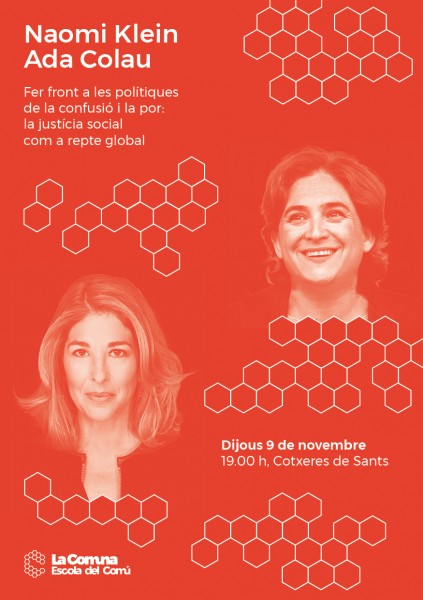
Colau and Klein debate in Barcelona: "Facing the politics of change and fear"

This Thursday the 9th of November at 7pm the Barcelona Mayor Ada Colau and progressive international author/journalist Naomi Klein will be speaking together.

In a very timely moment for this part of the world in particular, the organisers say that "the starting point of this debate will be the imposition by antidemocratic powers of global policies that challenge our lives, our security and survival..."

The event is open to all the public but seating is limited to 700 people. It will also be broadcast live on their  Facebook Live and the YouTube channel of La Comuna, Escola del Comú. There will also be a simultaneous translation service and translation into sign language.

Location:


Auditori de Cotxeres de Sants
Carrer de Sants, 79
L1 Plaça de Sants; L5 Sants Estació