Showing posts with label public life. Show all posts

Tuesday, February 14, 2023

"Grabbing Granados" – My latest article for Catalonia Today magazine

[This article* was first published in Catalonia Today magazine, Feb. 2023.]

The Barcelona street named after Granados. ANDREU PUIG.

A huge boat is sinking in The English Channel. A man is clinging on to the side of a tiny raft, only big enough for one woman to kneel on. Soon, both drown in sight of other passengers.

According to witness Daniel Sargent, this is what happened to Catalan composer and pianist Enric Granados i Campiña and his wife Amparo Gal, who was too heavy to get into a lifeboat. Granados apparently refused to leave her alone in the sea and tragically on March 24, 1916 their six children became orphans.

In this ill-fated transatlantic crossing, returning from a tour, the boat they’d been on (the French-flagged Sussex) was mistaken for an enemy minelayer craft and torpedoed and sunk by the Germans. Only days earlier Granados had been playing piano in the White House for US President Woodrow Wilson.

Born in Lleida in 1867 and the son of a colonel (originally from Spanish Cuba) and a Galician mother, at the age of 10 he began to study music and gave public concerts in his hometown (though his first major recital was in 1890, when he was 23 years old.) Still a child, he moved to Barcelona and was enrolled at the Escolania de la Merced.

As is so often the case though with historical figures, myths and disagreement surround important areas of Granados’ life. The financial impact of his father’s premature death at just 57 is unclear but it seems likely that his mother received the correct widow’s military pension and kept the wolves from the door in this way.

What is known is that Enric got a job playing piano for five hours a day at the Café de las Delicias, but around the time he moved his ivory tinkling gig to the Café Filipino, the Catalan impresario Eduardo Condé was also funding him to a very pretty tune as music teacher of his children.

In fact, many of the best Catalan pianists of recent times came out of the music academy in Barcelona that bore Granados’ name. The institution became a centre for a theoretical-practical method for piano pedals that Granados had developed from the teachings he’d held onto from living in Paris two years before.

His masterpiece as a composer is the suite for piano “Goyescas” (1912-14) inspired by works of the Spanish painter Francisco de Goya. Partially first performed at the Metropolitan Opera House in New York, it helped lead to his White House triumph. Despite these kinds of success, Granados went on to suffer from extreme stage fright later in his performing life, according to one source, even begging that he not be forced to play.

I wanted to know more about this man with the fruity name, his name having been given to one of my favourite streets in the Catalan capital. With only one slow lane of traffic, it’s a gently sloping oasis of near-calm and almost-quiet when all around is everything but that, lined with superb restaurants and quaint little speciality shops or delis at both ends.

I grab any opportunity to walk up or down this street. Sometimes I go out of my way to be on it, a part of it, while I think about the man too these days.


[*Most likely this will be my final piece for Catalonia Today magazine. Apparently for economic reasons, it has been cut in half: down to just 32 pages. This means independent journalists who are not directly employed have been also cut. I wrote for them between 2008 – 2023 and would like to thanks all those involved in the production of the publication.]

Friday, December 31, 2021

In 2022: "Spain's beaches are now smoking free zones"


[A beach in Sanxenxo, Galicia © Xurxo Lobato / Getty Images]

"Spain is the first country in Europe to ban smoking on all of its beaches after the government passed a new law following a public petition.  

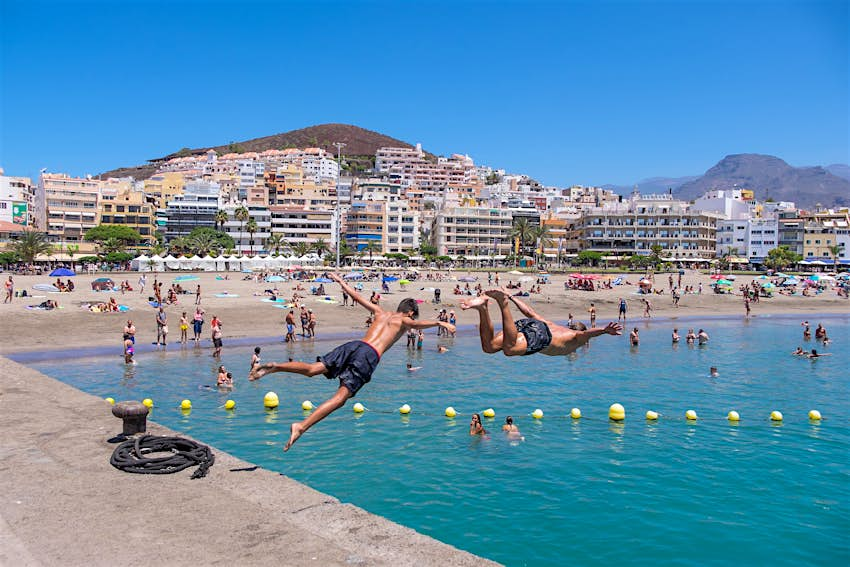
From now on, anyone caught lighting up on a beach is set to be hit with a hefty €2000 ($USD 2258) fine. A ban is already in place in Barcelona and the Canary Islands, where smoking on popular tourist beaches is prohibited.

A petition in Spain that led to the smoking ban 

The move comes in a bid to clean up pollution on the country’s 3000 miles of coastline. The new law passed on December 23 followed a petition of 283,000 names demanding action on beach pollution was handed to the Spanish government. Cigarette butts are a hazard on many beaches, as they contain non-biodegradable plastic polymer. The European Environment Agency found cigarette butts among the most common items littering Europe's beaches. As well as contaminating the soil, they are also extremely harmful if swallowed by sea life. Sardinia in Italy and some areas in southern France have already banned smoking on their beaches.

shutterstockRF_1465537337.jpg
 [Los Cristianos in the Canary Islands where smoking is already outlawed on beaches © Salvador Aznar / Shutterstock]

Spain's other bans on smoking

In 2020 in a bid to curb the spread of COVID-19, Spain banned smoking in outdoor public spaces where people can't maintain a social distance of at least six feet. Galicia, in northwestern Spain, first introduced a ban on smoking in streets, bars and restaurants and this was adopted by the country’s health minister and brought in nationally.  

Read more from source at Lonely Planet here.

Sunday, May 30, 2021

"Backlash for Spain's postal service anti-racist campaign"


Backlash for Spain's postal service anti-racist campaign - YouTube

"Spain's postal service is feeling a backlash from its attempt to highlight racial inequality after releasing four stamps of different skin colour and different values."

Maybe if they'd consulted with people of colour before the campaign it could have all been different...

Saturday, February 22, 2020

"Street photographer documenting Madrid's invisible population"

"When Michael Damanti, a photographer from the United States, moved to Madrid five years ago with his Spanish wife and two children he expected to make a bunch of new friends in the new city...

'In 2015 I was an outsider in this country, trying to learn the language and find work. A chance encounter soon changed that, forming the beginnings of a long-term photographic series about Romani population in Europe,' he told The Local.

'Walking home one day from another disappointing day of cliche photos, I came across a Roma Girl sleeping on the ground holding an old change cup. Her name was Sibella. I knelt down to take her photograph and as I stood up I noticed another Roma-girl walking right towards me saying, "What are you doing? That is my sister!" That was the day I met the "Cobadin-Girls of Sol".


“Over the next four years I met with them every day, carefully documenting their story and gradually becoming absorbed into their lives. We have been through births, deaths, arrests, fights and the day to day struggles we all endure.”

What he has produced is a remarkable set of photographs of a group of people who are at best invisible to society and at worst, the frequent targets of abuse.

At first, he approached them with handmade signs with witty slogans, such as 'freewifi' and '#Brexit: Keep calm and give me money' to replace the ineffectual ones they had written themselves.
“This was the way into their lives, I noticed their signs were incredibly long (5-6 lines) and 100 percent trite and boring.  No one was reading them. So I offerend alternatives, lighthearted signs with quick simple messages in English for the tourists. This began the friendship.”

Read more from Fiona Govan's article at the Local.es here.


Sunday, November 24, 2019

"Barcelona launches the Brexit Information Point for citizens and businesses"

 "The Barcelona City Council launches the Brexit Point, a fixed and face-to-face service point in the Business Support Office, in the MediaTIC building, aimed at citizens, companies, freelances and talent to answer questions on the possible opportunities and consequences of the United Kingdom’s exit from the European Union.
This information point works by appointment and from 8:30 a.m. to 6:00 p.m. from Monday to Thursday and from 8:30 a.m. to 2:30 p.m. on Fridays to:
  • Assisting citizens and working for the retention of international talent: clarifying doubts and reducing the concern of British citizens living Barcelona.
  • Building loyalty and retention of investments and projects: informing British capital companies that operate in our territory and other people or organizations that may be affected by the impact of Brexit.
  • Attracting investments and international talent: helping companies that want to establish in the city as a result of the UK’s exit from the EU.
This new service is launched by the Barcelona City Council, in coordination with the Embassy of the United Kingdom in Spain through the British Consulate General in Barcelona and the Ministry of Interior through the Government Subdelegation in Barcelona."

Read more from source here.

Saturday, August 11, 2018

'Empathy is a political value' -- "Barcelona’s Experiment in Radical Democracy"

[Barcelona Mayor Ada Colau -- Photo: Paolo Verzone/Agence VU/Redux]


"Barcelona City Hall looks like it’s been occupied by protesters. 

A banner over the entrance to the fourteenth-century building reads, in Catalan, “Free Political Prisoners”—a reference to Catalan pro-independence activists, some of whom have been prosecuted while others were forced into exile by the national government in Madrid.

The banner was placed here by the city government, which is indeed run by protesters: the ruling coalition of Mayor Ada Colau has its roots in the Indignados, the anti-austerity movement that’s often referred to as Spain’s precursor to Occupy Wall Street. (Colau is not herself a supporter of Catalan independence; more on that later.)


Barcelona is the heart of a new global political phenomenon known as municipalism. Last weekend, municipalist activists from North America, Europe, and Africa met in New York City for the third Fearless Cities summit. (The first took place in Barcelona, last year, and this summer there were summits in Warsaw and New York on subsequent weekends in July.) 

Municipalism is hard to define, intentionally so. Municipalist activists aim to break the bounds of traditional party politics and challenge institutional politics as they currently exist, making the language of party and institutional politics a priori insufficient for describing them.

I was in Barcelona in June and interviewed several of the key members of Barcelona en Comú, the “platform,” as its participants call it, that brought Colau and her coalition to City Hall, in June, 2015. Barcelona en Comú, in turn, is part of a wave of what has been dubbed “municipalist confluences”—new formations that have emerged from activist movements in Madrid, Cádiz, and elsewhere in Spain.

For the activists, entering institutional politics was something like a measure of last resort. “We have tried everything,” Gala Pin told me. Pin began her work as an activist as a member of an anarchist collective that squatted in a disused building in Barcelona and then, after the 2008 housing crash, she worked as an anti-eviction activist. “We have tried civil disobedience. We have tried negotiating with banks. Nothing works. We have to join institutions in order to change the way we make policy.”

Colau, like Pin, was best known for her activism on behalf of people displaced by Barcelona’s real-estate and tourism boom and the crisis of 2008. Another prominent voice in Barcelona en Comú, Marta Cruells, a feminist political scientist, was a professor at the Autonomous University of Barcelona before she went to work at City Hall. According to Vicente Rubio-Pueyo, a Fordham University professor who has written a think-tank report on Spanish municipalism, this is typical of municipalist confluences: they consist “mainly of a young, urban and precarious ‘cognitariat’ ”: academics, artists, and journalists, among others. 

This makes the municipalist trend look like the direct opposite of the right-wing populist movements in Europe and the United States. Stateside, the Spanish municipalists are in conversation with organizations such as the James and Grace Lee Boggs Center, in Detroit, a rare group whose community-organizing efforts have explicit philosophical roots.

The municipalist agenda is intentionally broad; it’s based, as Pin puts it, on common goals rather than differences. As overgeneral and even naïve as that may sound, it has practical implications: municipalism is not trying to distinguish itself from other political parties, in part because it’s not itself a party. Municipalist programs tend to be focussed on the specific needs of a city’s residents and specific programs that address them. 

In Barcelona, much of the program is focused on regulating tourist industries in order to improve the lot of local residents, but also to restore some of the city’s particular character that has attracted tourism in the first place.

As the name makes clear, Barcelona en Comú is focussed on the commons. Colau speaks of the importance of public space often and articulately. “Public space is the place, par excellence, for democracy: this space that belongs to all of us,” she told me. “Therefore, this is also the space of the most vulnerable people, which is what democratic systems should prioritize: the people who have fewer opportunities. If you have little private space, you have more public space and public services—libraries, beaches, parks. It is the space to meet with others, but also it’s a space where you can be who you want to be—this is the space for freedom. And, therefore, it is a space where you can build up the city with others. So, from that point of view, the more public space there is, and the better its quality, the better the quality of the democracy.” 

Colau’s government has pushed experiments in community management of space and resources, such as handing over public buildings to local communities. Barcelona is launching a publicly held energy company that will supply energy to municipal buildings.

A central aspect of municipalist politics, and also, perhaps, the hardest to define, is a focus on what is called the feminization of politics. “Knowing that emotions and affects are very important in politics” is part of what feminization means, Pin said. “Men don’t say that. Empathy is a political value.” 

Pin’s work in anti-eviction activism is an example of politics that placed emotions at its center. The Barcelona Housing Platform holds open assemblies to which people bring their cases. “The last platform [assembly] we had, this Colombian woman said, ‘When I came here, I wanted to commit suicide, and since then, I have realized that it’s possible to survive and keep my place and negotiate with the bank,’ ” Pin said. “And other people recognize themselves in it. It’s the biggest expression of dignity I have ever seen. I cry every time—these are tears of dignity.” Pin was crying.

...In 2016 [Ada Colau] joined the former Greek finance minister Yanis Varoufakis in launching DiEM25, a movement that aims to rejuvenate the European project..."

Read more from source at The New Yorker here.

Saturday, April 21, 2018

In France: "Literary Vending Machines Serve Up Short Stories"

IN GRENOBLE, FRANCE, the short story addict doesn’t have to go far to get their fix. 

Across the seven square miles of the central city, 14 orange-and-black machines* are dotted like Easter eggs in train stations, municipal buildings, and even the local museum. 

At the push of a button, each one will unspool a little piece of literature, printed on a long strip of paper, like a grocery store receipt. 

You can select for length—one, three, or five minutes—but precisely what you’ll be served up is in the hands of the gods. These are story dispensers, built by Grenoble-based publishing company Short Edition.
When the company began producing the machines in 2015, they were hardly set on global domination. But today, they are found around the world, with some 30 dispensers across the United States alone. (A map of the machines can be seen here.
In restaurants and hotels, libraries and government buildings, loiterers and literati alike can help themselves to these free stories, pulled from a digital bank of more than 100,000 original submissions.
The stories come from writing contests, with each entry carefully evaluated by Short Edition’s judges. At some point, they hope to translate them, and to “have some Asian authors read in Europe or America, American authors read in Africa or South America, etc.,” Loïc Giraut, an international business developer for the company, told LitHub
“We want to create a platform for independent artists, like the Sundance Institute,” Kristan Leroy, export director at Short Edition, said in an interview with the New York Times. “The idea is to make people happy. There is too much doom and gloom today.”
(* Dispensers cost $9,200, with an additional $190 monthly fee for content and software. COURTESY SHORT EDITION)
Read at source, Atlas Obscura.

Sunday, June 18, 2017

"The lost photos of Barcelona"

[Image: Milagros Caturla, courtesy of Tom Sponheim]


An envelope in a Barcelona flea market held the work of an unknown master photographer...

"In the summer of 2001, American Tom Sponheim was vacationing in Barcelona with his wife. On their way to the cathedral of Sagrada Familia, they wandered through the bustling flea market of Els Encants.

Sponheim spotted a stack of photo negatives on a table, and after checking that they were decently exposed, asked the vendor how much. She asked for $2.50 for an envelope of the shots. He paid her $3.50.

Upon returning home, Sponheim scanned the negatives and discovered that he had stumbled upon the work of an unknown but immensely talented photographer."

Read more from source and see more of the remarkable photos here.

(Article first found via Business Over Tapas.)


Saturday, June 10, 2017

"The quiet one" -- My latest article for Catalonia Today magazine

[Photo: Lluís Serrat.]
 There he is. Sitting along the side of the class, with his head down. He could be a child or an adult -- and certainly female too -- but today at least this introvert has very little to say for himself.   

Familiar to most of us who spend any time in group situations at work or in a social setting, the introvert is not shy by definition. 

According to North American author (and self-acknowledged introvert) Susan Cain, shyness is actually about fear of being judged by others.

In fact, she argues, it’s just that “introverts feel at their most alive and their most switched-on and their most capable when they're in quieter, more low-key environments.” Extroverts -- their opposites -- are people who simply function better with a high level of social stimulation.

The wider point that Cain makes in her book on the subject is she believes that a bias has crept into “our most important institutions, our schools and our workplaces. They are designed mostly for extroverts and for extroverts' need for lots of stimulation. And also we have this belief system right now that I call the new groupthink, which holds that all creativity and all productivity comes from a very oddly gregarious place.”

Myself, as someone who does not fit neatly into either category of the out-going chatterbox or the silent internal type (but rather seem to flit between the two depending on the moment) I confess to having largely failed in my attempts to run a fully inclusive classroom. 

When I was a secondary teacher I tried to democratically involve all of my students in being vocal but (like many educators) I was unaware of how best to do this or that some teenagers just do not want to speak if it can be avoided.

Teaching adults over the last few years I’ve learned that the prevailing culture in this part of the world too is clearly in favour of extroverts. I have even taught in companies where they believe that they do not have any introverts working alongside them as their colleagues. 

In the endless rounds of group meetings and chatty open plan offices introverts often fade into the background. It is as if being introverted is a mark of shame and sets someone apart as “not a team player.”  

But there is no good reason for this to be the case. 

As Susan Cain discovered, “when it comes to leadership, introverts are routinely [ignored] for leadership positions, even though introverts tend to be very careful...and when psychologists look at the lives of the most creative people, what they find are people who are very good at exchanging ideas and advancing ideas, but who also have a serious streak of introversion in them.” 

She gives the examples of Charles Darwin, Steve Jobs and genius children’s author Dr Seuss.

Of course, extroverts can and do lead us the wrong way though. 

Cain notes that “groups famously follow the opinions of the most dominant or charismatic person in the room, even though there's zero correlation between being the best talker and having the best ideas.”

For some reason, the name Donald Trump immediately comes to mind.


[This article was first published in Catalonia Today magazine, June 2017.]


Sunday, May 21, 2017

"Democracy and other duds" -- My latest opinion column for Catalonia Today magazine

[Photo: JUANMA RAMOS.]
At a time when the European Union appears to be slowly falling apart, its highest court was fixated on whether a woman at one workplace in Belgium should be allowed to wear material covering her head.

As a staunch non-believer in religion, I find the continuing European fascination with burkas, hijabs and the like very, very odd. 

Yes, when I was 16 in Australia and deeply afraid of the unknown (in the form of Malaysian and Indonesian Muslim students at my school) it was challenging to my childish attitudes but I associate that kind of fear with cultural ignorance. 

I don't see why this style of dress should force someone out of their job, as it did in the case of Samira Achbita.

In essence, the European Court of Justice supported the right of a private company to have an "internal policy or rule" on staff clothing. If this means the wearing of a uniform, I see no problem. 
But to outlaw other items is to trample on human rights. 

Ironically, this is the very thing that modern and secular society is supposedly better than because fundamental Islam tries to impose restrictions on women's dress. Moderate, progressive Islam does not.

Logic now dictates that if a Muslim-run company based in Europe told its female workers to wear a cloth head covering then they would have to if the company decided it was part of their uniform and not an individual choice. 

As Human Rights organisation Amnesty International stated after the court's recent decision, "by ruling that company policies can prohibit religious symbols on the grounds of neutrality, they have opened a back door to precisely such prejudice."

Manfred Weber, head of the center-right European People's Party, the largest in the European Parliament, said that he believed it was: "[an] important ruling by the European Court of Justice: employers have the right to ban the Islamic veil at work. European values must apply in public life."

If we substitute the words “European values” for “German values” we have the same flavour of statement that was repeated continually in the 1930’s about another religious minority. “Jews have to accept that German values must apply.”

In this way, by establishing the idea that a Muslim cannot be a true European, it is already going part way to also establishing the idea that a Muslim is a lesser human.
 
This makes the association of a Muslim as a terrorist much easier to create in the mind of the average person. (It is then only a small step to restrict their travel, as Trump is currently in the process of doing.) 

We are led to believe that the European court decision is a first strike for great European democracy, a brave attack on the terrible dangers of those frightening women who wear a bit more more than others do.

So, what we call democracy has now taken away the liberty of a small number of females without a single good reason. 

Recently, different arms of our imperfect democracies, have also thrown up a far-reaching referendum result in the UK that only 25 percent of the population voted for. In the USA, a demagogue President strutted into office despite his opponent getting almost 3 million votes more than he did.

In other news, it has come to light that in that same 'land of the free' (the USA) almost 1 in 5 adults are are in fact free from the burden of being able to read. Hurray for democracy!

[This article was first published in Catalonia Today magazine, May 2017.]

Saturday, March 4, 2017

Is Spain a parents' paradise? - A reprinted except from my book "The Remade Parent"

Republished this week on Child in the City was the following extract of my non-fiction book, The Remade Parent...

"Different countries have different relationships with their children, something that can be especially evident to immigrants. In his new book, The Re-Made Parent: why we are losing our children and how we can get them back, the Australian, Brett Hetherington, a resident of Barcelona, wonders whether Spain may just be a ‘paradise’ for parents. We publish edited extracts here.

Some parents (including myself) believe that, compared to many other countries, Spain is generally a more physically secure place for children and adults alike. For instance… In 2000, the Parliament in Spain’s autonomous region of Navarra passed a ground breaking law allowing all registered couples in that region (including same-sex couples) to adopt children. (In the first Chapter of this book I made the point that a parent should be thought of as anyone who can provide to a child continuous care, concern and affection.)…
The pride that so many adults and children have of their town and region means that they often take an active interest in defending it and being part of its collective life. A lot less Spaniards move away from their home area than say, North Americans, which creates bonds of attachment to the people and places of they grew up with. In other words, adults and younger people “know their roots” here and have a fundamental respect for them.


Public, not commercial, space

Related to this point above is the fact that in Spain there are plenty of public open spaces that are not there to be commercial. The plazas are not shopping centres and the ramblas are not principally designed for trade. The parks are many and they are not “retail parks” for buying and selling. The town square is not a “mall” but is instead reserved for festivals or protests.
All these places are for idling, strolling, gathering and talking, socialising and playing. They are social by their nature and they function as spaces for community activities rather than for simply spending money. To someone like myself who grew up with the focal point of young life being a multi-storey shopping centre, I am happy to know that my son and his friends will not be spending their free time sitting around in a place where everyone is first and foremost a consumer.
Blanca, a mother of three who has also lived in several countries outside the Iberian Peninsula has a view of Spain that certainly sums up many of the benefits of residing in this country. Her words make a fitting conclusion to the case in favour of Spain being a parental paradise:
“I think children feel more free here than in many other countries. They can run and play because you can count on friends and neighbours. In England I didn’t feel this. People there just mind their own business and look the other way. We all know each other here and you spend more time together.


The Re-Made Parent: why we are losing our children and how we can get them back by Brett Hetherington is available here