Showing posts with label culture. Show all posts

Sunday, September 24, 2023

The Sobremesa Podcast: "More than Quixote – unusual books on Spain with David Price from Secret Kingdoms"


https://open.spotify.com/episode/01ogjKyUpngHPNpQMcuneG


Really informative chat with a guy who clearly knows his literature (and I don't just say that because because he's complimentary about my latest work here.)
 
Miguel de Cervantes - The Banks of Algeas/ The Great Sultana
María de Zayas y Sotomayor - Exemplary Tales of Love and Tales of Disillusion
Maria Dueñas- a Vineyard in Andalusia
Salvador Dali, Marx brothers - Giraffes on Horseback Salad
Gerald Brenan - South of Granada/ Spanish Labyrinth / The Literature of the Spanish People
Almudena Grande - Ages of Lulu/ The Frozen Heart


Thursday, August 24, 2023

Fish and chips? Spain's Jews are the origin


[Illustration: Leonardo Berbesi]

"The history of the dish begins with the persecution of the Jews in the Iberian Peninsula, during the 16th century.

Many of them ended up in England, taking the fried fish with them. It was a Sephardic dish that they used to eat on Fridays.

The secret was the use of oil, which sealed the flavours, made the flour crispy and the fish very tasty.

To those islanders accustomed to lard, frying in oil seemed revolutionary…’ Later we read: ‘…A Jewish fishmonger who emigrated from Eastern Europe, named Joseph Malin, was the first to come up with the idea, in 1860, of putting fried fish and potatoes together in his store in [London's] East End…"


Found at BoT but original source is here.


Sunday, June 18, 2023

Launch of my latest book (in Barcelona)

I'm happy to say I'll be launching my non-fiction book,

"Slow Travels in Unsung Spain" at this unique independent bookshop:
Fahrenheit 451

(C/- de la Ribera, 8, [El Born] BARCELONA 

[Metro: Barceloneta] 

Friday, 3Oth June, 7.00-8.00PM.

We'd love to see you there!

(Look inside the book here: https://www.amazon.com/dp/B07NJG91W7/ )

Thursday, June 15, 2023

A coincidence?

On the same day that the neighbouring region's new ultra right culture Minister is installed,...at a cafe in a coastal town in Catalonia a Black man is refused service by a waiter who racially insults him. 

Wednesday, May 24, 2023

"Spain Welcomes Springtime With ‘Maya’ Girls"

"The festivity of the Maya comes from pagan rites and dates from the medieval age, appearing in ancient documents. It takes place every year in the beginning of May and celebrates the beginning of the spring. 

Girls between 7 and 11 years old are chosen as “Maya” and should sit still, serious and quiet for a couple of hours in altars on the street decorated with flowers and plants and afterwards they walk to the church with their family where they attend a ceremony. 

(All photos by Daniel Ochoa de Olza/AP Photo)" Source here.

7
8ad
11
12ad
13

Tuesday, February 14, 2023

"Grabbing Granados" – My latest article for Catalonia Today magazine

[This article* was first published in Catalonia Today magazine, Feb. 2023.]

The Barcelona street named after Granados. ANDREU PUIG.

A huge boat is sinking in The English Channel. A man is clinging on to the side of a tiny raft, only big enough for one woman to kneel on. Soon, both drown in sight of other passengers.

According to witness Daniel Sargent, this is what happened to Catalan composer and pianist Enric Granados i Campiña and his wife Amparo Gal, who was too heavy to get into a lifeboat. Granados apparently refused to leave her alone in the sea and tragically on March 24, 1916 their six children became orphans.

In this ill-fated transatlantic crossing, returning from a tour, the boat they’d been on (the French-flagged Sussex) was mistaken for an enemy minelayer craft and torpedoed and sunk by the Germans. Only days earlier Granados had been playing piano in the White House for US President Woodrow Wilson.

Born in Lleida in 1867 and the son of a colonel (originally from Spanish Cuba) and a Galician mother, at the age of 10 he began to study music and gave public concerts in his hometown (though his first major recital was in 1890, when he was 23 years old.) Still a child, he moved to Barcelona and was enrolled at the Escolania de la Merced.

As is so often the case though with historical figures, myths and disagreement surround important areas of Granados’ life. The financial impact of his father’s premature death at just 57 is unclear but it seems likely that his mother received the correct widow’s military pension and kept the wolves from the door in this way.

What is known is that Enric got a job playing piano for five hours a day at the Café de las Delicias, but around the time he moved his ivory tinkling gig to the Café Filipino, the Catalan impresario Eduardo Condé was also funding him to a very pretty tune as music teacher of his children.

In fact, many of the best Catalan pianists of recent times came out of the music academy in Barcelona that bore Granados’ name. The institution became a centre for a theoretical-practical method for piano pedals that Granados had developed from the teachings he’d held onto from living in Paris two years before.

His masterpiece as a composer is the suite for piano “Goyescas” (1912-14) inspired by works of the Spanish painter Francisco de Goya. Partially first performed at the Metropolitan Opera House in New York, it helped lead to his White House triumph. Despite these kinds of success, Granados went on to suffer from extreme stage fright later in his performing life, according to one source, even begging that he not be forced to play.

I wanted to know more about this man with the fruity name, his name having been given to one of my favourite streets in the Catalan capital. With only one slow lane of traffic, it’s a gently sloping oasis of near-calm and almost-quiet when all around is everything but that, lined with superb restaurants and quaint little speciality shops or delis at both ends.

I grab any opportunity to walk up or down this street. Sometimes I go out of my way to be on it, a part of it, while I think about the man too these days.


[*Most likely this will be my final piece for Catalonia Today magazine. Apparently for economic reasons, it has been cut in half: down to just 32 pages. This means independent journalists who are not directly employed have been also cut. I wrote for them between 2008 – 2023 and would like to thanks all those involved in the production of the publication.]

Sunday, January 22, 2023

"Christmessi" – My latest opinion column for Catalonia Today magazine


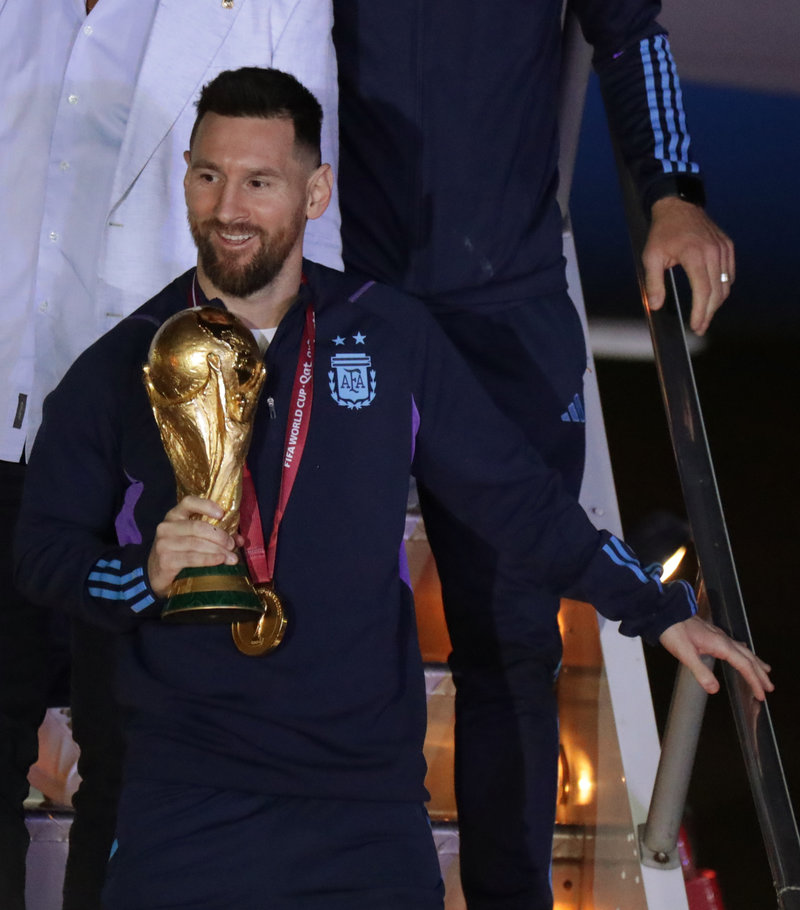
Messi arives in Argentina with the World Cup. EFE.

[This article was first published in Catalonia Today magazine, January 2023.]

Is the legend now complete? Is it a case of all praise to The Great One, Lionel Messi, the Messiah of Argentina, Saviour of Rosario and FIFA-family favourite?

On the whole it seems so, but like so many public figures, this 35 year old (who spent all his crucial teenage years at La Masia, the Barcelona Football Club youth academy) sharply divides opinion. Even within me.

On the one hand, he’s undoubtedly the most skilled footballer I’ve ever seen. I was lucky enough to watch him play at the Camp Nou stadium in the King’s Cup final of 2013. He hit the crossbar with a penalty but (unlike on television) what I noticed more than anything else was that every pass, run and movement he made was at least 20 percent faster than anyone else. And just as throughout the world cup tournament, he was also more accurate than any other player on the pitch.

Every time I’ve watched this wizard play I’ve seen something new to admire about his work. In the semi final against Croatia he set up a goal with an opponent leaning all over his 1.69 metres, as he controlled the ball and shifted position several times. Shrugging his much bigger pursuer off, Messi’s strength and balance in those vital seconds was a rare, rare thing. It meant his team was able to get into the final and go on to win the damn thing.

I was a good young footballer myself and considered trying to shoot for a career in the sport (or in cricket) so the talents and longevity of a supreme athlete like Messi are impossible for me to dismiss. What disturbs me is that while Messi has always been a relatively “clean” sportsman on the field – well known for not fake ’diving’ to get a free kick, for example – his record off the field deserves plenty of criticism.

For me, it’s hard to stomach his tax evasion of more than four million euros: using offshore and shell companies in Belize, Uruguay and Panama. In 2022 alone, his income has been put at 41 million US dollars. His various acts of philanthropy during a decade and a half career can’t take away from the argument that these high-profile guys need to be a role model as a citizen and celebrity.

“The Messi Brand” has Adidas as its main corporate sponsor. The same Adidas that has a lengthy history of human rights abuses against its workers and parts suppliers. Messi himself would surely know but has chosen to ignore this.

The fact that he, with the major help of his teammates and support staff, has given countless hours of pleasure, and even joy, to millions of people has to be considered, though. With a round ball on an expanse of turf, Messi’s been an entertainer like no other. He’s generally avoided Cristiano Ronaldo’s vain parading or the unethical cheating and self-abuse of Maradona.

In the end, I’d consider lifting the world cup as a fitting way to recognise Messi’s otherworldly ability. I just can’t help also wishing that our heroes were more heroic when they step out of the arena.


Sunday, January 1, 2023

Safia El Aaddam’s “Immigrants’ daughter” (2022)


"Lunja is brave. A warrior. Born in a small Catalan village, of Amazigh origin, an indigenous [group] of North Africa, from childhood she confronts racism, poverty,...sometimes even her own culture." 

With this YA novel, the author puts mental health on the table and how it gets worse due to being an immigrants’ daughter and racialized as of African origin."

First found at Literary Rambles.


Sunday, September 18, 2022

Baldwin's Barcelona -- My latest article for Catalonia Today magazine

(Photo: Allan Warren)

The book must always come before the author,” said Nobel Prize winner, VS Naipaul. 

Unlike another genius such as James Baldwin, Napaul spent his entire brilliant, vicious life seemingly trying to prove himself wrong.

For Baldwin, words came first. By becoming a child preacher in his native New York City he avoided the Harlem ghetto.

He also soon found the power of images and a sense of himself as gay and American, an American “negro”: the mid 20th century polite English word for “black”.

(I remember the shock of hearing the other, offensive ‘N-word’ when my cousin in Sydney used it as the name for his pet dog. I was seven years old at the time but even then somehow I knew how wrong that was.)

On a wider tour of Iberia, Baldwin (who died in rural France in 1987) came to Barcelona six decades ago last May.

He met the poet Jaime Gil de Biedma and stayed in his basement in Carrer Muntaner – “blacker than my reputation,” he called it – and they spent seven frenzied days together with [current mayor of Hijar] Luis Marquesán.

Biedma wrote in his diary: “Life, since Monday, when I met Jimmy Baldwin, has been so hectic that today I find myself in a state of real moral and physical exhaustion, aggravated by the intellectual dullness that comes with an alcoholic regime such as the one I have been following.”

According to Marquesán’s biographer, Miguel Dalmau, they went to the picnic areas of Montjuïc, “where they saw the landscape of misery, the shantytowns in disarray on the mountainside.” Ultimately it all led to Baldwin’s new friend Biedma questioning himself about whether he was a coward.

Despite the stimulating week, it seems fair to say that the Catalan capital was a place of mixed fortunes for Baldwin.

As reported in this magazine in October 2019, the publisher, Lumen, “had asked Barcelona photographer Oriol Maspons to advise on publishing the book ‘Nothing Personal’ by James Baldwin and Richard Avedon, but his advice was ignored.

Hurt, he and other photographers published a signed ad in the magazine Destino, criticising the indifference shown towards a masterpiece dealing with the US’ racist and classist system.”

Fortunately though, one of Baldwin’s books, ‘Beale Street Blues’ has finally found its way into a Catalan translation, thanks to the publisher Edicions 1984 and the work of Oriol Ampuero.

He launched it along with professor and writer Josep-Anton Fernàndez on June 13 at the Sants bookshop La Inexplicable.

Baldwin’s work, like so many others, was censored in Spain during the Franco years, but Barcelona played another part in his local history when the US writer Nicholas Boggs was a recent writer-in-residence at Jiwar on Carrer Astúries (founded by two Barcelona residents, Mireia Estrada Gelabart and Moroccan-Canadian Ahmed Ghazali). Boggs spent his time co-editing and writing the introduction to a new edition of Baldwin’s ‘Little Man, Little Man: A Story of Childhood.’

He is also continuing work on his manuscript in progress about love and race in Baldwin’s life and work at the Department of English at New York University.

I share Boggs’ fixation. It knocked me sideways when I read Baldwin’s novel, ’Tell Me How Long the Train’s Been Gone’, during lockdown in spring 2020 and I’ve barely left his words untouched since then.

Reading James Baldwin (or listening to his captivating voice) is like having a fogged-up window wiped clean. Now the view can be seen for what it is, whether picturesque or hideous.

Baldwin’s penetrating work, too, is now starting to be seen more and more for what it is, both in Catalonia and across the wider planet.

[This article was first published in Catalonia Today magazine, Sept. 2022.]


Sunday, May 29, 2022

"Hands on" – My latest article for Catalonia Today magazine


[Erika Lust_Pic: Monica Figueras]

On a crisp but sunny early afternoon last month, I took myself to (lower) Sant Gervasi-Galvany, part of Barcelona city. I had volunteered to be interviewed for a documentary and before stepping through the door of the rented film studio on the building’s 8th floor, a young woman asked me and two other participants to speak in a whisper and only when necessary.


Filming had already started. The hushed silence inside only added to the strangeness of the experience. I was there – only for research purposes of course – to answer questions about masturbation for what was apparently “a non-explicit video to celebrate self-pleasure.”


As we came in, we were asked to sign several legal documents, including one that confirmed we did not have Covid. I was given (here’s a piece of full disclosure) an envelope with 50 euros cash inside. Then we were taken by a different woman (who repeatedly told me how exciting it all was) across the bare, wide concrete studio floor and into a separate area.


A young man began to put makeup on the face of the next interviewee. I waited on a sofa with a guy with a North American accent. He was avoiding eye contact and only mumbled something unclear when I made a friendly observation, suggesting we were doing something very different today.


On the other side of the thin wall, I could hear talk from the middle of the room. I could make out some questions I’d probably be asked and from the woman answering I was also able to get a sense of what I might say. That helped.


I chatted to the curly-haired Argentine who painted and patted makeup over my nose, eyes, and cheeks. Paris wasn’t to his liking but Barcelona was, so far. Then I was up: it was my turn to sit on a stool in front of an especially bright light. A microphone was clipped onto my shirt and an assistant reminded me that I wasn’t obliged to try and answer any questions that I wasn't “comfortable with.”


The person asking the private questions and getting answers for her public, was the owner of the company. She uses Erika Lust as her business name and her website states she is “an award-winning filmmaker, producer, and writer [whose] focus on female pleasure, cinematic values and ethics in adult cinema have helped to change how pornography is consumed.”


I quickly found Erika to be a skilled interviewer partly because her questions were thoughtful and related specifically to the answers I gave. She was a good listener, that rare quality. The session seemed exploratory, not a dry run-through of a list or a pre-prepared line of interrogation. Instead, it quickly became a more open ended, fast-moving quarter of an hour. I was impressed, for example that she also wanted to know how I educated my son about sex and bodies. Her intelligence was obvious. I later discovered she was named as one of the BBC’s 100 Most Influential Women of The Year in 2019.


As her press kit states, “Erika defends the importance of having women, BIPOC, and LGBTQ+ people behind the camera in all key positions.” Her all-female production crew – young, efficient, English-speaking, and keen – were working a 9-hour day.


Finally, Erika asked me to wish the viewers “Happy Masturbation Month”. I was more than okay to do that and hammed it up, waving my arms and added with a laugh, “Go for it!” On the way out, I nibbled on the free lunch provided then headed back outside to Carrer Arribau with the sense that I’d done something good. And surely so was everyone else there.


(The end result...https://www.youtube.com/watch?v=lfppLfTomd0)


[This article was first published in Catalonia Today magazine, May 2022.]


Wednesday, April 20, 2022

My book signing/sales location on St Jordi's Day (April 23)


I'm happy to say I'll be doing a signing and sales session of Slow Travels in Unsung Spain with Barcelona's Come In bookshop's stand on the international day of books and Catalonia's St Jordi's Day, Saturday, April 23.

Time: 5pm-6pm

Place: Paseig de Gracia between C/-Provença and C/- Mallorca

Maybe I'll see you there!


Sunday, March 20, 2022

"My Catalonia" -- My latest opinion column for Catalonia Today magazine


[Photo: C.Morell]


When I think of Catalonia what immediately comes to mind is the word ‘home’. I see the wide view across rows of vineyards, the mountains of the Penedès in the distance, the tops of Montserrat further away, only able to be seen in winter when the leaves on the bare trees allow it. That, from our back terrace.

I have to think about our house too. A narrow but tall and modern ‘adossat’ terrace that has been ours to enjoy (and pay off back to the bank) for the last eleven years. The nighttime light from the old church tower across the street still angles in across our lowly bed. Its bells still ring every fifteen minutes to remind me I rise and sleep in Europe, not Australia, England or Japan.

I am also compelled to recall the splendours of the food here. Discovering the joy in simple ‘pa amb tomàquet’ and the savoury wonder of salt cod, ‘suquet’ seafood stew or the earthy richness of ‘calçot’ green onions cooked on a wood fire.

In Catalonia too, I found the pleasure of chewing the sweet, scant flesh on rabbit bones and diving into a bowl of snails ‘a la llauna’ hot from a tin tray, freshly out of the oven. We still drink the co-op white wine from Covides (an unfortunate name in these times.) Good, cheap stuff pressed from Xarel·lo, Macabeu and Parellada grapes.

Of course, Catalonia is so much more than just that. It’s where we’ve worked. I’ve written, taught and travelled thousands of kilometres to do these things. It’s an hour-long seat on RENFE trains, it’s driving the hills up and down the single-lane N340 running past Vallirana.

Equally, this place has sustained us and drained us; given so much but also taken so much energy and expense. It’s where our son went to school and learnt to use two languages. Catalan is his second language and as he makes his way as an independent young adult he still uses it every day in his work and study, I’m immensely happy to say.

Catalonia gave him superb teachers all through primary and secondary school. Every one of them were caring and dedicated women, apart from a handful of young men and they too were the exact kinds of male anyone could hope for as role models for him.

As well, my thoughts can’t go much further than to the selfless people who work with such heart and humanity in the public health system here. I owe a great deal to them all and so does my wife.

And there’s always The Big Smoke, the capital that brings tourists from everywhere. I was first one myself almost 25 years ago and now as a local I love to busy myself in the crowds on the streets. Every part of Barcelona is a gift, even the least attractive corners.

My Catalonia continues to spur the imagination. (I once had the idea of a book of photos of every rambla in every town where they could be found across the land).

Now, in my more optimistic times, I see somewhere I’d never want to leave. As it is, I don’t want to live anywhere else. Here is as good as it gets.


[This article was first published in Catalonia Today magazine, March 2022.]


Monday, November 1, 2021

New centre in Barcelona for Plural Masculinities


"The Plural Masculinities Centre is a new municipal facility which is opening to foster a diverse, positive and plural perspective of masculinity, helping to generate different collective perceptions from the strictest and outdated meaning of “being a man” or “behaving like a man”. 

Greater flexibility in the perception of masculinity paves the way for promoting healthier and more equal relationships and doing away with binary-based stereotypes.

The new centre is an open space for citizens and will carry out its projects in conjunction with organisations linked to masculinities, through three areas of action:

  • Education: boost awareness among young people through work with the education community, taking into account formal and non-formal education alike. This action must allow for work on different models of masculinity with children and teenagers, and also to address parent models and ways of exercising masculinity with parents and adults.
  • Culture: foster the creation of pieces and spaces at cultural facilities in the city which address this area, with projects which allow them to reach the general public and open up the debate on the problems of hegemonic masculinity.
  • Sport: this is a social sector where the stereotypical role of masculinity has a strong presence, meaning work will be geared towards collaboration with sports organisations to conduct training and awareness campaigns.

The centre is located at Av. Marquès de l’Argentera, 22, and has a team of ten specialists. The premises include a large multi-purpose room and shared facilities with the Men’s Support Service for the Promotion of Non-Violent Relations (SAH).The annual budget for the new centre is 1.3 million euros.

The idea behind the opening of the Plural Masculinities Centre is to develop public policies on gender which include men and offer reflection from the perspective of masculinities in two ways: firstly, to highlight the benefits for men in the construction of positive and respectful masculinities, and secondly to get men to commit men to the change towards equal gender relationships.

Debate on masculinities with the Decidim platform

In a move to facilitate open debate with the general public, a specific section has been created on the municipal participation website Decidim Barcelona, to work on masculinities jointly and connect local people with experts and organisations in this area. Initially, the project has three different spaces: introduction and perspective, open debates, and city agenda and resources on masculinities. Campaigns and communication initiatives will also be designed to reach out to young people via social media."


Read more from source at Barcelona's local government here.

Wednesday, August 25, 2021

"Books about Spain" -- a listing


I'm proud that my book Slow Travels in Unsung Spain has just been included on ThisIsSpain.com on a "list intended for those who want an overview of Spain and the Spanish, particularly directed at those who are considering moving to the country."


The full list of selected books can be seen here.

Friday, June 25, 2021

"Living the reality" -- My latest book review for Catalonia Today magazine

[Writer Carrie Frais: Pic by Poppy Maidment]

Who are these people? “Immigrants temporarily or permanently residing in a country other than the one[s] in which they were raised.”


This to me is a much better explanation than the word expat (or expatriate) which I dislike and so does Carrie Frais the editor of a new book titled “#LivingTheDream: Expat life stripped bare.” 


Her preferred definition of herself and the other ten women who contributed a chapter each is stated in her introduction, inside a publication with a cover photo of broken sunglasses. (It reminded me of Yoko Ono’s album cover for “Season of Glass” showing John Lennon’s bloodied specs after his murder in New York in 1980.)


The book explores “grief, loneliness, Brexit, motherhood, identity, belonging, single parenthood, rootlessness and integration” but these are just some of the issues that are ranged over. The nebulous concept of “home” is also touched on in various distinct ways.


As an author, Frais focuses especially on the emotional baggage of her relocation. Her timeline of the last decade and a half jumps between London and Cabrils (not Cambrils) in Catalonia and moves between themes of parental illness and death, the power of memory and ultimately the Covid 19 pandemic. Wisely, she both recognises and reconciles her status as an outsider: an adventurous one, open to challenges.


Deborah Gray, Managing Director of Canela Public Relations in Barcelona has some specific advice. She finishes her chapter with a title taken from a century old quote from Max Ehrmann’s Desiderata, saying “exercise caution in your business affairs, for the world is full of trickery. But let this not blind you to what virtue there is: many persons strive for high ideals, and everywhere life is full of heroism.”


Her own life experiences include managing a private life (including children) and running offices in Madrid and Lisbon as well as the Catalan capital. She has been navigating the rough seas of European business conditions since 2006. Gray states, “Don’t define yourself by what you do for a living because it can all disappear overnight through no fault of your own.” Millions across Catalonia and the rest of Europe could relate to that.


Mother of three, teacher, writer, designer and Associate Director of MumAbroad.com Jane Mitchell, lives in El Masnou on the Maresme coast just north of Barcelona. Her part of the book is called “Becoming Me (Again)” and talks about how she made happiness a priority ahead of her career. She believes her previous years in Cairo taught her about acceptance and adaptability but didn’t fully prepare her for a new role as a mother in Catalonia.  


Sue Wilson of the Bremain in Spain organisation is another highlight, writing about the legacy of Brexit for her, living in Valencia.


A great strength of this book is that it avoids most of the cliches that surround those who relocate. In several places it confronts them face on to dispel fanciful dreams and watery eyed romantic projections of Europe as a land of sunny, easy plenty. I, too, think this needs to be done.


[This review was first published in Catalonia Today magazine here.]


Sunday, February 21, 2021

"Eva's eye" -- My latest article for Catalonia Today magazine


[Photo: Eva Parey, from Expulsiones Anunciadas]

Even if you just look at the titles of just a few of her solo exhibitions before you focus on the poignancy of her photography, you can get an idea of the scope of Eva Parey’s work: ‘Expulsions Foretold,’ ‘Chernobil Beach,’ ‘Princesses for sale,’ ‘Forced Nomads,’ ‘Gypsy lives,’ ‘The daughters of Durga.’  


From last summer until now, the Covid-19 pandemic was also the subject of an especially harrowing set of photos she took of life in Barcelona’s streets and treatment rooms. It has also meant that several of Eva’s recent exhibitions have had to move online.


I would say it’s near impossible to do justice to the best photography by attempting to use words to describe or comment on it. What I can express is how I’m taken in by her images because of the pure humanity that shines through them and how sensitively she frames her subjects. 


The nucleus of her whole catalogue is people and the living environment but more particularly, people from minority groups or disadvantaged backgrounds.


These include children in Barcelona’s eviction-ravaged Meridiana, ethnic Kalash animists, slum-dwelling women in Mumbai, the victims of new segregation along the Slovak wall and Pakistani immigrants in Barcelona (including her photos of men at prayer in a mosque).


Much of Eva’s work can be viewed on her website (EvaParey.com). One project  she talks about there that has been widely displayed in galleries across Catalonia is titled ‘East Winds.’


According to her it’s “a portrait of the Romani Diaspora [concentrating on a family headed by Ioana,] a matriarch whose 15 children are dispersed across Europe, between Romania, France, Germany and Spain.”


In the section of pictures called ‘Under a Hot Tin Roof’ she says that “After living for a while in Barcelona, Ioana decided to return to Romania, taking care of her grandchildren.”


In Eva’s opinion her children “aspire to be like their elders who are their role models, putting them in the same position as their predecessors once they become adults: at the mercy of political decisions, socio-economic ups and downs and socially at the back of the queue. Emigration is the only way out.”


Her skills are not restricted to fixed images though. Recently, Eva’s first documentary film became available through Filmin. Called ‘Arrels fondes’ (Deep roots) and jointly directed by Pep Martínez, it’s an hour length co-production with IB3 Television in Catalan with English or Castellano subtitles.


As a “journey through the branches of memory on the island of Formentera from the Franco regime to its opening to tourism, locals on the island of Formentera narrate how they survived the famine in the mid-1950s.


Through autumn to summer, the island's transformation is shown, “from tranquillity to tourist saturation with globalization causing the inevitable loss of certain ancestral customs, despite the retired peasants remaining rooted in land and sea; a deep bond that few young people inherit.”


Eva appears to not be content with her substantial creative output since 2006, sharing her knowledge by teaching photography at the Tecnocampus University of Mataró and photojournalism at the UPF in Barcelona. Her professional history also includes participation in collective and group shows such as ‘Photojournalists: looking at violence against women in the world,’ which was held in Barcelona’s Institut Català de la Dona in 2019.


George Orwell wrote that “ As with the Christian religion, the worst advertisement for Socialism is its adherents.” I’d argue that the progressive left could certainly do with a lot less factional tribalists and a lot more people like Eva Parey.

She’s someone who quietly gets on with using their empathy and talents to reveal the human damage that the capitalist machine is doing every day to countless millions across our groaning planet.

(This article was first published in Catalonia Today magazine, Feb. 2020.)

From Eva Parey's webpage...

EXPULSIONS FORETOLD

In the summer of 2010 the French government ordered the mass expulsion of thousands of Roma during August and September after the riots in Saint-Aignan that were triggered by the death of a Roma at the hands of the police.


Some of Ioana’s children were living in camps on the outskirts of Lille in France. The police arrived with an expulsion order for everyone to leave within 24 hours. When the time was up they led them to the Belgian border or deported them by plane on the understanding that they would not return to French soil. Many left voluntarily in order to be able to return.


This happens every year to Roma people from Eastern Europe. The French government continues expelling Gypsies, nowadays offering no form of financial help.