Showing posts with label social classes. Show all posts

Saturday, February 4, 2023

"High power prices taking extra toll on sick Spaniards"

[Pic: Reuters: Nacho Doce]

"Nearly 4 per cent of Spanish households in the fourth income decile — a segment typically viewed as middle class — have spent more than half of their income on energy since the rise in prices last year, an Oxfam survey has found."

Read more from ABC (Australia) here.


Thursday, December 22, 2022

Orwell's Barcelona, December 1936 (& who really are the "wealth creators") [Reposted]

Standing in a Spanish Doorway: Orwell's Barcelona, December 1936 (& who really ar...: It was at a moment in Barcelona, of this same time, late in December 1936, that George Orwell chose to open his exceptional book “Homage to Catalonia.”

In the first page of chapter one, he describes how the city seemed to him then…


“The Anarchists were still in virtual control of Catalonia and the revolution was still in full swing. To anyone who had been there since the beginning it probably seemed even in December or January that the revolutionary period was ending; but when one came straight from England the aspect of Barcelona was something startling and overwhelming. It was the first time that I had ever been in a town where the working class was in the saddle. Practically every building of any size had been seized by the workers and was draped with red flags or with the red and black flag of the Anarchists; every wall was scrawled with the hammer and sickle and with the initials of the revolutionary parties; almost every church had been gutted and its images burnt. Churches here and there were being systematically demolished by gangs of workmen. Every shop and cafe had an inscription saying that it had been collectivized; even the bootblacks had been collectivized and their boxes painted red and black. Waiters and shop-walkers looked you in the face and treated you as an equal. Servile and even ceremonial forms of speech had temporarily disappeared. Nobody said 'Senior' or 'Don' or even 'Usted'; everyone called everyone else 'Comrade' and 'Thou', and said 'Salud!' instead of 'Buenos dias'. 

Tipping was forbidden by law; almost my first experience was receiving a lecture from a hotel manager for trying to tip a lift-boy. There were no private motor-cars, they had all been commandeered, and all the trams and taxis and much of the other transport were painted red and black. The revolutionary posters were everywhere, flaming from the walls in clean reds and blues that made the few remaining advertisements look like daubs of mud. Down the Ramblas, the wide central artery of the town where crowds of people streamed constantly to and fro, the loudspeakers were bellowing revolutionary songs all day and far into the night. And it was the aspect of the crowds that was the queerest thing of all. In outward appearance it was a town in which the wealthy classes had practically ceased to exist. Except for a small number of women and foreigners there were no 'well-dressed' people at all.
 
Practically everyone wore rough working-class clothes, or blue overalls, or some variant of the militia uniform. All this was queer and moving. There was much in it that I did not understand, in some ways I did not even like it, but I recognized it immediately as a state of affairs worth fighting for. Also I believed that things were as they appeared, that this was really a workers' State and that the entire bourgeoisie had either fled, been killed, or voluntarily come over to the workers' side; I did not realize that great numbers of well-to-do bourgeois were simply lying low and disguising themselves as proletarians for the time being.”


So, Orwell thought that not only could Socialism work but it that it was already working in Barcelona during that time, however brief.

In Orwell's earlier life he had argued that wealthy Britain was only able to exist thanks to coal miners working themselves to early deaths in underground infernos. They were the true creators of that nation’s wealth.

As William Blake outlined, the entire modern world is "underwritten by constant, speechless suffering and that "culture" begins in the callused hands of exhausted children," [to quote historian, Robert Hughes.]

It all reminds me of a line in a song by another Australian expat, NickCave:

"Out of sorrow, entire worlds have been built."

Sunday, February 13, 2022

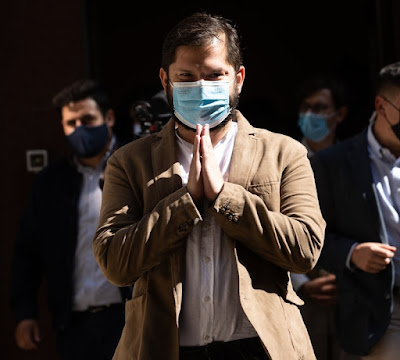
"More Borics please" -- My latest opinion column for Catalonia Today magazine


[Photo: EFE]

Was it sexism?

It wasn’t widely reported in the English language media but Gabriel Boric, the new leftist President of Chile has a Catalan mother, María Soledad Font Aguilera, who was originally from the working class area of Badalona bordering Barcelona

Instead, his father’s Croatian heritage was emphasised and I suspect this is not only because of the single family name.

A graduate of The British School in Punta Arenas, 35 year old Boric is the youngest holder of his nation’s most prized office, having gained just under 56% of the vote in Chile’s second round of elections last December. He defeated the right-wing José Antonio Kast, son of a veteran of World War II and militant in the German Nazi Party.

Boric’s party was able to earn a victory even after “a sudden blackout of bus services in Santiago and across the country forced voters to endure long commutes in the summer heat to express their basic right to a free and fair vote.

But against these efforts at voter suppression, the people of Chile offered their cars, vans, and motorcycles to assist their neighbours to get to the polls.” Most apparent was his support from younger voters and millennials, tired of the usual divisive political rhetoric.

Irina Karamanos Adrian, the new President’s “first lady,” has said she doesn’t want to be the country’s first lady, at least in a traditional sense. As a writer, anthropologist and militant feminist originally coming from Greek and German immigrants out of Uruguay, in her own right, she has also appeared on TV political debates before the presidential campaign.

(To me, if the new president had been a woman then we would have certainly seen a great deal of scrutiny of her life-partner/husband/wife/significant other, or whatever term you want to use. I have a distinct memory that just over a decade ago when Australia had its one and only female prime minister, Julia Gillard, there was a big hooha from conservatives about how she was partnered, not even married (!) to a man who had the supposedly “effeminate” job of a hairdresser.)

Boric himself came to wider attention after his message on Twitter following the independence consultation in Catalonia on October 1, 2017. He posted the words: “Images of police violence in Catalonia are shocking. A firm embrace from Chile to the Catalan people. More democracy, less repression”.

An electoral dark-horse and surprise victor, Boric is to be sworn into office this March in just one of the Latin American countries that have recently opted for left-wing presidencies; other examples being Argentina, Bolivia, Honduras, Mexico and Peru.

Boric was swept into power on an ambitious platform of practical changes like raising the minimum wage, reducing the cost of education, expanding the social safety net, fighting climate crisis and extending rights to indigenous people and gay and transgender individuals. He has even talked about creating a British-style national health service that is universal across Chile.

The big test for any progressive leader in power is what they do, not what they say, but if his manifesto is any indication then Europe too could do with plenty more like him.


[This article was first published under the title "Was it sexism?" in Catalonia Today magazine, February 2022.]

Sunday, February 21, 2021

"Eva's eye" -- My latest article for Catalonia Today magazine


[Photo: Eva Parey, from Expulsiones Anunciadas]

Even if you just look at the titles of just a few of her solo exhibitions before you focus on the poignancy of her photography, you can get an idea of the scope of Eva Parey’s work: ‘Expulsions Foretold,’ ‘Chernobil Beach,’ ‘Princesses for sale,’ ‘Forced Nomads,’ ‘Gypsy lives,’ ‘The daughters of Durga.’  


From last summer until now, the Covid-19 pandemic was also the subject of an especially harrowing set of photos she took of life in Barcelona’s streets and treatment rooms. It has also meant that several of Eva’s recent exhibitions have had to move online.


I would say it’s near impossible to do justice to the best photography by attempting to use words to describe or comment on it. What I can express is how I’m taken in by her images because of the pure humanity that shines through them and how sensitively she frames her subjects. 


The nucleus of her whole catalogue is people and the living environment but more particularly, people from minority groups or disadvantaged backgrounds.


These include children in Barcelona’s eviction-ravaged Meridiana, ethnic Kalash animists, slum-dwelling women in Mumbai, the victims of new segregation along the Slovak wall and Pakistani immigrants in Barcelona (including her photos of men at prayer in a mosque).


Much of Eva’s work can be viewed on her website (EvaParey.com). One project  she talks about there that has been widely displayed in galleries across Catalonia is titled ‘East Winds.’


According to her it’s “a portrait of the Romani Diaspora [concentrating on a family headed by Ioana,] a matriarch whose 15 children are dispersed across Europe, between Romania, France, Germany and Spain.”


In the section of pictures called ‘Under a Hot Tin Roof’ she says that “After living for a while in Barcelona, Ioana decided to return to Romania, taking care of her grandchildren.”


In Eva’s opinion her children “aspire to be like their elders who are their role models, putting them in the same position as their predecessors once they become adults: at the mercy of political decisions, socio-economic ups and downs and socially at the back of the queue. Emigration is the only way out.”


Her skills are not restricted to fixed images though. Recently, Eva’s first documentary film became available through Filmin. Called ‘Arrels fondes’ (Deep roots) and jointly directed by Pep Martínez, it’s an hour length co-production with IB3 Television in Catalan with English or Castellano subtitles.


As a “journey through the branches of memory on the island of Formentera from the Franco regime to its opening to tourism, locals on the island of Formentera narrate how they survived the famine in the mid-1950s.


Through autumn to summer, the island's transformation is shown, “from tranquillity to tourist saturation with globalization causing the inevitable loss of certain ancestral customs, despite the retired peasants remaining rooted in land and sea; a deep bond that few young people inherit.”


Eva appears to not be content with her substantial creative output since 2006, sharing her knowledge by teaching photography at the Tecnocampus University of Mataró and photojournalism at the UPF in Barcelona. Her professional history also includes participation in collective and group shows such as ‘Photojournalists: looking at violence against women in the world,’ which was held in Barcelona’s Institut Català de la Dona in 2019.


George Orwell wrote that “ As with the Christian religion, the worst advertisement for Socialism is its adherents.” I’d argue that the progressive left could certainly do with a lot less factional tribalists and a lot more people like Eva Parey.

She’s someone who quietly gets on with using their empathy and talents to reveal the human damage that the capitalist machine is doing every day to countless millions across our groaning planet.

(This article was first published in Catalonia Today magazine, Feb. 2020.)

From Eva Parey's webpage...

EXPULSIONS FORETOLD

In the summer of 2010 the French government ordered the mass expulsion of thousands of Roma during August and September after the riots in Saint-Aignan that were triggered by the death of a Roma at the hands of the police.


Some of Ioana’s children were living in camps on the outskirts of Lille in France. The police arrived with an expulsion order for everyone to leave within 24 hours. When the time was up they led them to the Belgian border or deported them by plane on the understanding that they would not return to French soil. Many left voluntarily in order to be able to return.


This happens every year to Roma people from Eastern Europe. The French government continues expelling Gypsies, nowadays offering no form of financial help.


Saturday, September 14, 2019

"Jokerman" -- My latest opinion column for Catalonia Today magazine

  
[Photo: EFE]

Unlike this summer’s extreme weather, which came to Europe then went, extreme conservative governments have also recently come but unfortunately don’t seem to be going.
In the UK, the latest incarnation of this threat to the average person is the new Prime Minister, Boris Johnson (or simply ‘Boris,’ as plenty of his fellow media personalities call him.) 

But there is only one important question to be asked about him. Who will he and his Conservative Party govern for?

The answer is already clear. If we ignore all his populist, nationalistic public language and ignore his long history of incompetence, his almost continual episodes of self-serving immorality and if we also ignore his continuing catalogue of lies and vile racist and homophobic insults, there is still something much more important than all that staring us in the face.

The fact is that Boris Johnson has always represented no-one else other than the exact same kind of young males who he is pictured alongside in the ‘Wall of Fame’ at Eton, the school where only Britain’s wealthiest families send their children.

In other words, Boris Johnson will continue to act only for the richest part of the social spectrum. His first policy announcement after he declared he would run for the party’s leadership was calculated to let the rich know that he was still well and truly on their side. He stated he would give tax cuts to 3 million higher income earners.

As well as that he is arguing for further cuts to business tax, even though UK corporation tax rates are “one of the lowest...among developed economies, with successive reductions taking it from 28% in 2008 to 19% now.”

The great problem with schools like Eton where Johnson (and 20 other former UK Prime Ministers) went, is that, according to Germany’s Der Spiegel magazine, it is a major part of “an archaic system that teaches those who belong to it that they are destined for the kind of greatness that others cannot reach.”

The idea of a personal destiny is appealing to people like Johnson because as adults it means they believe that they never have to show ability. “Preparatory” boarding schools such as Eton brainwash their young at a time in their lives when they are highly impressionable, being away from their families for almost the entire academic year. In essence, they instill the value of ultimate self-confidence as superior to expertise. 

This is exactly the root cause of Britain’s wider mediocrity in much of it’s politics and business; it comes from a social class system that virtually insists on taking nothing at all too seriously.

Johnson’s public image as a mumbling, bumbling, patriotic jokester is initially easy to like. He has a light-hearted charm which works with Anglo people who don’t like anyone to be earnest for very long. Comedy is good entertainment, they’d say. 

This tone of amusement was also something Johnson used in his earlier career in journalism and writing. Astonishingly, he wrote a sexist and offensive novel titled Seventy-Two Virgins – A Comedy of Errors (published in 2004) where the main character, obviously entirely based on Johnson, becomes a hero during a terrorist attack. The hand of destiny again.

Ultimately, Johnson is hellbent on “delivering” Brexit at any cost to the middle and working class people of his country. The irony here is that as recently as 2013 he wrote a newspaper article that advised his fellow cabinet ministers “to stop blaming Brussels for all our problems.”

Now though, we have him and his Brexit to more accurately blame. Johnson’s jokes are all the more hollow and the saddest joke is on us.

[This article was first published in Catalonia Today magazine, Sept. 2019.]


Sunday, July 14, 2019

"Who are The English?" --- My latest article for Catalonia Today magazine

This summer while we on the continent of Europe are enjoying doing whatever we can afford to do under the Mediterranean sun, we should all spare a thought for the English and their other Brit cousins.

They will be living through the continuing economic and social disaster created by Brexit and other agonies that are certain to multiply and crowd around like flies at a July barbecue.
A large slice of the pain of modern England comes from its identity and Brexit is only one symptom of this disease. 
I recently read an exceptional book titled ‘God is an Englishman’ published exactly 50 years ago, and all the way through it the Australian author Donald Horne, (who also wrote the well-known book ‘The Lucky Country’ about his own homeland) shows as much penetrating insight into who exactly the English are as anyone else I know of.
Using his book as a measuring stick against the past, it’s remarkable how little England seems to have changed (especially for the better) in that half a century that I have now lived through.
Facing up to the coming instability of the 1970s, Horne found that Britain’s history meant that it too deserved to be called a fortunate country. As he saw it though, “what gets on British people’s nerves is that they no longer know who they are.” (Loud echoes of today’s Brexit confusion?)
He saw a culture where people “find reality in excitements of..fashion and the entertainment businesses.” This led to an emptiness and general dissatisfaction with their lot. For him, it meant too that almost half of young British people alive then were fantasizing about emigrating. Of course, many did or already had (including my father.)
Some of Horne’s other best observations come from his clear understanding of the social class system that still operates deeply all through life there. He recognised that all Brits essentially operate to serve the comfort and ease of the “Upper English” but that a visitor who stayed for years might not notice that England is genuinely one of the world’s most working class nations.
Here, the author, who did in fact marry an Englishwoman and live for five years on a farm in Cornwall, west England, relates a truth that few Brits would have liked to admit, even in the unlikely event that they knew it. Twice as many manual workers as white-collar workers went out to their jobs in this “antique economy”; one that directly made it possible for the queen to stay happy in her castle.
The average Brit was in fact a relative of a peasant who had been tossed by need into the provincial towns or London, just like so many ’internal immigrants’ who arrived in Catalonia from (other) parts of rural Spain in the 1950s and ‘60s.
Soon after the time that Horne was writing though, it was estimated that at least half of England’s land was entirely unregistered: a hotchpotch of inherited wealth. Today we now know that this half a nation is owned by just 1% of its population: 25,000 landowners – typically members of the aristocracy and corporations.
These crucial numbers of course ignore the ironic title of the book. It refers to the 16th century monarch Elizabeth’s bishop of London who specifically claimed that “God is English” and “His nation was to be the New Jerusalem” of the British Isles.
The very English genius George Orwell warned against the “habit of assuming that human beings can be classified like insects” but if we think about today’s English people I’d compare them to that little desert lizard who hops from foot to foot to avoid getting its feet burnt on the hot sand. 
Here I mean the political and social temperature, not that from the sun.

(This article was first published in Catalonia Today magazine, July 2019.)

Friday, May 31, 2019

3 min. VIDEO: "Two worlds" -- The brilliant imagery of Uğur Gallenkuş


"Istanbul-based artist Uğur Gallenkuş portrays two different worlds within in a single image.

Combining a pair of side-by-side photographs - one of the thriving Western world and the other of the war-torn Middle East - he highlights how, despite living on the same planet, these places could not be more different.

The differences are as striking as they are heartbreaking."

Friday, January 25, 2019

"The ruling class that drove Brexit"

[Arron Banks and Nigel Farage. Photograph: Ben Birchall/PA]

"The media loves to blame far right movements and moments on the working class. Our Brexit research tells a very different story...

After Trump’s election, millions of words were typed about how ‘blue collar’ areas had turned out to vote Republican. Yet Clinton led by 11% among voters who earn less than $50,000. Trump secured his victory by winning among those who earn $50-200,000
Much the same can be said for the far right in Italy, whose core support is in the wealthier – though now de-industrialising – north, rather than in the more impoverished south; or about Brazil, where 97% of the richest areas voted for the fascist Bolsonaro, whilst 98% of the poorest neighbourhoods voted for the Workers’ Party candidate, Haddad.
We see a similar distortion in debate about Brexit. 
After the vote, journalists went on endless tours of deprived areas to report on how working-class people voted Leave (which many did). 
However, they somehow forgot to mention that wealthy counties like Wiltshire backed Brexit, while some of the poorest areas of the UK – the western parts of Wales, Scotland and Northern Ireland, as well as Liverpool and Leicester – voted Remain. 
Academics who studied the class breakdown of the Brexit vote found ‘the Leave vote to be associated with middle class identification and the more neutral “no class” identification. But we find no evidence of a link with working class identification.’
This is nothing new. Ruling classes have always sought to blame bigotry on the working classes. Too often in recent times, the liberal media have been willing to champion this myth, rather than confronting the prejudice in its own ranks.
The way we talk about social media is central to narratives that blame the oppressed for their own oppression. 
Online bigotry, abuse and trolling are often framed as problems of the unwashed masses, who need to be regulated by ‘benign’ institutions such as global data corporations or the police. 
In reality, whilst racism, Islamophobia, misogyny, anti-immigrant hysteria and other forms of bigotry feature up and down the social spectrum, their recent mobilization is part of a different story. It has been led and co-ordinated by elite networks, seeking to reshape the world at the dusk of neoliberalism. 
And they are often in direct collaboration with these supposedly respectable institutions, from Facebook to the FBI.
To put it another way: the decade since the financial crisis has accelerated the emergence of a new global oligarch class. With growing wealth has come growing power and a growing ability to shape political debate through the dominant communications technology of the era: TV and the internet. 
As has long happened with right-wing movements, they have done so in close collaboration with military and security networks. Because the era is neoliberalism, those networks are largely privatised, made up of mercenary firms with names like Palantir, Arcanum, SCL, AggregateIQ and Cambridge Analytica.

Brexit, Arron Banks and the missing millions


Take, for example, the Brexit referendum in the UK. The Leave movement operated a bit like a solar system, whose two largest planets were surrounded by a collection of moons. First, there was Vote Leave, the official Brexit campaign, fronted by Conservative politicians Boris Johnson and Michael Gove, and orbited by numerous other campaigns and front groups. 
Second was Leave.EU, associated with the further-right UK Independence Party, fronted by iconic blazered bigot Nigel Farage and primarily funded by an insurance man called Arron Banks. (Banks, by my sums, claims to have funnelled about £15m into the group and its various moons...)
READ MORE in detail from source at openDemocracyUK here.


Friday, November 16, 2018

Video: "The politically abandoned"


As well as the above short film (with English subtitles) there is this fascinating and insightful study on right-wing strongholds in deprived populations across France and Germany that recently found...

"There is a considerable discrepancy between the issues that people view as the ‘biggest problems’ facing their country (which are immigration and the economy) and the challenges that they face in their everyday lives (precarious working conditions, worries about money and declining social infrastructure). 

Media and politics at the national level are criticised for not having properly adopted this ‘citizens’ agenda’. This problem also results in a sense of unfairness and disadvantage.

As such, when people in these regions devalue others, especially migrants, they do so as a reaction to their own experiences of devaluation (this follows the ‘logic of comparative devaluation’). Importantly, the interviews demonstrated no intrinsic patterns of xenophobia.

The central narratives employed by the populists are far less prevalent in their strongholds than is generally assumed. 
When people are asked to describe political contexts in their own words, issues such as Islamisation, Euroscepticism, sweeping criticism of the media and the emphasis on national identity hardly ever crop up. Instead, more often than not the European Union, for example, tends to be viewed as part of the solution, not the problem.
Nationalist clamouring or demands that include a ‘Germany first!’ approach, are ultimately based on the view that politics sets the wrong priorities and focuses on issues that do not reflect the realities of people’s everyday lives. 
However, the interviewees did not necessarily view measures aimed at tackling the refugee crisis, or foreign policy commitments, as fundamentally wrong. 
Nevertheless, the interviewees often believed that a focus on immigration and foreign policy tended to result in less investment and fewer policy measures at the local level that would help tackle the tangible challenges that these people face in their everyday lives. 
This includes increased economic pressure faced by people on low incomes and the gaps in public services. Finally, many interviewees believe that politics has withdrawn from certain social and geographical areas. Importantly, this feeling has led to a strong sense of abandonment.

Conclusions...


Areas now exist which are marked by ‘political abandonment’. 
To regain the trust of the people who live in these areas, it will be necessary to establish a local presence, provide recognition and resolve the problems that they face. 
This study outlines five relevant fields of action as a means of contributing towards this aim:
  • solidarity with the resident population is essential if solidarity is to be expressed with newcomers;
  • infrastructure as a means of promoting equal opportunities;
  • strengthening structures through the presence of political parties at the local level;
  • make structural change compatible with society;
  • and confidence and assertiveness in the face of right-wing populist narratives."

To download the full study from Zentrum click here.


Saturday, March 3, 2018

"How we fight Fascism" [Lessons from history]

As Europe (including Spain's government) piles on the right-wing repression, Chris Hedges sees clear comparisons with another earlier era...

"In 1923 the radical socialist and feminist Clara Zetkin gave a report at the Communist International about the emergence of a political movement called fascism. 

Fascism, then in its infancy, was written off by many liberals, socialists and communists as little more than mob rule, terror and street violence. 

But Zetkin, a German revolutionary, understood its virulence, its seduction and its danger. 

She warned that the longer the stagnation and rot of a dysfunctional democracy went unaddressed, the more attractive fascism would become. And as 21st-century America’s own capitalist democracy disintegrates, replaced by a naked kleptocracy that disdains the rule of law, the struggle of past anti-fascists mirrors our own. 

History has amply illustrated where political paralysis, economic decline, hypermilitarism and widespread corruption lead.


Zetkin’s analysis, eerily prophetic and reprinted in the book “Fighting Fascism: How to Struggle and How to Win,” edited by John Riddell and Mike Taber, highlights the principal features of emerging fascist movements. 
Fascism, Zetkin warned, arises when capitalism enters a period of crisis and breakdown of the democratic institutions that once offered the possibility of reform and protection from an uninhibited assault by the capitalist class. 
The unchecked capitalist assault pushes the middle class, the bulwark of a capitalist democracy, into the working class and often poverty. It strips workers of all protection and depresses wages. 
The longer the economic and social stagnation persists, the more attractive fascism becomes. Zetkin would have warned us that Donald Trump is not the danger; the danger is the growing social and economic inequality that concentrates wealth in the hands of an oligarchic elite and degrades the lives of citizens.
The collapse of a capitalist democracy, she wrote, leaves those in the working class disempowered. Their pleas go unheard. Reforms to address their suffering are cosmetic and useless. Their anger is written off as irrational or racist. 
A bankrupt liberal class, which formerly made incremental and piecemeal reform possible, ameliorating the worst excesses of capitalism, mouths empty slogans about social justice and the rights of workers while selling them out to capitalist elites. 
The hypocrisy of the liberal class evokes not only a disdain for it but a hatred for the liberal, democratic values it supposedly espouses. The “virtues” of democracy become distasteful. 
The crude taunts, threats and insults hurled by fascists at the liberal establishment express a legitimate anger among a betrayed working class. Trump’s coarseness, for this reason, resonates with many pushed to the margins of society. 
Demoralized workers, who also find no defense of their interests by establishment intellectuals, the press and academics, lose faith in the political process. 
Realizing the liberal elites have lied to them, they are open to bizarre and fantastic conspiracy theories. Fascists direct this rage and yearning for revenge against an array of phantom enemies, most of them scapegoated minorities."
Read more from source at Truthdig here.

Saturday, December 16, 2017

"The High Cost of Denying Class War"


"In 2016, the year of both Brexit and Trump, two pieces of data, dutifully neglected by the shrewdest of establishment analysts, told the story. In the United States, more than half of American families did not qualify, according to Federal Reserve data, to take out a loan that would allow them to buy the cheapest car for sale (the Nissan Versa sedan, priced at $12,825). 

Meanwhile, in the United Kingdom, over 40% of families relied on either credit or food banks to feed themselves and cover basic needs..."


Read more from this article by DiEM25's co-founder Yanis Varoufakis here.

Saturday, November 18, 2017

"Evolution's forgotten man" -- My latest article for Catalonia Today magazine


This story begins in the late 18th century with a small boy’s limitless curiosity, at first for staring at his marbles and stones, but soon this grows into a thirst for knowing what lies deep beneath the British countryside around him.

William Smith was unusual for many reasons. As a self-taught young man he traveled a great deal further than most parochial males from farms and this helped to fire his fascination with the natural world. 
Unlike almost all “well-learned” professionals of his day, he also had no distaste about repeatedly climbing down into dark, dangerous coal mines.
Here, he was one of the first to study and report on that black mineral where it actually lay. Of course, it was coal and it was coal miners who were largely responsible for the Industrial Revolution that was then raising Britain’s status to that of an empire-building superpower.
One of the major founding fathers of geology, Smith went on to cover about 10,000 miles a year on foot, on horse and by carriage, cataloguing the locations of all the rock and fossil formations that are to be found in the UK.
Over 14 long years, he also laboriously produced a giant hand-coloured map that showed exactly where the strata of rocks could be found under the earth. Nobody had done anything of the sort before in such a comprehensive and systematic way and two centuries later this sublime masterwork is still accurate and relevant.
World-changing map
In his book titled “The Map that Changed the World” Simon Winchester makes the valuable point that Smith’s “lonely and potentially soul-destroying project” was done, at this time in our history, “in a wholly unknown area of imaginative deduction; there were no teachers, no guidebooks.”
As well as these limitations, Smith could have looked around and noticed that even scientists were convinced, for example, that “mountains grew like trees, organically, upwards and outwards,” all apparently from god’s design.
Smith played a major part in the grinding process where religious and other superstitious beliefs were slowly being cast off (just as we today are [hopefully] living in an era where stupidity related to gender, race or sexual and national prejudices are finally starting to die.)
For most of his career Smith was also an expert in the crucial programme of canal building, but he was in fact snubbed by the main organisation or ‘society’ of his profession as a geologist.
His working-class family background meant that a couple of the ‘perfumed’ snobs who ran and financed what was in truth little more than a gentlemen’s club could steal his ideas and claim them as their own. Largely as a result of this, Smith was to spend time in a debtors prison in London. He was to write with understandable bitterness that “the theory of geology is in the possession of one class of men [and] the practise in another.”
William Smith clearly deserves a much greater and more prominent place in the collective memory of science’s leading men and women. His name merits being up there with the likes of Charles Darwin, Albert Einstein or Richard Dawkins.

[This article was first published in Catalonia Today magazine, November 2017.]