Showing posts with label society. Show all posts

Sunday, February 6, 2022

How southern Europe will be hotter than the rest of the planet


This is an alarming, even disturbing video.


"The speed and magnitude of the climate change we are facing today is unprecedented. Heatwaves, droughts, floods... We are feeling its effects on our daily lives, year after year. Its impacts will increase at least until 2050 and every region of Europe will be affected.

Based on the results of the latest available studies, and in particular, on the 6th IPCC report, this film, produced by scientists in the framework of the European project EUCP, aims to present to the general public the climate changes expected in Europe in 2050. The researchers explain in an accessible way the variations in temperature and precipitation as well as the extreme climate events that European inhabitants will have to face. This film provides the keys to understand how climate will reshape our landscapes and lifestyles over the coming decades. ... and to enable us to better anticipate the need for human societies to adapt to this partly inevitable climate change."

Friday, May 21, 2021

"The quiet one" -- From an article I wrote for Catalonia Today magazine


[Photo: Lluís Serrat.]
There he is. Sitting along the side of the class, with his head down. He could be a child or an adult -- and certainly female too -- but today at least this introvert has very little to say for himself.   

Familiar to most of us who spend any time in group situations at work or in a social setting, the introvert is not shy by definition. 

According to North American author (and self-acknowledged introvert) Susan Cain, shyness is actually about fear of being judged by others.

In fact, she argues, it’s just that “introverts feel at their most alive and their most switched-on and their most capable when they're in quieter, more low-key environments.” Extroverts -- their opposites -- are people who simply function better with a high level of social stimulation.

The wider point that Cain makes in her book on the subject is she believes that a bias has crept into “our most important institutions, our schools and our workplaces. They are designed mostly for extroverts and for extroverts' need for lots of stimulation. And also we have this belief system right now that I call the new groupthink, which holds that all creativity and all productivity comes from a very oddly gregarious place.”

Myself, as someone who does not fit neatly into either category of the out-going chatterbox or the silent internal type (but rather seem to flit between the two depending on the moment) I confess to having largely failed in my attempts to run a fully inclusive classroom. 

When I was a secondary teacher I tried to democratically involve all of my students in being vocal but (like many educators) I was unaware of how best to do this or that some teenagers just do not want to speak if it can be avoided.

Teaching adults over the last few years I’ve learned that the prevailing culture in this part of the world too is clearly in favour of extroverts. I have even taught in companies where they believe that they do not have any introverts working alongside them as their colleagues. 

In the endless rounds of group meetings and chatty open plan offices introverts often fade into the background. It is as if being introverted is a mark of shame and sets someone apart as “not a team player.”  

But there is no good reason for this to be the case. 

As Susan Cain discovered, “when it comes to leadership, introverts are routinely [ignored] for leadership positions, even though introverts tend to be very careful...and when psychologists look at the lives of the most creative people, what they find are people who are very good at exchanging ideas and advancing ideas, but who also have a serious streak of introversion in them.” 

She gives the examples of Charles Darwin, Steve Jobs and genius children’s author Dr Seuss.

Of course, extroverts can and do lead us the wrong way though. 

Cain notes that “groups famously follow the opinions of the most dominant or charismatic person in the room, even though there's zero correlation between being the best talker and having the best ideas.”

For some reason, the name Donald Trump immediately comes to mind.


[This article was first published in Catalonia Today magazine, June 2017.]

Saturday, October 12, 2019

"Natsukashi" -- My latest column for Catalonia Today magazine

This morning, with the dying of this summer and noticing the shortening of the hours of light in the evening, I remembered that exactly two decades ago I went with my new wife to live in the city of Kyoto, in Japan.
It became possibly the single most influential experience in and on my life. 
To look at a period of what became three years and see it as one complete experience (or a collection of thousands of experiences wrapped into one) is obviously unusual. But Japan is exactly that: unusual. 
In fact, it’s unique. Living there, I found myself sometimes saying to myself or whoever was near me, “Everything here is different. Everything!”
Of course not literally everything is, in fact, different there but that was how Japan and its people struck you, especially at first sight. 
Essentially, Japanese people want the very same things as you and I, and the rest of the inhabitants of the planet. We all basically want love, food, shelter, respect and satisfaction. But it often seemed that how they thought they would get these wants was a polar opposite to me, a 30-year-old male from Australia, so geographically close to Japan.
The Japanese language is unique, too, like every language, I suppose. There’s a word in Japanese - “natsukashi” - for which the closest translation in English is “nostalgia”. This translation, though, does not do justice to such a complex, nuanced word that is actually a highly emotional one.
In Japan you would find even primary school children saying this word, not just adults. I think this is because from a very young age in Japan you are taught (or at least influenced) by parents, schools, and wider society to reflect back on your actions, your experiences, and even individual moments. This is a mentality not currently in vogue in much of the Western world, partly because Japan is a very formal society.
There is a structure, a ritual, an accepted composed method and set order (and a set order of words in a phrase) for virtually every daily action the Japanese do; whether it is eating, leaving home, getting to or leaving school or work, or even how you conduct relationships with people. 
To my wife and I and our non-Japanese friends, for at least a year or two, this was mystifying, confusing, frustrating but eventually somehow comprehensible. Although it was quite simple to understand and learn the basics of daily routine, having relationships with Japanese people was another matter, despite the fact that almost everyone was extremely kind to us.
The multiple layers of meaning that everything has in Japan can be seen in my current nostalgic yearning feeling towards Japan through the word ‘natsukashi’.
It turns out that my understanding of this word was not quite on the mark though. After researching it, I find that this feeling is better expressed by the longer word ‘mukashiwonatsukashimu’. ‘Natsukashi is apparently a more simple term for someone or something that is dear, desired or missed.
Next month, I plan to write a follow-up article on some specific examples that illustrate the points I’ve made above about Japan, this most unique of unique places. Until then, I’ll finish with a ‘haiku’ I wrote in Japan. ‘Haiku” is the traditional 5-7-5 syllable simplified form of poetry that’s designed to recall a single moment:

Portuguese song voice
Sweet, controlled, but free and light
Heard in a night street.

[This article was first published in Catalonia Today magazine, October 2019.]

Friday, May 31, 2019

3 min. VIDEO: "Two worlds" -- The brilliant imagery of Uğur Gallenkuş


"Istanbul-based artist Uğur Gallenkuş portrays two different worlds within in a single image.

Combining a pair of side-by-side photographs - one of the thriving Western world and the other of the war-torn Middle East - he highlights how, despite living on the same planet, these places could not be more different.

The differences are as striking as they are heartbreaking."

Friday, September 14, 2018

In Catalonia: "Major rise in politically motivated hate crime"

"The number of incidents of politically motivated discrimination reported to the police has shot up in Catalonia, rising to 121 cases last year (of a total of 393 reports of hate motivated offences) compared with 54 in 2016. 

The 124% increase is attributed to “the major politicisation of a part of Catalan society” arising from the independence process, according to the prosecutor for the Hate Crimes service in Barcelona, Miguel Àngel Aguilar.

Aguilar yesterday pointed out that political affiliation is the second most important motive for hate crimes in both police and judicial reports. Of the 291 legal cases begun in 2017, some 59 were politically motivated. This number is greater than the record number of 35 politically motivated hate crimes in November 2017.

The main causes for discrimination offences in Catalonia are ethnic (34%), followed by political (31%), with sexual orientation (22%) coming third.
The prosecutor also pointed to a rise in discrimination against the Muslim community, a rising trend in recent years, and one that spiked following the terror attacks in Barcelona and Cambrils last August.
Injury and threats are the main offences committed, with discrimination a growing problem. Most of these offences are committed in person (87% of cases), followed by those on social media (8%) and then the internet (5%)."
 - BARCELONA IN catalonia today news (from el punt avui.)

Saturday, September 8, 2018

"The great human paella" -- My latest opinion column for Catalonia today magazine

Walk around any medium sized town in this part of the world and you will see something different.

Compared to say, Britain or the USA, here on the average wall in public places, there is a lot of space that is used for posters which are not commercial advertising.

Apart from the sometimes humorous and succinct graffiti and crammed Informatico Ciutadana boards, blank vertical spaces are often being utilised for letting people know about various events, festivals and not-for-profit performances.

The number and range of groups and organisations that do not follow the "post no bills" credo still surprises (and impresses) me even after more than a decade of living here. What this suggests is that there is a collective consciousness that goes well beyond clicking the "Join" button on a Facebook group. It shows that there is a genuine interest and involvement with what goes on outside ourselves.

The cult of fear


In stark contrast to this, as Lewis Thomas identified as early as the 1970's, in countries like Australia and the USA, people have instead become obsessed with their health -- the private world, not the public one.

He believed there was "something fundamentally unhealthy" about this "loss of confidence in the human body" and saw much of this attitude being created through (apart from the obvious) such seemingly unlikely sources as television medical dramas and those shows where the central human dilemma is illness.

I would say that the "cult of fear," meaning fear in general, is what keeps alive entire industries. It feeds self-obsession.

This in turn has infected that species of person whose mind is never too far from the state of their own body. They can be heard in San Francisco or Melbourne cafes talking about how their last purely organic meal affected them or how they are desperately craving some holistic yoga therapy. They are not only looking for power over their own physical domains but over fear of ageing and inevitable decay.

As Lewis Thomas pointed out, the "healthy hypochondriacs" should not distract us from more urgent problems. Thirty five years ago he correctly foresaw that preoccupation with personal health would be a worrying distraction. Just outside the limits of our flesh and bone, he observed that "the whole of society is coming undone."

On a more optimistic note, it makes me happy to see that others enjoy what I enjoy. The journalist Vicente Molina Foix recently wrote about travelling in the Madrid Metro:

“I like to see the juxtaposition of various skin colors, and hear the melody of incomprehensible languages, as the train of the future approaches on the rails of life.”

Here is a man at ease with one of the biggest changes to European and Spanish life in the last few decades. He is not afraid of the new. The cult of fear has seemingly bypassed him. Instead, Molina Foix has realised that this continent is becoming one great human paella with a tasty mixture of fresh ingredients.

Those Europeans who make the effort to appreciate the benefits of migrants from across this odd little planet will be doing little more than opening up their senses.The continuing mixing of cultures is one of the great success stories of human history and closing ourselves off from the results of migration is as pointless as trying to ignore the music from a neighbour’s radio drifting into our ears.

Migration will not end. The human animal that adapts best to the changes in its surroundings will continue to be the human animal that thrives.


[This article was first published in Catalonia Today magazine, September 2018.]


Saturday, July 14, 2018

"Work, money, machines" -- My latest opinion column for Catalonia Today magazine

My twin brother is a poet. Usually when I tell my adult English students this they ask me how he is able to survive economically.

They are always surprised when I say that Australia has an unemployment benefit paid monthly by the government and that this benefit does not stop after six months, as it does in Spain.

Of course my brother, just like all the other recipients of 'the dole,' as it's called there, have to jump through bureaucratic hoops and many have recently been victims of all sorts of horrific stuff ups by a system that is being privatised.


Yes. Soon the payments the poorest live on will be controlled by businesses that put making a profit from their 'clients' as their biggest interest. In Australia these unemployment benefits are only just enough to live on if they are combined with other government payments such as rent assistance.


I have a friend living in Barcelona who is a very talented graphic artist and is also a photographer with a unique eye. Like me, he teaches to pay the bills because his creative work does not get him and his family consistent income. Also like me, he enjoys his classes but would ideally like to be spending more time on using his talents to make new 'products' as our consumer society would insist on calling them.

But there is a wider question for every society here. Is a form of guaranteed basic income a good idea?


Some people argue that the public purse should not pay people to do what non-creatives believe to be just hobbies but this is missing a vital point. Practically every industry is now using greater numbers of robots  and other types of automation and mechanisation.

When I was leaving university in the early 1990's a guaranteed job for life was working in a bank. We now know this rapidly became not the case and branch closures across the world have meant the loss of most banking jobs.


Mainly this has been because machines now do the jobs that people used to do and the finance sector is only one place where this type of change is marching on. At Amazon for example, every job that can be done by a mechanical device is being done by one.

The people who work there have to keep up with the productivity of machines (even if it costs them their nervous systems) or they are simply fired and replaced with another very low paid worker who works long, long shifts almost exactly as a robot does.


Not long ago, I myself once worked in a full-time job for one of the world's largest smartphone companies (sitting at a computer) until one day my right arm completely froze-up after months of tendinitis problems caused by using a mouse at a high speed.

I was sacked the same day I came back to the office after being on medical leave for this problem. My body just would not work as a machine does.


The question that has to be asked and answered is what do our societies do to deal with increasingly significant numbers of people who don’t have enough paid work or even any paid work.

Economic survival can be close to impossible. In much of Mediterranean Europe the family unit has typically helped out, as have charities but this has created an uneven coverage of the basics of life for many people.

The obvious solution is a universal basic income for every individual in society. Europe’s newest progressive political party DiEM25 believes that the funding for this “should come from a dividend, financed from the returns on all capital; a 'public' percentage of companies’ profits, especially for companies that commercialise technology developed from public funding.”

In other words, “Technological progress should not simply serve capitalism.”

The great benefit from this is that it would allow creativity to flourish and people who prefer paid work at a higher income can do that too.

No automatic alt text available.
[Image: Nacho Diaz]


[This article was first published in Catalonia Today magazine, July 2018.]

Saturday, April 28, 2018

"In Spain, there is a fear of talking about race"

[Photo by Maité Escarria and courtesy of Lucía Asué Mbomío Rubio. Used with permission.]


Read more from Sandra Abd'Allah-Alvarez Ramírez' original article at Global Voices here.

Friday, January 5, 2018

"Reclaiming the commons" -- an interview with veteran land rights campaigner George Monbiot

"Guy Shrubsole speaks to veteran land rights campaigner George Monbiot...

Movements for land reform in the British Isles have ebbed and flowed for centuries. Each new wave can seek to learn from the past - or be destined to repeat its mistakes. The Land senses that the past year has seen a fresh flowering of public interest in land issues - sparked by the ongoing housing crisis, the Grenfell Tower disaster, debates about farming post-Brexit, and other factors. It’s a good time to take stock, so this section brings together voices, new and established, to make sense of the current moment and lend momentum to a new, rising land movement. It features veteran land rights campaigners George Monbiot, Marion Shoard, and Andy Wightman, includes a graphic history of UK land movements, and an assessment of land value capture as a mechanism for economic fairness, before introducing a representative of the Other Side, and some of the activists and organisations of today’s land movement. 

GS: What first got you interested in land and land rights? 

GM: I was working in Brazil in the late 1980s, and I was interested in why so many people were moving into the Amazon, often with quite damaging impacts on the rainforests. It didn’t take me long to see that people were being effectively forced to go because their own land was being stolen from them in their home states. A group of very violent businesspeople supported by the Government were seizing the land owned by peasant communities. People with indigenous roots often going back millennia, but who didn’t have written, legal title to their land; rather it had been held by them in common for a very long time. There were people being killed left, right and centre; there was a bishop who was murdered. I spent long enough there to get beaten up myself by the military police. Then after six years of working in Brazil, West Papua and East Africa, I returned to Britain, and was persuaded by some of my friends to go along to Twyford Down, where there was this huge dispute over a road being driven through beautiful chalk downland and Iron Age remains. And as soon as I got there I thought, this is what I’ve been seeing in Brazil. This is a land dispute over land massively valued by local people, being taken from them by an outside force – in this case, government combined with a huge construction company, and everything that people value here being destroyed. I started reading the poems of John Clare, and saw how his early poetry documented the rich life of the community in which he was brought up, and the way their lives were granted meaning by the land, spiritually, ceremonially, economically, socially – and then his later poems, like The Fallen Elm, documenting the destruction of that entire system through enclosure. And I realised that this was exactly the same process that I’d seen happening amongst indigenous people in the three continents in which I’d worked. Alienation and anomie leading to psychic rupture. And then I realised that what I’d witnessed there is still with us here, in Britain today. 

GS: In 1995 you wrote A Land Reform Manifesto, in which you criticised a huge landowning estate for selling off its land for the Newbury bypass to be built. At the time you said a landed estate’s “power to treat its property as it wishes is scarcely restrained. It is this that lies at the heart of our environmental crisis” . Do you still believe that? 

GM: Well, I would take it further. Land as an issue has to be painfully uncovered, because it’s so successfully hidden from us. Hidden in a thousand ways – hidden by the media, obviously; hidden by economics, which discusses land as if it were any other form of capital, a great methodological mistake; hidden by the power of patrimonial capital. It’s not just the power of the great estates to do as they will; my thinking’s gone way beyond that – it’s the conversion of broad possession into narrow property in general. It’s the almost complete closure of a whole sector of the economy, the commons, and its replacement by both state and market." 


Read more from The Land Magazine [PDF] here.

Saturday, June 10, 2017

"The quiet one" -- My latest article for Catalonia Today magazine

[Photo: Lluís Serrat.]
 There he is. Sitting along the side of the class, with his head down. He could be a child or an adult -- and certainly female too -- but today at least this introvert has very little to say for himself.   

Familiar to most of us who spend any time in group situations at work or in a social setting, the introvert is not shy by definition. 

According to North American author (and self-acknowledged introvert) Susan Cain, shyness is actually about fear of being judged by others.

In fact, she argues, it’s just that “introverts feel at their most alive and their most switched-on and their most capable when they're in quieter, more low-key environments.” Extroverts -- their opposites -- are people who simply function better with a high level of social stimulation.

The wider point that Cain makes in her book on the subject is she believes that a bias has crept into “our most important institutions, our schools and our workplaces. They are designed mostly for extroverts and for extroverts' need for lots of stimulation. And also we have this belief system right now that I call the new groupthink, which holds that all creativity and all productivity comes from a very oddly gregarious place.”

Myself, as someone who does not fit neatly into either category of the out-going chatterbox or the silent internal type (but rather seem to flit between the two depending on the moment) I confess to having largely failed in my attempts to run a fully inclusive classroom. 

When I was a secondary teacher I tried to democratically involve all of my students in being vocal but (like many educators) I was unaware of how best to do this or that some teenagers just do not want to speak if it can be avoided.

Teaching adults over the last few years I’ve learned that the prevailing culture in this part of the world too is clearly in favour of extroverts. I have even taught in companies where they believe that they do not have any introverts working alongside them as their colleagues. 

In the endless rounds of group meetings and chatty open plan offices introverts often fade into the background. It is as if being introverted is a mark of shame and sets someone apart as “not a team player.”  

But there is no good reason for this to be the case. 

As Susan Cain discovered, “when it comes to leadership, introverts are routinely [ignored] for leadership positions, even though introverts tend to be very careful...and when psychologists look at the lives of the most creative people, what they find are people who are very good at exchanging ideas and advancing ideas, but who also have a serious streak of introversion in them.” 

She gives the examples of Charles Darwin, Steve Jobs and genius children’s author Dr Seuss.

Of course, extroverts can and do lead us the wrong way though. 

Cain notes that “groups famously follow the opinions of the most dominant or charismatic person in the room, even though there's zero correlation between being the best talker and having the best ideas.”

For some reason, the name Donald Trump immediately comes to mind.


[This article was first published in Catalonia Today magazine, June 2017.]


Saturday, July 2, 2016

"Why British boarding schools produce bad leaders"

[Boarders … Boris Johnson and David Cameron. Photograph: Yui Mok/PA]
 "In Britain, the link between private boarding education and leadership is gold-plated. 

If their parents can afford it, children are sent away from home to walk a well-trodden path that leads straight from boarding school through Oxbridge to high office in institutions such as the judiciary, the army, the City and, especially, government. 

Our prime minister was only seven when he was sent away to board at Heatherdown preparatory school in Berkshire. 

Like so many of the men who hold leadership roles in Britain, he learned to adapt his young character to survive both the loss of his family and the demands of boarding school culture. The psychological impact of these formative experiences on Cameron and other boys who grow up to occupy positions of great power and responsibility cannot be overstated. It leaves them ill-prepared for relationships in the adult world and the nation with a cadre of leaders who perpetuate a culture of elitism, bullying and misogyny affecting the whole of society.
Nevertheless, this golden path is as sure today as it was 100 years ago, when men from such backgrounds led us into a disastrous war; it is familiar, sometimes mocked, but taken for granted. But it is less well known that costly, elite boarding consistently turns out people who appear much more competent than they actually are. They are particularly deficient in non-rational skills, such as those needed to sustain relationships, and are not, in fact, well-equipped to be leaders in today's world

I have been doing psychotherapy with ex-boarders for 25 years and I am a former boarding-school teacher and boarder. My pioneering study of privileged abandonment always sparks controversy: so embedded in British life is boarding that many struggle to see beyond the elitism and understand its impact. The prevalence of institutionalised abuse is finally emerging to public scrutiny, but the effects of normalised parental neglect are more widespread and much less obvious. Am I saying, then, that David Cameron, and the majority of our ruling elite, were damaged by boarding?"

Read more from source here.

Sunday, August 23, 2015

Dinner "Withlocals" Barcelona - a review


This week I was fortunate enough to have a free dinner courtesy of Withlocals (in exchange for writing this blog post.)


In a small apartment near Barcelona's Plaça d'Espanya my wife Paula and I met a home cook who uses the name Yosuz and a Finnish friend of hers. We were immediately served glasses of homemade summer white-wine sangria and started nibbling on fried pastry triangles which we dipped into a lovely smoky, roasted baba ganoush eggplant dip.


We all soon sat down to get know each other over a wonderful home-cooked meal of salty Portuguese clams, simple "Spanish-style" mussels and a seafood and pasta stew. The food was exceptionally fresh, not at all overcooked and I greatly enjoyed the difference from Spanish food in that coriander leaves were used rather than parsley.


For dessert we tucked into another homemade delicacy - this one pistachio ice cream served with an unexpected dab of tahini paste on the side which beautifully accented the nuttiness of the dish (see picture.) Yosuz had lived for some time in Egypt (as well as in Venezuela and England) and this was also reinforced in the perfumed hibiscus tea we drank before saying our thanks and goodbyes.


If our experience was indicative of what a curious, hungry person usually finds using Withocals then I highly recommend it to anyone visiting a foreign country or even living in one. It struck me as a great way to try international food of your choice and meet new people.

Sunday, July 19, 2015

"How Spain’s Chinese immigrants went from dishwashers to doctors"

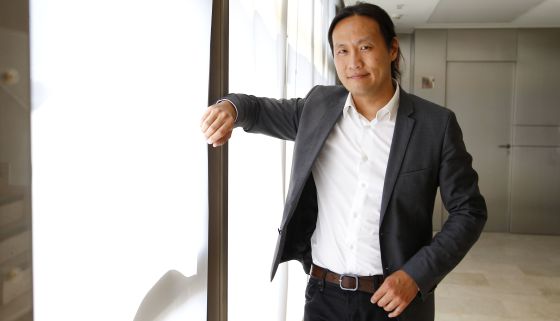
[Dídac Lee in Madrid on June 25. / LUIS SEVILLANO, El Pais.]
Fascinating stories of modern Chinese-Catalans and Chinese-Spaniards: proof that Iberia is slowly becoming more multi-cultural, and maybe at a faster rate than people here think.