Showing posts with label Britain. Show all posts

Friday, January 6, 2023

"Running dry – Protecting the right to water in Europe"


[Greenwich Park parched by the heat and lack of rain on 12 August 2022. Photo by Alisdare Hickson. Source: Wikimedia Commons.]

"Water privatization has catastrophic results, as shown by France and the United Kingdom. Citizens across Europe are increasingly opposed to the liberalization of essential services. But with climate change worsening droughts and heatwaves, public ownership is only the first step towards just and effective water management.


European policy has traditionally treated water as an abundant commodity to be extracted for profit. The severe droughts recently experienced in Europe indicate that this era of abundance is over and have brought home the true value of water as a precious and scarce resource. It is time to look at water in a new light.

This new situation requires a radical change in our approach to water policy and management. Former attempts to integrate water resources into the European single market now appear short-sighted at best and potentially disastrous. In order to build the resilience necessary to overcome the climate-related challenges ahead, we can no longer allow water to be exploited by market forces for private gain. The neoliberal water policies in place in many European countries need to be reversed, and water must be subject to public or commons-based governance. Only in this way can we build resilient water systems and keep water universally available and affordable.

Privatization and resistance

The current era of water privatization first began to emerge in the 1980s when, under the conservative rule of Margaret Thatcher, the UK government oversaw the transformation of water facilities into private assets. Water was privatized in England and Wales in 1989 as part of a wider liberalization agenda for public services and resources. Ten regional water authorities and their proprietary infrastructure were completely transferred to privately owned companies. As a result, water companies became ‘permanent regulated monopolies’, facing ‘public sector levels of competition and risk’ with ‘private sector levels of profit and return’.1

The result was a complete collapse in investment in water infrastructure with serious consequences for water losses. Private company Thames Water, which provides water to the London metropolitan area, has been criticized for its inability to deal with huge leaks from its pipes. The estimated water loss is 600 million litres per day – almost a quarter of all the water it supplies. This quickly becomes a severe problem in the context of drought-induced water scarcity. Thames Water and Southern Water, another large water and wastewater company, have also been criticized for unacceptable levels of sewage pollution and spills, which seriously affect both valuable ecosystems and public health."

Read more (especially about Italy and remunicipalisation of water in France) from source at Eurozine here.


Sunday, November 6, 2022

Video: "Chaos in the UK! with Yanis Varoufakis..."


"Rishi Sunak has taken over as British PM, the richest-ever person to hold the job. He’s already promising austerity for the poorest, with public services like the NHS in danger as never before.
Sunak’s appointment comes after the disastrous Liz Truss (who was outlasted by a lettuce at 44 days), and the scandal-ridden premiership of Boris Johnson. What can British people – and those around Europe – expect from this latest (unelected) Tory government? And with a Labour Party incapable of representing common people, should progressives be adding to calls for early elections? "

Sunday, June 19, 2022

"Wine and a whine" – My latest opinion column for Catalonia Today magazine


As a reptile – I like to think of myself as one of those lizards that runs across the hottest desert sands with a high knee action like an Olympic hurdler, though in reality I’m probably more of a slow-moving komodo dragon – waking up to yet another spring morning with a sky the colour of an iron lung is all too much.


Most likely, you’re reading this with summer’s heat well underway but I actively resent the idea that most foreigners have moved to Mediterranean countries solely for solar delight. 

Not true. 

Speaking only for myself, there’s plenty of other reasons to live here long-term and I’ve written in detail about them in this column over the years.

But yes, I admit, I don’t remember a spring here in the last decade and a half that was so bloody gloomy. 

Apparently, March had the least number of sunlight hours in 50 years and April/early May didn’t feel much better. 

I want my money back. I didn’t sign up for these relentless, grim overhead conditions and general damp.

Simon Winder in his book Germania, makes an argument (with Germany as the exception) that “one very odd aspect of European countries is that if you start in their north-wests they are generally unattractive, harsh places but if you head south-east life gets better.” 

He goes on to put this down to fairly obvious factors like the existence of more sun, olives, melons and an outdoor life including wine and vineyards.

Then the author uncorks some wider history, quoting a British wine-merchant who maintains that for most people in England until the First World War, “wine meant drinking ‘hock’ (German Rhine/Mosel white) or [what was popularly called] ‘claret’ (French Bordeaux red). 

Following this, post-war, the German drop “tasted too much of steel-helmet” and apart from the sweeter “Blue Nun” it largely disappeared from many British tables.

It seems to me that a lot of 21st-century Europeans, including Catalans and Spanish of course, take good wine slightly for granted. 

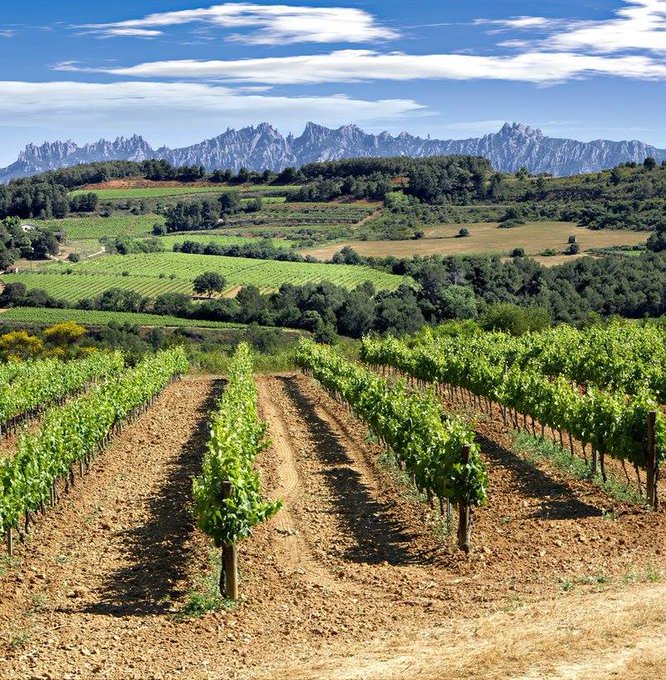
In some areas, the geography supports that. Just travel [I almost remember what that verb means] down the roads or look out the train window between Martorell and down the line through the Penedès to near the coast at Sant Vicenç de Calders. 

The landscape is a non-religious hymn to the grape.

That great truth-teller Eduardo Galeano wrote, “We are all mortal until the first kiss and the second glass of wine.” 

Personally, I can’t remember ever having anything better than an ice-cold Chilean dry white called Concha y Toro in a Canberra restaurant called El Rincon Latino.

With the recent scarcity of a penetrating heat and further east a war that must’ve taken any warmth out of any scattering of sun, I hope that rays of natural serotonin are soon seeping into our souls like “that first swallow of wine… after you’ve just crossed the desert.”

Now I’m reminded of the basic and essential difference between climate and weather, though I doubt Leonard Cohen was thinking about that when he wrote, “Springtime starts and then it stops in the name of something new.” 

What else is new apart from the season? Anything? Something?


[This article was first published in Catalonia Today magazine, June 2022.]

Sunday, May 16, 2021

"They took me to prison:" The nightmare of a young Italian woman at UK border after Brexit

Marta, 24, was supposed to work as an au pair in London but without a work visa, she was sent to the Colnbrook Immigration Removal Centre.

"They took me to prison; then I burst into tears..." [Dozens of EU citizens have reportedly suffered similarly.]

Read more from La Repubblica here.

Sunday, March 14, 2021

I vote, therefore I am? -- An opinion from Lenox


From the editor of BoT (Business Over Tapas) news service...


"News arrives that an elderly Briton living in Italy was finally successful in his long-term campaign to persuade the British Government to allow Brits living abroad the right to vote. 


Each country has its own rules about this chestnut. The British either lose their vote after fifteen years abroad; or they don’t, because they never had it in the first place (being born abroad or leaving the UK as a minor). Most other nationalities do not lose this right. 


The idea is that we Brits abroad should finally have representation in the World’s Greatest Democracy. What this means is unclear, since the Parliamentary Member for North Norfolk (for example) might have a few dozen supporters living across the world – all of them clueless about sugar-beet and the price of Norfolk wherries (it’s an obscure type of barge). 


Much better we expatriate Brits, all thirteen million of us (Wiki) of which 1.2 million are estimated to be living in the EU (here) – that’s about the size of the city of Brussels by the way – get some useful representation where we live. 


Just for comparison, the official number of Brits in Spain (even after Brexit) is around the same size as the city of Alicante, or ten times the size of the city of Teruel (here). 

Having the vote – probably even swinging the vote – for the Brexit referendum would have been very useful, but it's not much use to us expatriates any more, unless Westminster allows foreign-based constituencies.


The French have eleven of these, representing the French citizens who live outside of their motherland (Wiki). The MP (deputy) for the French diaspora in Spain, Portugal, Andorra and Monaco is called Samantha Cazebonne. I’m sure she is kept busy.

So, unless we have someone who solely represents us Brit expatriates in Westminster, there's not much point. 


My constituency was North Norfolk, and I haven't been back there since I left the UK (via public school somewhere) at the age of 16. Would the different candidates write me glowing testimonials about their work with sugar beet futures? After careful consideration, which one would I chose to represent me (or rather, not represent me) in Westminster? Hmm, tricky.


In general terms, having the vote – or rather representation – here in Europe would be much more useful and fair. So thank you Beacon of Democracy, but I’ll not be bothering to vote. "

                                                                                                                    Lenox Dixit


Sunday, January 3, 2021

"Richest 1% have almost a quarter of UK wealth..."

[Photo: Jeff Gilbert/Alamy]

'Official figures have missed £800bn of private assets, says thinktank, amid calls for wealth tax to fund Covid recovery'

Almost a quarter of all household wealth in the UK is held by the richest 1% of the population, according to alarming new research that reveals a historic underestimation of inequality in the country.

The study found that the top 1% had almost £800bn more wealth than suggested by official statistics, meaning that inequality has been far higher than previously thought. Researchers said the extra billions was a conservative estimate and could well be more.'

Read more from source at The Guardian's Observer here.

Sunday, September 6, 2020

"'We don't know what to do': asylum seekers flown to Spain by Home Office"

      [Guardia Civil at Madrid-Barajas airport arrivals hall. Photograph: Europa Press News/Europa Press/Getty Images]

One of the most disgusting acts against refugees that I can remember seeing. This, from the current British government...

"Eleven Syrian asylum seekers have been abandoned outside the airport in Madrid where a Home Office charter flight deposited them, the Guardian has learned." 

Taken without even their ID documents, according to the story. The "hostile environment on steroids" as one commenter called it.

Read more from source here.
  

Sunday, August 2, 2020

"Oxford vaccine is safe, according to second stage study data"

[ Rumyana Vakarelska]
"The vaccine builds immunity, but still does not protect against infection."

"We have some really good news; the so-called "British 'A' vaccine being developed by scientists at Oxford University is entering its third phase of testing," Rumyana Vakarelska, a journalist in London, told Horizon's "Before All" program. She works for an American financial information and analysis corporation and covers Covid-19 and the impact on business.

Her comment is that the latest phase of clinical trials of the experimental coronavirus vaccine, developed by the American National Institute of Allergy and Infectious Diseases and one of the major biotechnology companies, begins today in the United States. 

This is the first vaccine tested in the United States. The University of Oxford and one of the major pharmaceutical companies are also testing vaccines against Covid 19. This was announced last week from the rostrum of the British Parliament.

"The most important thing from the second stage of the study is that this vaccine is safe. It is likely to be implemented in early 2021 and the team's optimal plan is that most people can be vaccinated by April-May next year. "

In the third phase of testing the vaccine, there are also questions, the journalist believes.

"What is known so far is that the vaccine builds immunity, but still does not protect against infection. That is, if you get sick, you will get sick more easily and deaths will be reduced in the future. The vaccine will attack the virus and create antibodies and will create immunity. '

Rumyana Vakarelska explained that a gradual vaccination is expected , and the vaccine has so far been tested on the age group between 18 and 55. Testing has also begun on people between the ages of 59 and 65 and a second group for people over the age of 70.

The United Kingdom has ordered 100 million vaccines from the company, and the United States has ordered 400 million vaccines, although they are also developing a vaccine, Vakarelska explained.

When asked if there will be access to the vaccine at a good price, the journalism specified:
"The UK will do everything possible if the vaccine is completed successfully and in the third stage the transmission of the infection from person to person is prevented, the UK will help the vaccine reach everyone. The program for the UK provides for its distribution through GPs and will most likely be free. It is not yet known whether pharmacies will be available and available there. "

Vakarelska stressed that anti-epidemic measures, however, must not stop being observed, although we will be able to catch our breath if there is a vaccine.

"14 percent of people in the UK have said they will not get the vaccine, for the United States this percentage is 45 percent," said Vakarelska in connection with the anti-vaccine movements."

Original source from Bulgarian media BNR here.


Tuesday, July 28, 2020

Sunday, May 31, 2020

(1 min video:) "Covid19 Appeal: Food & vital supplies for migrant workers in Southern Spain"


"Migrant workers, providing fruits and vegetables to UK supermarkets, have been confined to the cramped settlements in Southern Spain where they live due to recent social-distancing laws, often without access to running water, basic sanitation or food.

Ethical Consumer (here) appears to be an organisation that looks to publicise bad business practice. ‘Learn how to use your spending power to help change the world for the better’, they say."

Original source: (the highly informative) Business Over Tapas.

Monday, April 20, 2020

"Who owns London's golf courses?"

[Beckenham Place Park, a former golf course turned into a public park by its owner, Lewisham Council.]
"Half the golf courses in Greater London are owned by councils or the Crown Estate, a new investigation by Who Owns England can reveal. 
The findings add further impetus to growing calls for golf courses and other private green spaces to be opened up to the public during the coronavirus crisis, so that there is more space to safely exercise in...
              [Golf courses (red) vs existing public parks & gardens (green) in Greater London.]

The lockdown has highlighted how access to nature is a fundamental human need – there’s mountains of evidence on the physical and mental health benefits of getting outdoors – and the fact that this is a matter of social justice: people in deprived areas have smaller gardens and less access to green space.
In the context of this emerging debate, let’s take a look at who owns London’s golf courses, and whether they could be readily persuaded to open up to a wider public.

THE OWNERS OF LONDON’S GOLF COURSES: FROM HARROW TO IMPERIAL TOBACCO

To uncover who owns London’s golf courses, I took Ordnance Survey’s Greenspace dataset, extracted just golf courses, clipped this with the GLA boundary, cleaned up a couple of errors in the dataset where polygons overlapped, and measured the area of each course. I then cross-checked the resulting 131 golf courses against Land Registry’s Corporate & Commercial dataset to uncover the owners. The full results are in this Google Spreadsheet.
Here’s the headline findings:
Golf course owners in Greater LondonAcresPercent
Corporate / private5,12245%
Councils4,70242%
Crown Estate8538%
Split 50/50 council & private owner3633%
Unknown ownership:2702%
Total11,310 acres100%
Whilst most of the corporate owners are simply fee-paying golf clubs, there are also some intriguing names, including:
  • Harrow School;
  • Dulwich College, who have commendably already opened up their sports fields for the public;
  • Imperial Tobacco’s pension fund, owners of Selsdon Park golf course (who knew Big Tobacco cared about outdoor exercise?);
  • and Du Parcq (Jersey) Ltd, owners of Brockley Hill Golf Park, registered in the offshore tax haven of Jersey.
The Crown Estate own golf courses at Hampton Court, Richmond Park, and Eltham, amongst others.
But to me the most interesting owners are the councils. Hillingdon, Enfield and Barnet are the top three London councils who own the most acres of golf course. And Bexley, Brent, Bromley, the City of London Corporation, Croydon, Ealing, Harrow, Havering, Hounslow, Kingston, Lee Valley, Lewisham, Redbridge, Richmond, Sutton, Waltham Forest – together they own thousands of acres of golf courses. They could all be opening this up immediately, if they chose to, to create more space for safer exercise. So why don’t they?
If you’d like to see this change, please sign and share my petition!"
Source here.

Sunday, March 1, 2020

Nobody says it better...

   
I've never read anything that undestands what's behind support for Brexit or explains it better...

Definitely worth reading from start to finish.


A.A. Gill (Sunday Times journalist and food critic) writing about Brexit before his death in Dec 2016:

“It was the woman on [BBC] Question Time that really did it for me. She was so familiar. There is someone like her in every queue, every coffee shop, outside every school in every parish council in the country. Middle-aged, middle-class, middle-brow, over-made-up, with her National Health face and weatherproof English expression of hurt righteousness, she’s Britannia’s mother-in-law. The camera closed in on her and she shouted: “All I want is my country back. Give me my country back.”
It was a heartfelt cry of real distress and the rest of the audience erupted in sympathetic applause, but I thought: “Back from what? Back from where?”

Wanting the country back is the constant mantra of all the outies. Farage slurs it, Gove insinuates it. Of course I know what they mean. We all know what they mean. They mean back from Johnny Foreigner, back from the brink, back from the future, back-to-back, back to bosky hedges and dry stone walls and country lanes and church bells and warm beer and skittles and football rattles and cheery banter and clogs on cobbles. Back to vicars-and-tarts parties and Carry On fart jokes, back to Elgar and fudge and proper weather and herbaceous borders and cars called Morris. Back to victoria sponge and 22 yards to a wicket and 15 hands to a horse and 3ft to a yard and four fingers in a Kit Kat, back to gooseberries not avocados, back to deference and respect, to make do and mend and smiling bravely and biting your lip and suffering in silence and patronising foreigners with pity.
We all know what “getting our country back” means. It’s snorting a line of the most pernicious and debilitating Little English drug, nostalgia. The warm, crumbly, honey-coloured, collective “yesterday” with its fond belief that everything was better back then, that Britain (England, really) is a worse place now than it was at some foggy point in the past where we achieved peak Blighty. It’s the knowledge that the best of us have been and gone, that nothing we can build will be as lovely as a National Trust Georgian country house, no art will be as good as a Turner, no poem as wonderful as If, no writer a touch on Shakespeare or Dickens, nothing will grow as lovely as a cottage garden, no hero greater than Nelson, no politician better than Churchill, no view more throat-catching than the White Cliffs and that we will never manufacture anything as great as a Rolls-Royce or Flying Scotsman again.

The dream of Brexit isn’t that we might be able to make a brighter, new, energetic tomorrow, it’s a desire to shuffle back to a regret-curdled inward-looking yesterday. In the Brexit fantasy, the best we can hope for is to kick out all the work-all-hours foreigners and become caretakers to our own past in this self-congratulatory island of moaning and pomposity.

And if you think that’s an exaggeration of the Brexit position, then just listen to the language they use: “We are a nation of inventors and entrepreneurs, we want to put the great back in Britain, the great engineers, the great manufacturers.” This is all the expression of a sentimental nostalgia. In the Brexiteer’s mind’s eye is the old Pathé newsreel of Donald Campbell, of John Logie Baird with his television, Barnes Wallis and his bouncing bomb, and Robert Baden-Powell inventing boy scouts in his shed.

All we need, their argument goes, is to be free of the humourless Germans and spoilsport French and all their collective liberalism and reality. There is a concomitant hope that if we manage to back out of Europe, then we’ll get back to the bowler-hatted 1950s and the Commonwealth will hold pageants, fireworks displays and beg to be back in the Queen Empress’s good books again. Then New Zealand will sacrifice a thousand lambs, Ghana will ask if it can go back to being called the Gold Coast and Britain will resume hand-making Land Rovers and top hats and Sheffield plate teapots.

There is a reason that most of the people who want to leave the EU are old while those who want to remain are young: it’s because the young aren’t infected with Bisto nostalgia. They don’t recognise half the stuff I’ve mentioned here. They’ve grown up in the EU and at worst it’s been neutral for them.
The under-thirties want to be part of things, not aloof from them. They’re about being joined-up and counted. I imagine a phrase most outies identify with is “women’s liberation has gone too far”. Everything has gone too far for them, from political correctness — well, that’s gone mad, hasn’t it? — to health and safety and gender-neutral lavatories.

Those oldies, they don’t know if they’re coming or going, what with those newfangled mobile phones and kids on Tinder and Grindr. What happened to meeting Miss Joan Hunter Dunn at the tennis club? And don’t get them started on electric hand dryers, or something unrecognised in the bagging area, or Indian call centres , or the impertinent computer asking for a password that has both capitals and little letters and numbers and more than eight digits.

Brexit is the fond belief that Britain is worse now than at some point in the foggy past where we achieved peak Blighty.

We listen to the Brexit lot talk about the trade deals they’re going to make with Europe after we leave, and the blithe insouciance that what they’re offering instead of EU membership is a divorce where you can still have sex with your ex. They reckon they can get out of the marriage, keep the house, not pay alimony, take the kids out of school, stop the in-laws going to the doctor, get strict with the visiting rights, but, you know, still get a shag at the weekend and, obviously, see other people on the side.
Really, that’s their best offer? That’s the plan? To swagger into Brussels with Union Jack pants on and say: “ ’Ello luv, you’re looking nice today. Would you like some?”

When the rest of us ask how that’s really going to work, leavers reply, with Terry-Thomas smirks, that “they’re going to still really fancy us, honest, they’re gagging for us. Possibly not Merkel, but the bosses of Mercedes and those French vintners and cheesemakers, they can’t get enough of old John Bull. Of course they’re going to want to go on making the free market with two backs after we’ve got the decree nisi. Makes sense, doesn’t it?”

Have no doubt, this is a divorce. It’s not just business, it’s not going to be all reason and goodwill. Like all divorces, leaving Europe would be ugly and mean and hurtful, and it would lead to a great deal of poisonous xenophobia and racism, all the niggling personal prejudice that dumped, betrayed and thwarted people are prey to. And the racism and prejudice are, of course, weak points for us.

The tortuous renegotiation with lawyers and courts will be bitter and vengeful, because divorces always are and, just in passing, this sovereignty thing we’re supposed to want back so badly, like Frodo’s ring, has nothing to do with you or me. We won’t notice it coming back, because we didn’t notice not having it in the first place.

Nine out of 10 economists say ‘remain in the EU’

You won’t wake up on June 24 and think: “Oh my word, my arthritis has gone! My teeth are suddenly whiter! Magically, I seem to know how to make a soufflé and I’m buff with the power of sovereignty.” This is something only politicians care about; it makes not a jot of difference to you or me if the Supreme Court is a bunch of strangely out-of-touch old gits in wigs in Westminster or a load of strangely out-of-touch old gits without wigs in Luxembourg. What matters is that we have as many judges as possible on the side of personal freedom.

Personally, I see nothing about our legislators in the UK that makes me feel I can confidently give them more power. The more checks and balances politicians have, the better for the rest of us. You can’t have too many wise heads and different opinions. If you’re really worried about red tape, by the way, it’s not just a European problem. We’re perfectly capable of coming up with our own rules and regulations and we have no shortage of jobsworths. Red tape may be annoying, but it is also there to protect your and my family from being lied to, poisoned and cheated.

The first “X” I ever put on a voting slip was to say yes to the EU. The first referendum was when I was 20 years old. This one will be in the week of my 62nd birthday. For nearly all my adult life, there hasn’t been a day when I haven’t been pleased and proud to be part of this great collective. If you ask me for my nationality, the truth is I feel more European than anything else. I am part of this culture, this European civilisation. I can walk into any gallery on our continent and completely understand the images and the stories on the walls. These people are my people and they have been for thousands of years. I can read books on subjects from Ancient Greece to Dark Ages Scandinavia, from Renaissance Italy to 19th-century France, and I don’t need the context or the landscape explained to me. The music of Europe, from its scales and its instruments to its rhythms and religion, is my music. The Renaissance, the rococo, the Romantics, the impressionists, gothic, baroque, neoclassicism, realism, expressionism, futurism, fauvism, cubism, dada, surrealism, postmodernism and kitsch were all European movements and none of them belongs to a single nation.

No time for walls: the best of Europe, from its music and food to IM Pei’s pyramid at the Louvre, depends on an easy collision of cultures

There is a reason why the Chinese are making fake Italian handbags and the Italians aren’t making fake Chinese ones. This European culture, without question or argument, is the greatest, most inventive, subtle, profound, beautiful and powerful genius that was ever contrived anywhere by anyone and it belongs to us. Just look at my day job — food. The change in food culture and pleasure has been enormous since we joined the EU, and that’s no coincidence. What we eat, the ingredients, the recipes, may come from around the world, but it is the collective to and fro of European interests, expertise and imagination that has made it all so very appetising and exciting.

The restaurant was a European invention, naturally. The first one in Paris was called The London Bridge.

Culture works and grows through the constant warp and weft of creators, producers, consumers, intellectuals and instinctive lovers. You can’t dictate or legislate for it, you can just make a place that encourages it and you can truncate it. You can make it harder and more grudging, you can put up barriers and you can build walls, but why on earth would you? This collective culture, this golden civilisation grown on this continent over thousands of years, has made everything we have and everything we are, why would you not want to be part of it?

I understand that if we leave we don’t have to hand back our library ticket for European civilisation, but why would we even think about it? In fact, the only ones who would are those old, philistine scared gits. Look at them, too frightened to join in.”