News video of the school where my wife Paula teaches.
A blog on social / public issues / education and cultural life in Catalonia, Spain and wider Europe.
Sunday, May 21, 2023
"Demand for Garraf's international schools is growing..."
News video of the school where my wife Paula teaches.
Tuesday, February 14, 2023
"Grabbing Granados" – My latest article for Catalonia Today magazine
[This article* was first published in Catalonia Today magazine, Feb. 2023.]

A huge boat is sinking in The English Channel. A man is clinging on to the side of a tiny raft, only big enough for one woman to kneel on. Soon, both drown in sight of other passengers.
According to witness Daniel Sargent, this is what happened to Catalan composer and pianist Enric Granados i Campiña and his wife Amparo Gal, who was too heavy to get into a lifeboat. Granados apparently refused to leave her alone in the sea and tragically on March 24, 1916 their six children became orphans.
In this ill-fated transatlantic crossing, returning from a tour, the boat they’d been on (the French-flagged Sussex) was mistaken for an enemy minelayer craft and torpedoed and sunk by the Germans. Only days earlier Granados had been playing piano in the White House for US President Woodrow Wilson.
Born in Lleida in 1867 and the son of a colonel (originally from Spanish Cuba) and a Galician mother, at the age of 10 he began to study music and gave public concerts in his hometown (though his first major recital was in 1890, when he was 23 years old.) Still a child, he moved to Barcelona and was enrolled at the Escolania de la Merced.
As is so often the case though with historical figures, myths and disagreement surround important areas of Granados’ life. The financial impact of his father’s premature death at just 57 is unclear but it seems likely that his mother received the correct widow’s military pension and kept the wolves from the door in this way.
What is known is that Enric got a job playing piano for five hours a day at the Café de las Delicias, but around the time he moved his ivory tinkling gig to the Café Filipino, the Catalan impresario Eduardo Condé was also funding him to a very pretty tune as music teacher of his children.
In fact, many of the best Catalan pianists of recent times came out of the music academy in Barcelona that bore Granados’ name. The institution became a centre for a theoretical-practical method for piano pedals that Granados had developed from the teachings he’d held onto from living in Paris two years before.
His masterpiece as a composer is the suite for piano “Goyescas” (1912-14) inspired by works of the Spanish painter Francisco de Goya. Partially first performed at the Metropolitan Opera House in New York, it helped lead to his White House triumph. Despite these kinds of success, Granados went on to suffer from extreme stage fright later in his performing life, according to one source, even begging that he not be forced to play.
I wanted to know more about this man with the fruity name, his name having been given to one of my favourite streets in the Catalan capital. With only one slow lane of traffic, it’s a gently sloping oasis of near-calm and almost-quiet when all around is everything but that, lined with superb restaurants and quaint little speciality shops or delis at both ends.
I grab any opportunity to walk up or down this street. Sometimes I go out of my way to be on it, a part of it, while I think about the man too these days.
[*Most likely this will be my final piece for Catalonia Today magazine. Apparently for economic reasons, it has been cut in half: down to just 32 pages. This means independent journalists who are not directly employed have been also cut. I wrote for them between 2008 – 2023 and would like to thanks all those involved in the production of the publication.]
Sunday, May 8, 2022
"the blint: english events in barcelona"
the blint
english events in barcelona
Sunday, March 13, 2022
"WHY ARE WE AFRAID OF #REFUGEES? / by ELIF SHAFAK"
Sunday, February 13, 2022
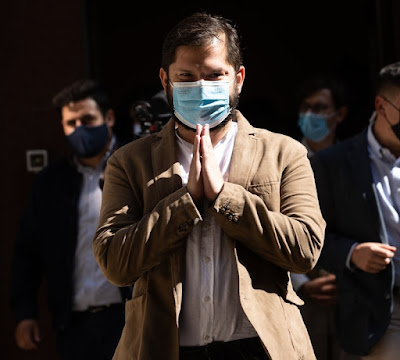
"More Borics please" -- My latest opinion column for Catalonia Today magazine
| [Photo: EFE] |
Was it sexism?
It wasn’t widely reported in the English language media but Gabriel Boric, the new leftist President of Chile has a Catalan mother, María Soledad Font Aguilera, who was originally from the working class area of Badalona bordering Barcelona.
Instead, his father’s Croatian heritage was emphasised and I suspect this is not only because of the single family name.
A graduate of The British School in Punta Arenas, 35 year old Boric is the youngest holder of his nation’s most prized office, having gained just under 56% of the vote in Chile’s second round of elections last December. He defeated the right-wing José Antonio Kast, son of a veteran of World War II and militant in the German Nazi Party.
Boric’s party was able to earn a victory even after “a sudden blackout of bus services in Santiago and across the country forced voters to endure long commutes in the summer heat to express their basic right to a free and fair vote.
But against these efforts at voter suppression, the people of Chile offered their cars, vans, and motorcycles to assist their neighbours to get to the polls.” Most apparent was his support from younger voters and millennials, tired of the usual divisive political rhetoric.
Irina Karamanos Adrian, the new President’s “first lady,” has said she doesn’t want to be the country’s first lady, at least in a traditional sense. As a writer, anthropologist and militant feminist originally coming from Greek and German immigrants out of Uruguay, in her own right, she has also appeared on TV political debates before the presidential campaign.
(To me, if the new president had been a woman then we would have certainly seen a great deal of scrutiny of her life-partner/husband/wife/significant other, or whatever term you want to use. I have a distinct memory that just over a decade ago when Australia had its one and only female prime minister, Julia Gillard, there was a big hooha from conservatives about how she was partnered, not even married (!) to a man who had the supposedly “effeminate” job of a hairdresser.)
Boric himself came to wider attention after his message on Twitter following the independence consultation in Catalonia on October 1, 2017. He posted the words: “Images of police violence in Catalonia are shocking. A firm embrace from Chile to the Catalan people. More democracy, less repression”.
An electoral dark-horse and surprise victor, Boric is to be sworn into office this March in just one of the Latin American countries that have recently opted for left-wing presidencies; other examples being Argentina, Bolivia, Honduras, Mexico and Peru.
Boric was swept into power on an ambitious platform of practical changes like raising the minimum wage, reducing the cost of education, expanding the social safety net, fighting climate crisis and extending rights to indigenous people and gay and transgender individuals. He has even talked about creating a British-style national health service that is universal across Chile.
The big test for any progressive leader in power is what they do, not what they say, but if his manifesto is any indication then Europe too could do with plenty more like him.
[This article was first published under the title "Was it sexism?" in Catalonia Today magazine, February 2022.]
Sunday, November 21, 2021
VIDEO: Evading eviction in one of Europe's most densely populated cities (L’Hospitalet de Llobregat)
"On the border with Barcelona, L’Hospitalet de Llobregat is one of the most densely populated cities in the EU and home to a large migrant community.
Dedicated to protecting the most vulnerable members of this fringe society, a group of young volunteers set up Sindicat, a renters union that is working relentlessly to counteract the housing crisis engulfing the often undocumented residents."
VIDEO here.
Read more from director Irene Baqué about the genesis of the group, and the documentary, here
Sunday, August 15, 2021
A living in Spain guide
![]() |
| [Image of Catalonia: Shutterstock.com] |
I was sent this Spain expat guide recently by their editors.
It's a mixture of quite useful links, info about relocating, daily life and the bleedin' obvious .
Worth a quick look if you want some basics and a bit of specific advice.
Friday, June 25, 2021
"Living the reality" -- My latest book review for Catalonia Today magazine
![]() |
| [Writer Carrie Frais: Pic by Poppy Maidment] |
Who are these people? “Immigrants temporarily or permanently residing in a country other than the one[s] in which they were raised.”
This to me is a much better explanation than the word expat (or expatriate) which I dislike and so does Carrie Frais the editor of a new book titled “#LivingTheDream: Expat life stripped bare.”
Her preferred definition of herself and the other ten women who contributed a chapter each is stated in her introduction, inside a publication with a cover photo of broken sunglasses. (It reminded me of Yoko Ono’s album cover for “Season of Glass” showing John Lennon’s bloodied specs after his murder in New York in 1980.)
The book explores “grief, loneliness, Brexit, motherhood, identity, belonging, single parenthood, rootlessness and integration” but these are just some of the issues that are ranged over. The nebulous concept of “home” is also touched on in various distinct ways.
As an author, Frais focuses especially on the emotional baggage of her relocation. Her timeline of the last decade and a half jumps between London and Cabrils (not Cambrils) in Catalonia and moves between themes of parental illness and death, the power of memory and ultimately the Covid 19 pandemic. Wisely, she both recognises and reconciles her status as an outsider: an adventurous one, open to challenges.
Deborah Gray, Managing Director of Canela Public Relations in Barcelona has some specific advice. She finishes her chapter with a title taken from a century old quote from Max Ehrmann’s Desiderata, saying “exercise caution in your business affairs, for the world is full of trickery. But let this not blind you to what virtue there is: many persons strive for high ideals, and everywhere life is full of heroism.”
Her own life experiences include managing a private life (including children) and running offices in Madrid and Lisbon as well as the Catalan capital. She has been navigating the rough seas of European business conditions since 2006. Gray states, “Don’t define yourself by what you do for a living because it can all disappear overnight through no fault of your own.” Millions across Catalonia and the rest of Europe could relate to that.
Mother of three, teacher, writer, designer and Associate Director of MumAbroad.com Jane Mitchell, lives in El Masnou on the Maresme coast just north of Barcelona. Her part of the book is called “Becoming Me (Again)” and talks about how she made happiness a priority ahead of her career. She believes her previous years in Cairo taught her about acceptance and adaptability but didn’t fully prepare her for a new role as a mother in Catalonia.
Sue Wilson of the Bremain in Spain organisation is another highlight, writing about the legacy of Brexit for her, living in Valencia.
A great strength of this book is that it avoids most of the cliches that surround those who relocate. In several places it confronts them face on to dispel fanciful dreams and watery eyed romantic projections of Europe as a land of sunny, easy plenty. I, too, think this needs to be done.
[This review was first published in Catalonia Today magazine here.]
Sunday, May 16, 2021
"They took me to prison:" The nightmare of a young Italian woman at UK border after Brexit
Sunday, December 27, 2020
"In a small world" -- My latest article for Catalonia Today magazine
Barcelona isn’t well-known for flamenco but Kayoko Nakata, thinks it should be.
Kayoko told me, “At the Barcelona Ciutat Flamenco Festival at the end of October, my work, “Hermandad” was selected from a lot of applications and I was able to perform at the Auditori Sant Marti. “That was just before the last three concerts in the festival were cancelled due to Covid restrictions.”
“Flamenco is a small world,” said. “Here and in Seville where I studied it, the attitude is very often that [Romani] Gypsies do this and Japanese people could never dance flamenco. Tourists don’t want to see Japanese or Chinese or Africans dancing flamenco. It's a closed world too. I struggled a lot and eventually doors opened for me and I danced in “tablaos” (or daily organised performances on stage) a lot.”
“The title of my latest show means bonding but also brotherhood. In that way, it describes what I’ve done with two types of music. I fuse flamenco with traditional musical elements from Japan.
I asked Kayoko about the meaning to her of “duende,” that core spirit of the art that is said to take over flamenco dancers when they are in full flight. She compared it to the Japanese idea of “mu:'' nothingness or being without, "unasking." She said in that state, thought was absent, like when she meditates.
Other things are also absent in her life, however. Currently because of the theatres being closed and face to face sessions prohibited, Kayoko teaches flamenco online from her apartment, though she’s only doing a small number of classes. Her students are both in Japan and those living in Barcelona, where she believes the flamenco scene is based on many thousands of residents who have an Andalusian family background.
Like so many other teachers though, she’s had to try to adapt this year. As have the people around her. “I think the neighbours in my building are angry at me because of all my stamping on the floor but luckily none of them have said anything,'' she laughs. “I want to restart classes in my studio because that’s more enjoyable.”
As a foreigner or “gaijin” as they are called there, I was lucky enough to live in Japan for three years. Similar to Kayoko Nakata, I also had a partner and young child with me. Also like her, I discovered something of a small world.
I learned that the world was not as big as I’d thought because Japanese people basically wanted many of the same things as me. This, despite the fact that they have a hugely different culture and history from where I’d grown up in Australia.
[This article was first published in Catalonia Today magazine, December 2020.]
Sunday, September 27, 2020
"Living too together?" -- My latest opinion column for Catalonia Today magazine
Back in mid-July, after more than four months, I (reluctantly) set foot in the city of Barcelona.
I love the place and always get a thrill out of going there – we live on the edge of Barcelona province in a small town – but walking through crowds of people in the midst of a contagious pandemic, it was impossible to relax and enjoy myself as I’d always done before.
Yes, most people were wearing masks covering the nose and mouth but around 20 or 30 percent of those in the street were not. Plenty of them appeared to be tourists. The following day, regulations were changed so that it was compulsory to wear a mask in all public places across Catalonia.
I have to say though, the relief I felt when I escaped the absurdly narrow traffic lanes of Gran Via and got the car out near the space and mountains surrounding Josep Tarradellas Barcelona–El Prat Airport was a welcome one.
It seemed almost claustrophobic and unnatural to be in a city of 4.8 million on the day that a city with the same population (Melbourne in Australia) had just been locked down in Covid quarantine for six weeks.
It might also have been in my subconscious but in the days before my unusually disquieting visit, I’d read an article about Barcelona having Europe’s most densely populated square kilometre in Europe. More than 53,000 people inhabit this single 1km² area. (France also has a place with more than 50,000 people in a single km², in Paris.)
The urban zone that breaks this very dubious record lies just south of Barcelona Football Club’s Camp Nou stadium. Unlike older city locals who often refer to places (public squares) as reference points, for me as mainly a travelling teacher, I use Metro stations and recognised this ultra-dense area is between the Collblanc and Torrassa stations on one side. The other corners run along the old N340 national road to near Badal metro stop and down to Santa Eulalia station.
It’s true that technically speaking this compressed cube of humanity is in the “city” of L’Hospitalet de Llobregat but in reality it was originally agricultural land, subsumed by the Catalan capital and (as someone who has spent time working around there) it certainly feels to me like it’s a extension of Barcelona, being only eight stops on the Metro from Barcelona’s centre. When combined, the two “separate cities” make up the second most dense urban area in all of Europe.
It hardly needs saying but this particular part of Barcelona is one the poorest. It has a high number of low-income immigrants but residents say that renting an apartment can still cost 800 or 900 euros a month, which can only encourage overcrowding. This is made worse by the fact that a growing number of people living there are not registered with the local council. This leads to underfunding of social and other services.
Other problems in the area are a simple, natural result of this extreme density: major lack of parking, an almost complete lack of green spaces and related high levels of pollution. Recently, this square kilometre and surroundings have also been a centre of a wider outbreak of Covid-19 in L’Hospitalet de Llobregat.
As a result, I ask the question: If living in each others’ pockets is such a good thing then why aren’t the very richest in society doing it?
[This article was first published in Catalonia Today magazine, Sept. 2020.]
Sunday, July 26, 2020
"Where (some of) Spain's agricultural workers live"
A video report from LaSexta titled ‘Between garbage and no hot water in old farm-buildings: the inhumane conditions in which the seasonal workers have to live’.
[Thanks again to the comprehensive round up of weekly news at Business Over Tapas.]
Saturday, July 18, 2020
"Black lives matter in Barcelona" -- My latest opinion column for Catalonia Today magazine
It is believed that there are organised groups involved in the trafficking of people who bring these immigrants to Spain and there are also “criminal bands” linked to counterfeit goods.
But again in 2015, a penal code reform, carried out by the conservative government of the People’s Party (PP), reestablished street vending as an offence with sanctions of between six months and two years jail.
More info on the Barcelona 'top mantas' here: https://en.goteo.org/project/top-manta-bcn
Sunday, November 17, 2019
Q and A on life as an immigrant in Europe (or "expat" if you prefer.)
My name's Brett Hetherington and I'm a European (Australian/British) journalist, teacher and author (most recently of Slow Travels in Unsung Spain) living in Catalonia, Spain with my partner/wife Paula and our teenage son Hugo.
Where, when and why did you move abroad?
Our first move was to Japan in 1999 (where Hugo was born) and three years later we moved to England.
After two years there we moved to live in inland Catalonia in the Barcelona region and have been there since 2006.
What challenges did you face during the move?
Plenty! Languages were a big one because we all had to deal with Catalan as well as Spanish. Hugo was only five when we came, so he picked it up quickly with the help of some great teachers at his Catalan primary school. I've become functionally fluent in Spanish and generally understand Catalan okay, though I don't speak it.
How did you find somewhere to live?
Luckily, a teacher my wife was replacing was leaving his apartment in the town where we wanted to live, Vilafranca del Penedes. I communicated directly with the landlord (in a mixture of his poor English and my even worse Spanish). Later, we bought our own place in a small nearby town, almost a decade ago now.
Are there many other expats in your area?
Very few here, but 20 minutes away on the coast around Sitges (where we used to work) there is a strong expat community.
What is your relationship like with the locals?
Friendly, and some acquainatiances, but few real close friends, I would say. Most small-town, rural Catalan people call themselves "closed." They mean that they're not open to having many new social relationships outside their already established ones.
What do you like about life where you are?
The vineyards and open spaces of nature around. It's a great balance too when you mainly work in the big city of Barcelona.
What do you dislike about your expat life?
Well, I think of myself as an immigrant more than an expat because I don't see who we are as any different to others who came here from somewhere else for a better life. I do intensely dislike the bureaucracy and arbitary kinds of decision-making in Southern Europe. The low salaries that never rise are making life harder every year too.
What is the biggest cultural difference you have experienced between your new country and life back home?
This has been our home for a long time now, but if I compare it with where I lived most of my life, I'd say I miss the more spontaneous way people socialise and talk to strangers, as well as the multi-cultural population being a part of the mainstream.
What do you think of the food and drink in your new country? What are your particular likes or dislikes?
That's the only downside, because the seafood and usual high quality in well-priced "menus del dia" is great. There's fantastic, cheap wine in this area too.
What advice would you give to anyone following in your footsteps?
Do it! But be prepared to live in a low-wage economy unless you are very lucky. On the other hand, Spain/Catalonia is a great place to bring up kids, in my opinion.
What are your plans for the future?
You can find Brett's book, Slow Travels in Unsung Spain, on Amazon.
Sunday, July 14, 2019
"Who are The English?" --- My latest article for Catalonia Today magazine
Friday, July 5, 2019
"German captain becomes anti-populist heroine in Italy migrant standoff"
![]() |
| [Photo.
Guglielmo Mangiapane/Reuters]
|
Saturday, March 9, 2019
"Brexit blues" -- My latest opinion column for Catalonia Today magazine
![]() |
| [Protesters in London, January 2019. EFE] |