"I found Brett's very personal account of his travels through Spain a moving and very rewarding read.
His affection for the country and its peoples shines through and his encounters with the people he meets on his travels avoid caricature and shallow conclusions.
He is clearly still discovering aspects of the country he loves and enjoying the opportunity to complete the picture."
Rightly describing George Orwell as "one of the great commentators of his own era." Personally, I'd go further and say of any era in the English language.
Orwell had an ability to get to the visceral in a way that few have. Shakespeare regularly did. James Baldwin also did.
[This article was first published in Catalonia Today magazine, Dec. 2022 under the title “Promenade of multitudes”]
A really good book is a universe away from its marketing.
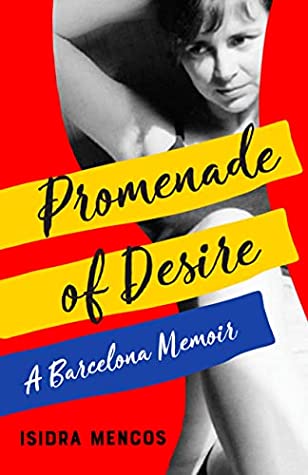
One vibrant new piece of nonfiction, “Promenade of Desire, A Barcelona Memoir” is being promoted as “a sensual coming of age story: From Catholic virgin to Mata Hari as Spain moves from dictatorship to democracy.”
All true enough, but as well as getting a grip on the massive changes in Barcelona from the 1960s until just after the Olympic games in the early 1990s, the author Isidra Mencos charts a deeply internal arc.
Apart from the apparent honesty, what I like most about this raw account of an individualist’s first few three decades is the richness of self-discovery it contains.
The author’s sexual desire is undeniable but so is her lust for experience itself.
With an equally powerful bravery, she plunges into a subculture of horny squatters, for a while, finding herself most at home with the homeless.
We also witness other improvised or adapting versions of her: as an uncertain teenager and then young adult, still racked with a punishing guilt.
Born to an affluent, emotionally-cold lawyer family (from the city’s high up Sant Gervasi-Bonanova area) who slowly fell on hard economic times, Mencos tellingly relates how her closest childhood at home was with their housekeeper/childminder/cook.
Quica, a semi-literate Andalusian woman who’d lost a husband and ten of her fourteen children during their infancy, was an anchor for the inquisitive young girl even during night-time bad dreams.
Mencos’ pure affection for this kind of person (who makes it possible for the rich to live like the rich) is touching.
It’s a clear sign that she transcended at least a snobbery of neglect. The words, ”I bawled at her death as I had not done for my lost grandparents,” poignantly ends one section in the book.
Looking at wider themes, identity is a major one. The author puts herself in the category of a “good girl,” even a “girlie girl” with “a quiet demeanor that dissolved with the ice cubes at the bottom of [her] second drink. Out came a fearless woman who declared her literary opinions with confidence and subjugated a man with a swing of her hips.”
In fact, alcohol became a major problem for her and some of the men who were her live-in lovers. Violence and abuse followed.
The details are harrowing but also somehow instructive and a kind of balance comes in the shape of a new half-American half-Japanese female friend. “A role model for me because I still lived at half speed, with a split personality,” writes Mencos.
As Barcelona remodeled and replenished itself for the 1982 Olympics, the author herself was doing something similar as a part-time translator of articles for the official games committee. Then she set a routine for passing TOEFL and SAT exams so she could do a PhD in the USA.
Ultimately, she is healed: by herself, by quality therapies, probably too by discovering a genuine, transporting passion for the “unique vocabulary and no fears, no confusion” of salsa music and dance.
Here, we see a Barcelona that would’ve even been foreign to many locals, an immigrant/latin underworld of afflicted aficionados and slaves to a beat that was new to these European shores.
One of the great qualities in this book is that we also see a person who is now unafraid of so much she had been.
Being a Spaniard myself, I really enjoyed the mix of literary musings, historical facts and sightseeing that Hetherington offers...
As the title says, it's a slow kind of travel, one that allows for immersion and a nuance, very personal travelogue that mixes reflection, description and awe.
Who are these people? “Immigrants temporarily or permanently residing in a country other than the one[s] in which they were raised.”
This to me is a much better explanation than the word expat (or expatriate) which I dislike and so does Carrie Frais the editor of a new book titled “#LivingTheDream: Expat life stripped bare.”
Her preferred definition of herself and the other ten women who contributed a chapter each is stated in her introduction, inside a publication with a cover photo of broken sunglasses. (It reminded me of Yoko Ono’s album cover for “Season of Glass” showing John Lennon’s bloodied specs after his murder in New York in 1980.)
The book explores “grief, loneliness, Brexit, motherhood, identity, belonging, single parenthood, rootlessness and integration” but these are just some of the issues that are ranged over. The nebulous concept of “home” is also touched on in various distinct ways.
As an author, Frais focuses especially on the emotional baggage of her relocation. Her timeline of the last decade and a half jumps between London and Cabrils (not Cambrils) in Catalonia and moves between themes of parental illness and death, the power of memory and ultimately the Covid 19 pandemic. Wisely, she both recognises and reconciles her status as an outsider: an adventurous one, open to challenges.
Deborah Gray, Managing Director of Canela Public Relations in Barcelona has some specific advice. She finishes her chapter with a title taken from a century old quote from Max Ehrmann’s Desiderata, saying “exercise caution in your business affairs, for the world is full of trickery. But let this not blind you to what virtue there is: many persons strive for high ideals, and everywhere life is full of heroism.”
Her own life experiences include managing a private life (including children) and running offices in Madrid and Lisbon as well as the Catalan capital. She has been navigating the rough seas of European business conditions since 2006. Gray states, “Don’t define yourself by what you do for a living because it can all disappear overnight through no fault of your own.” Millions across Catalonia and the rest of Europe could relate to that.
Mother of three, teacher, writer, designer and Associate Director of MumAbroad.com Jane Mitchell, lives in El Masnou on the Maresme coast just north of Barcelona. Her part of the book is called “Becoming Me (Again)” and talks about how she made happiness a priority ahead of her career. She believes her previous years in Cairo taught her about acceptance and adaptability but didn’t fully prepare her for a new role as a mother in Catalonia.
Sue Wilson of the Bremain in Spain organisation is another highlight, writing about the legacy of Brexit for her, living in Valencia.
A great strength of this book is that it avoids most of the cliches that surround those who relocate. In several places it confronts them face on to dispel fanciful dreams and watery eyed romantic projections of Europe as a land of sunny, easy plenty. I, too, think this needs to be done.
[This review was first published in Catalonia Today magazine here.]
I'm extremely thankful for these lovely words of praise from Lesley Postle about my latest non-fiction book...
"As someone who used to live in Spain and has been away for far too long, for me, Brett's book was a moving nostalgia trip through a country I love.
He brought it all back to life for me in a way that could only be done by someone who knows and understands the place really well. I adored the way he describes the minutiae of Spanish life, the food, the music, and the way things often don't quite work as they should over there, like having a tourist office which is impossible to find.
For me, the mix of travel writing with short commentaries on politics, history, religion and culture works well. There isn't too much of any one topic, so it never gets boring. I just wish it had been even longer. It was really interesting to read about some of the lesser-known towns which I do not know, but which I'd now love to visit.
I could really relate to Brett's personal story, having lived in a similar area and experienced a lot of the same things. It made me quite homesick and even more determined to get back there some day.
Original reader review titled "Gets to the Heart of the Real Spain" at Amazon here.
Can horses feel shame? Do deer grieve for their dead? Why do roosters deceive hens?
What about humpback whales that act as if they’re grateful, adulterous magpies or pigs that have learnt their own names?
These are the kinds of questions that are asked by people who spend lots of time around animals because our life experiences are full of stories that seem to support an obvious ‘Yes’ answer.
In Peter Wohlleben’s book, “The Inner Life of Animals” -- translated with warmth and clarity by Jane Billinghurst -- we get as close as (currently) possible to understanding how the creatures we share the planet with are much more complex than we might at first think.
With our inbuilt tendency to ‘humanise’ animal behaviour, we like to compare them with our own species but this book has a remarkable way of putting us into their minds, bodies and hearts.
Some of these are the author’s own pets and farm animals and his lifetime’s sharp observations of them bring the reader genuine insight.
The other great strength of this book is also one of it’s few weaknesses. We are moved and educated in equal measure with page after page of compelling anecdotes about the uplifting and even empathetic side of animals (squirrels adopting orphans and even cross-species pseudo-families) but there is only featherweight attention given to the cruelty that also runs through the animal world.
Where, for example is the fox that only eats the fatty jowls and throat of the sheep and leaves it to die in slow agony with the rest of its body intact?
If we humans are merely animals (and this is a biological fact of evolution that Wohlleben rightly points out) then surely the cruelty we routinely practice can also be found in our four-legged relatives too.
Wohlleben tells us with loving, enthusiastic praise about the crow that goes tobogganing for fun. He overlooks the cat that tortures and toys with the mouse for nothing but amusement. The book would be stronger if this was acknowledged because it would add a few fistfuls of balance.
Where the book also charms the reader is in overthrowing misconceptions we generally have. Fish have no memory? Pigeons are “bird-brained” or pigs are simpletons? After reading this work, your mind is very likely to have been changed for good on these and similar questions.
He also counters other popular notions by illustrating that ‘the law of the jungle” and “survival of the fittest” are only parts of how animals relate with each other.
Organised cooperation amongst individuals and groups is surprisingly common and it seems that many creatures (such as red deer) have the ability to switch off their hunger impulses when the seasons dictate this.
When it comes to domesticated animals though, in a brave and convincing section, Wohlleben also shows that some animals undoubtedly enjoy their work with men and women.
He writes about horses happily clear forests as well as shepherd dogs engaged in keen “partnership” with their owners. This is only after stating of course, that “most animals used by people lead dismal lives.”
Before now running his own home farm, the author worked in forestry commission woodland for 20 years and he has also written a book about the hidden life of trees.
Reading that might even persuade me to stop using paper.
[This book review was first published under the title ""Animal feelings" in Catalonia Today magazine, January 2020.]
Someone called 'Avidreader' is kind enough to write on Amazon: "A hispanophile travels across various hidden corners of Spain, holding dialogue with marginalised Spaniards on the way. A unique and quirky account of his journey, with a clear and consistent voice. I read it in one sitting. Hetherington's general knowledge of Spain's twentieth history and current political situation is excellent. His love of the country, in spite of its inherited prejudices and social inadequacies is evident. A very interesting read!"
"...This is a book for readers interested in areas beyond the coasts and in small glimpses on the reality of daily life in Spain. The author uses a personal style to give the readers an insight into different places...and culture, similar in style to articles of The New Yorker..." Read more from source at Literary Rambles blog.
It’s a great relief to read something as authentic as this memoir of Tobias Wolff’s childhood.
In 2018, when (even for adults) predictable superhero and action movies are dominating the western world’s popular culture as a form of escapism, my bowels were nicely warmed by having come across a one euro second hand copy of this little printed gem in Barcelona.
It had been republished in 1994, seemingly given away with an end of year issue of ‘Esquire’, a North American men’s magazine.
I happily absorbed all the low-lights of the author’s young life in Concrete, a small company-town just south of the Canadian border, dominated by a cement factory.
The reader learns that Jack (as he preferred to be called, after novelist Jack London) needed to drag himself through an upbringing that had all the underhandedness of Spain’s ultra-conservative government and the punishing violence of a month in Syria.
Punches and kicks at school were the norm and sometimes the same at home with added insults from Dwight, an ornery stepfather who drank to excess whenever he had the money to indulge.
Like plenty of working class women of her era, Jack’s bright and capable mother is shown to be trapped in low paying jobs and a string of abusive relationships. In a sign of what is to come, she and Dwight come back early from their two-day honeymoon “silent and grim, not even looking at each other.”
One of the refreshing things about this autobiography is how honest Wolff is about his own character.
With the perception of a fine mimic, he picks apart his family and friends but he also openly acknowledges how he uses lies to beef up his status with the locals and how he steals like a modern-day financier.
Wolff even details the deceptive methods he employed to swindle his way into an (unsuccessful) scholarship interview for an expensive private high school.
Touchingly, the author also explains where he found relief from the daily grind of school and unending chores at home.
Through music he gained some mental freedom and earning boy scout symbols provided a way to “compel respect, or at least civility from those who shared them and envy from those who did not.”
The official scout publications (where the book’s title comes from) Wolff read with the kind of fanaticism that is common in teenagers. “What I liked about [their] Handbook,” he remembers, “was its voice, the bluff hail-fellow language by which it tried to make being a good boy adventurous, even romantic.”
The Scout Magazine he reads in a trance, “accepting without question its narcotic invitation to believe that I was really no different from the boys whose hustle and pluck it celebrated...Reading about these boys made me restless, feverish with schemes.”
As you can see, for a book that was first published in the late 1980s its language is pleasingly still rooted in a much earlier post World War II rural USA.
As well as this, Wolff’s work stands out to me because it examines a cross-section of American society that is still badly neglected in English language literature. Today, these are the same gun-carrying people who voted Donald Trump into the White House, in the hope of something better for their receding lives and now dead or dying industries.
In a recent interview, Tobias Wolff quoted Auden’s line that “writing an autobiography [is] like being a leper showing his sores in the marketplace.”
He could just as easily have mentioned Flannery O’Connor, who argued that anyone who survives adolescence has enough material to write about.
[This article was first published in Catalonia Today magazine, April 2018.]
deal in statements with the grammar
of a road sign
they’re happy to put the sun in
the top corner of the page
count backwards from 9 and arrive
at the end of this sentence
These lines from Nathan Shepherdson’s newly-reprinted
“Sweeping the Light Back Into the Mirror” are an example
of what this award-winning poet does so well: he uses memory to
compress sentiments that are without sentimentality and gives us
self-revelations that are not self-obsessed. In one moment he is inside the mind of himself as a child:
innocence, naivety and then using exact nuances of expression to
capture that uncomplicated kiddy outlook. On another page you get the
distinct impression that he is having a (one-sided) talk with his
dead mother. The author not only dedicates the book to Noela Mary
Shepherdson (who died in 2003) but he also continually shows a deep
understanding of women in general, including an appreciation of
women’s clothes and ‘finery.'
But this poet’s skills go much
further than mere observation. His brilliantly gothic portrait of two
crows near his mother’s grave is sixteen lines of the best poetry I
have ever read, and his use of personification is equally as deft
because it never seems forced or misplaced. Shepherdson also has a
way of reminding us of what he calls the ‘tribunal of
memory’ and how it can make the settings of people we
have been fond of so poignant and emblematic.
I too share his obvious fascination with the insect world
(especially ants) and enjoy his regular references to plants, animals
and nature in general. It would be wrong though to say that this book
is in any way a breezy affair. There is barely a moment of lightness.
When it appears it is the bleakest of dark humour (remindeding me of
an episode with a waitress in Bob Dylan’s song Highlands.)
Shepherdson recalls his mother this way: "you
drew a straight line on the wall/laughed and turned/and declared it a
self portrait"
Every parent would surely like to be revered with such devotion
by a son or daughter, though for this poet it has come at a price.
Here, he is filleting his nerves: "this is where I murder
truth/cut the bowels out of the clock /this is where you pay the
bill/the one you kept under your left breast for years/you had
faith/i had you"
The final part of the book is a like
a doctor’s chart that puts graphic images on top of one another. It
gives snapshots of the brutal physical and mental decline of an
emotionally-generous woman, and is a kind of stretched agony. I found
tears stinging my eyes while reading the last pages of this book:
take a marking pen
and draw infinity around the eyes of
one just departed
you have just created two black
holes
marked them out with a warning for light to turn away… i wish i could draw your fingerprints from memory exhume entire landscapes from an archive of touch
[This article was first published in Catalonia Today magazine, June 2016.]