Showing posts with label ada colau. Show all posts

Sunday, May 9, 2021

New green oasis for Barcelona residents

[Photo: MataAlta]

"Terrats d'en Xifré is one of the initiatives promoted by the Barcelona City Council to further humanize the city.

It is a green space of 1,500 square meters with a garden that is located on the roof that connects six buildings between the neighbourhoods of Born and Ciutat Vella."

Read more from source at Barcelona Secreta here.

Sunday, January 10, 2021

"Captured" -- My latest article for Catalonia Today magazine

[A surveillance camera in Barcelona. MANEL LLADÓ.]


 “I’m the only foreigner in the Catalan government,” Italian, Francesca Bria used to sometimes say when introducing herself to a public audience. 

In the two years leading up to the pandemic, her team’s work on “digital sovereignty” for people living in the Catalan capital might prove to be as important as others' efforts on political sovereignty.

A Financial Times article gave her the cringe-inducing title “Barcelona’s Robin Hood of Data” but Bria’s official job name was CTO (Chief Technology Officer) for the city. 

Along with Amsterdam, under Bria's’ charge, Barcelona was one of the two big cities that ran a pilot program titled DECODE that aimed to “provide tools that put individuals in control of whether they keep their personal data private or share it for the public good.” It was funded by the European Union's Horizon 2020 Programme.

Invited to take up this position by Mayor Ada Colau, the legal framework her team produced might just have helped prevent the mistakes of other European cities and countries where the rights of citizens are fast being snatched by corporations operating hand in hand with governments and their agencies.

Recent government attempts to authorise drone surveillance by police in France were only barely defeated by public pressure. 

Their use for the so-called public good in the fight against terrorism and to ensure national security came out of the usual conservative arguments that don’t admit that new technology can violate basic human rights. 

With conservatives, the ends always justify the means, except when it hurts the most financially well off in society.

Echoing the history of especially the last 4 years in Catalonia, 
independent consultant and curator Marta Arniani Marta Arniani (who has worked in the same EU circles as Francesca Bria) said to me, "There have been cases of police beatings and if it’s a case of an individual citizen’s voice against the police, we know where power lies. That’s why it’s very important to [be able] to film the police. This is valid for France, for Catalonia, for Europe. It’s a matter of making these systems accountable. People who work in civil rights, lawyers for example, should be able to access which algorithms and surveillance tools are utilised, for instance through public registries. As emerged in my research for Digital Future Society on the gender dimension of digital welfare , the digitalisation of public services is mostly subcontracted to private companies: there is little know-how and social impact evaluation inside the public bodies, and no oversight from independent observers. Digitalisation should be an occasion to review the bias encoded in our public systems through centuries, so that they can be more inclusive; instead, the dominant solutionist approach is leading to automating inequalities. That's the title of a very good book, by the way!"

I very much share experts like Marta's concerns. Police and private drones are already flying with minimal legal restrictions in Barcelona but late last year the Spanish government approved the use of flying air taxis in Barcelona (and Santiago de Compostela; curiously both places being major foreign tourist destinations.)

My first question with this and every proposed legal or technological change is, ”Does it benefit the average person in any way? If not, then who does it benefit and who does it disadvantage?” Expensive helicopter rides only benefit those who can afford them and cause noise and visual pollution for everyone else.

The same basic question needs to be asked about new technology, including “biometric” facial recognition cameras. In my opinion, the answer is similar: the richest 1% (or 5%) of the population are those who gain from it. As usual.


[A version of this article was first published in Catalonia Today magazine, January 2021.]

Saturday, August 11, 2018

'Empathy is a political value' -- "Barcelona’s Experiment in Radical Democracy"

[Barcelona Mayor Ada Colau -- Photo: Paolo Verzone/Agence VU/Redux]


"Barcelona City Hall looks like it’s been occupied by protesters. 

A banner over the entrance to the fourteenth-century building reads, in Catalan, “Free Political Prisoners”—a reference to Catalan pro-independence activists, some of whom have been prosecuted while others were forced into exile by the national government in Madrid.

The banner was placed here by the city government, which is indeed run by protesters: the ruling coalition of Mayor Ada Colau has its roots in the Indignados, the anti-austerity movement that’s often referred to as Spain’s precursor to Occupy Wall Street. (Colau is not herself a supporter of Catalan independence; more on that later.)


Barcelona is the heart of a new global political phenomenon known as municipalism. Last weekend, municipalist activists from North America, Europe, and Africa met in New York City for the third Fearless Cities summit. (The first took place in Barcelona, last year, and this summer there were summits in Warsaw and New York on subsequent weekends in July.) 

Municipalism is hard to define, intentionally so. Municipalist activists aim to break the bounds of traditional party politics and challenge institutional politics as they currently exist, making the language of party and institutional politics a priori insufficient for describing them.

I was in Barcelona in June and interviewed several of the key members of Barcelona en Comú, the “platform,” as its participants call it, that brought Colau and her coalition to City Hall, in June, 2015. Barcelona en Comú, in turn, is part of a wave of what has been dubbed “municipalist confluences”—new formations that have emerged from activist movements in Madrid, Cádiz, and elsewhere in Spain.

For the activists, entering institutional politics was something like a measure of last resort. “We have tried everything,” Gala Pin told me. Pin began her work as an activist as a member of an anarchist collective that squatted in a disused building in Barcelona and then, after the 2008 housing crash, she worked as an anti-eviction activist. “We have tried civil disobedience. We have tried negotiating with banks. Nothing works. We have to join institutions in order to change the way we make policy.”

Colau, like Pin, was best known for her activism on behalf of people displaced by Barcelona’s real-estate and tourism boom and the crisis of 2008. Another prominent voice in Barcelona en Comú, Marta Cruells, a feminist political scientist, was a professor at the Autonomous University of Barcelona before she went to work at City Hall. According to Vicente Rubio-Pueyo, a Fordham University professor who has written a think-tank report on Spanish municipalism, this is typical of municipalist confluences: they consist “mainly of a young, urban and precarious ‘cognitariat’ ”: academics, artists, and journalists, among others. 

This makes the municipalist trend look like the direct opposite of the right-wing populist movements in Europe and the United States. Stateside, the Spanish municipalists are in conversation with organizations such as the James and Grace Lee Boggs Center, in Detroit, a rare group whose community-organizing efforts have explicit philosophical roots.

The municipalist agenda is intentionally broad; it’s based, as Pin puts it, on common goals rather than differences. As overgeneral and even naïve as that may sound, it has practical implications: municipalism is not trying to distinguish itself from other political parties, in part because it’s not itself a party. Municipalist programs tend to be focussed on the specific needs of a city’s residents and specific programs that address them. 

In Barcelona, much of the program is focused on regulating tourist industries in order to improve the lot of local residents, but also to restore some of the city’s particular character that has attracted tourism in the first place.

As the name makes clear, Barcelona en Comú is focussed on the commons. Colau speaks of the importance of public space often and articulately. “Public space is the place, par excellence, for democracy: this space that belongs to all of us,” she told me. “Therefore, this is also the space of the most vulnerable people, which is what democratic systems should prioritize: the people who have fewer opportunities. If you have little private space, you have more public space and public services—libraries, beaches, parks. It is the space to meet with others, but also it’s a space where you can be who you want to be—this is the space for freedom. And, therefore, it is a space where you can build up the city with others. So, from that point of view, the more public space there is, and the better its quality, the better the quality of the democracy.” 

Colau’s government has pushed experiments in community management of space and resources, such as handing over public buildings to local communities. Barcelona is launching a publicly held energy company that will supply energy to municipal buildings.

A central aspect of municipalist politics, and also, perhaps, the hardest to define, is a focus on what is called the feminization of politics. “Knowing that emotions and affects are very important in politics” is part of what feminization means, Pin said. “Men don’t say that. Empathy is a political value.” 

Pin’s work in anti-eviction activism is an example of politics that placed emotions at its center. The Barcelona Housing Platform holds open assemblies to which people bring their cases. “The last platform [assembly] we had, this Colombian woman said, ‘When I came here, I wanted to commit suicide, and since then, I have realized that it’s possible to survive and keep my place and negotiate with the bank,’ ” Pin said. “And other people recognize themselves in it. It’s the biggest expression of dignity I have ever seen. I cry every time—these are tears of dignity.” Pin was crying.

...In 2016 [Ada Colau] joined the former Greek finance minister Yanis Varoufakis in launching DiEM25, a movement that aims to rejuvenate the European project..."

Read more from source at The New Yorker here.

Saturday, November 4, 2017

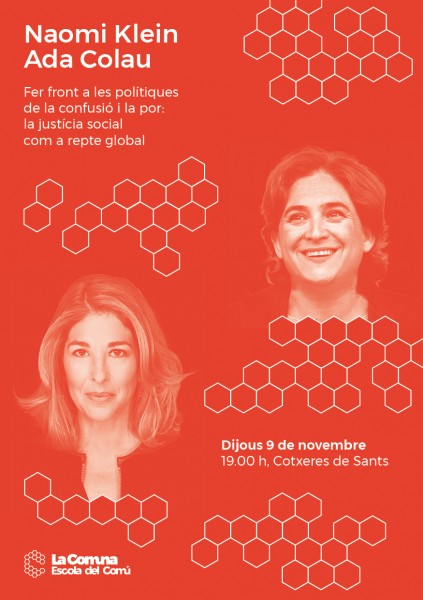
Colau and Klein debate in Barcelona: "Facing the politics of change and fear"

This Thursday the 9th of November at 7pm the Barcelona Mayor Ada Colau and progressive international author/journalist Naomi Klein will be speaking together.

In a very timely moment for this part of the world in particular, the organisers say that "the starting point of this debate will be the imposition by antidemocratic powers of global policies that challenge our lives, our security and survival..."

The event is open to all the public but seating is limited to 700 people. It will also be broadcast live on their  Facebook Live and the YouTube channel of La Comuna, Escola del Comú. There will also be a simultaneous translation service and translation into sign language.

Location:


Auditori de Cotxeres de Sants
Carrer de Sants, 79
L1 Plaça de Sants; L5 Sants Estació

Saturday, December 10, 2016

Barcelona Mayor restates role of the city in settling refugees

[Colau with her counterparts from Madrid, Zaragoza and Valencia at the Vatican.  Photo: EFE.]

 "The mayoress of Barcelona, Ada Colau, yesterday [restated] the role that cities can play in the reception of refugees in contrast with the “disastrous handling” so far of the states and the international community in the face of the crisis. 

Colau made these claims at the Vatican during her speech at the international summit ‘Europe: refugees are our brothers and sisters' where she was participating with seventy European mayors including those of Madrid, Manuela Carmena; Valencia, Joan Ribó; Zaragoza, Pedro Santisteve, and Malaga, Francisco de la Torre.

The summit opened yesterday but today Colau and other municipal leaders will be received by Pope Francis, who has also been critical of the management of the refugee crisis. Colau appreciated the role taken by the Pope in the issue and denied the existence of any contradictions in being a representative of a lay and non-confessional institution agreeing with the words of the Pope. 

For Colau, the meeting is focused “on human rights and democracy,” and asked the other municipal representatives to join forces to combat “the growth of neo-fascism” on the European continent as is represented by the presidential candidate in France, Marine Le Pen.

Warning that the European Union is at a crossroads where it must decide to aid refugees or support the far right, she called for safer means of access to prevent deaths when refugees are forced to flee their countries. Colau demanded more resources and authority for the cities to welcome refugees, grant work permits and allow them to pay taxes “like other citizens.”

“At stake is our civilisation and heritage. The EU was born to say no more to the horrors generated by wars, violence and dehumanisation,” the mayoress concluded."

Source: Catalonia Today.

Tuesday, August 23, 2016

"Welcome to Sunny Barcelona, Where the Government Is Embracing Coops, Citizen Activism, and Solar Energy"

 “When we moved into city hall, there were only paintings by men,” Barcelona Mayor Ada Colau tweeted in March, attaching a picture of her current office wall, which now featured portraits of eight prominent Catalan women—including the legendary anarchist leader Federica Montseny.

“Redecorating the walls, that was the easy change,” Colau’s second in command, Gerardo Pisarello, joked when we spoke with him in late June. “The other ones take quite a bit longer—they are more difficult and don’t just depend on us.” Pisarello’s office, too, features black-and-white photographs: one of a woman celebrating the proclamation of Spain’s Second Republic in 1931, and another taken at the country’s first LGBT protest after dictator Francisco Franco’s death in 1975, a demonstration that, as Pisarello proudly points out, happened in Barcelona. 

Colau and her team were unexpectedly swept into the mayor’s office in May 2015. Barcelona en Comú (“Barcelona in Common”), the progressive political platform Colau and others founded less than a year before the elections, won by the narrowest of margins, with a mere 11 of the 41 seats in the city’s council. It was just enough to form a minority government. 

Still, the BeC platform—a coalition that includes the Catalan branch of Spain’s new anti-austerity party Podemos, the United Left, and the Catalan Green Party—has faced a difficult challenge. Their aspiration is not just to alleviate the severe social and economic consequences of the Great Recession. They also want to reinvent how city government functions, from the ground up.

“I think what’s happening in Barcelona is unique,” Laura Roth, who teaches political science at the Universitat Pompeu Fabra and runs BeC’s neighborhood assembly for Ciutat Vella, says. “There are struggles everywhere. There are movements everywhere. Some are more democratic and others are less democratic. Some are more active and successful and others are less. But I think that there aren’t many movements today that are rethinking how to do politics.” 

Read more from source at The Nation here.