Showing posts with label corruption. Show all posts

Sunday, November 27, 2022

“Ugly Spain” – a book that provokes


"Why doesn’t the 1978 Constitution of Spain include the word “landscape”? 

Why doesn’t a Coastline Conservatory such as the French one exist in Spain

Why were more than 1,000 beautiful villages catalogued in 1967 in Spain, and now there are barely 100 are left? 

Why have democracy and the system of Autonomous Regions been seriously harmful to the landscape, and as a consequence, ruined in an irreparable manner the collective imagination?

España fea is a brillant study of the atrocities committed against the Spanish heritage from the end of the Franco dictatorship to today. 

With rigour and sensitivity it gives a detailed overview of all the absurdities undertaken on the Mediterranean coasts [from] the North, passing through “emptied Spain” and Madrid’s urban-planning disaster, and it analyses the causes that led to this cultural catastrophe. 

It reveals the strategy invented by ignorant and corrupt politicians and developers, with the complicit silence of a demobilized guild, that of architects, plus the indifference and ignorance of the intellectuals and the media. 

Nevertheless, the book also analyzes in detail some examples of a work well done, connecting with the best European tradition, in cities such as Barcelona or Santiago de Compostela, or in villages such as Albarracín or Vejer de la Frontera.

Starting from numerous interviews and uniting the journalistic chronicle, travel book and political essay, Andrés Rubio presents a truly original text full of nuances. Analyzing also the cases of France, Germany and Italy, it carries a Europeanist and progressive message in defense of the best qualities of the public, advocating for land-use planning as an essential weapon to affirm democracy."

Publisher's summary above found at Literary Rambles.

Sunday, October 18, 2020

"Opportunity"

A penetrating editorial from Lenox at the superb news summary service, Business Over Tapas...

"Spain has a political system which allows opportunity.

From the most humble councillor in the town hall (well, with a voice in the local government, that is) to the very top, there is opportunity. One can make use of it or not, as each and every politician must decide. 

Many did, and that led to the eventual fall of the last conservative government: for corrupción (Wiki)!


The famous mantra of ‘…y tú más’, which translates as something like ‘Oh yea? and what about your guys?’  was shattered with the rise of Pedro Sánchez (one recalls how the PSOE apparatus of the time did all it could to get rid of him) and, to the far-left, the arrival of Podemos with Pablo Iglesias.


Neither of these two is well seen by the Spanish Establishment. Business – and opportunity – is not best served.


From this comes the continuous plots and ferocious political opposition. 

This time though, the electorate is more attuned to the manipulation of the media.


In short, their enemies do all they can to find some dirt on either Pedro or Pablo, whose fame rests to a large degree on their integrity, knowing that any sign of having feet of clay will probably topple them.

And for this, the right-wing, much of the judiciary, the media and big business look under every stone and in every sewer, as they seek to manufacture some scandal that would stick, above all in the eyes of the voters."

This editorial was first published through BoT here.

Sunday, February 16, 2020

"Australia’s burning questions" -- My latest opinion column for Catalonia Today magazine

[EFE]

The great tragedy of the Australian bushfires -- that even after several months are still consuming huge parts of the country -- is that so much of the destruction is entirely avoidable.
How can this be? Why have more than 1 billion animals perished? Why have over 2,000 thousand homes been destroyed? Why have 23 people died and how is it possible that a total area of land bigger than Portugal or Hungary has already been burnt out?
The simplest correct answer is that Australia has always suffered from these kinds of wild blazes but that this time around the ‘fire season’ started much earlier and the spread of the fires was much wider than usual, with hundreds of them burning out of control at any one time.
Firefighters (most of whom are unpaid volunteers) have been almost completely powerless to stop the hydra-headed infernos because of continued fierce winds and the extreme high temperatures that the fires themselves have partly made worse.
Another major cause of the devastation can be accurately put down to state and federal governments underfunding emergency services for year after year.
ln an attempt to push any responsibility away from his own ultra-conservative party, Prime Minister Scott Morrison has used all kinds of political trickery and lies across the mainstream media (which fully supports him). He has also been widely condemned for choosing to go on holiday to Hawaii during the crisis, as did the relevant state minister from his party.
As well as that, Morrison has repeatedly argued that the global climate crisis is not a factor in this disaster, despite overwhelming scientific evidence showing it undoubtedly is.
As a fundamentalist Pentecostal Christian, he has instead maintained it is all the fault of arsonists or “greenies” who oppose targeted ‘back-burning’ to stop fires spreading. (The Green Party has always supported it, in fact.)
Accusations of climate denial against Morrison have come as thick and fast as the air that has choked the populations of Australia’s big cities of Canberra, Melbourne and Sydney over periods of weeks and months.
Even several former leaders of the PM’s own party have called for rapid action against carbon emissions and emergency policies to combat the years-long drought across the nation.
In many Australians’ experience, these fires have come on top of continuing and severe tap water shortages in many of Australia’s rural towns. Some, such as the small rural village of Murrurundi (located in a once relatively fertile area) have already run out of water and are having to buy in supplies privately. An increasing number of towns are expected to follow this disturbing practice soon.
Of course, water running low in Australian drought periods is nothing new.
What is causing outrage though amongst groups as diverse as farmers and environmentalists, is the massive (and often unmeasured) amounts of natural water from rivers, lakes and underground sources that are being sold off to private companies.
The Indian (multi-national) mining company Adani (which has the absurd, double-speak slogan of “Growth with Goodness”) extracts coal from the earth, among other things. It runs a business that is a major cause of global warming through carbon emissions and it requires large amounts of water in the coal cleaning process.
Adani -- which has paid not one cent of company tax in Australia -- will be allowed to siphon off 12.5 billion litres of local river water up until the year 2077. Another of its mines is being given $4.4 billion in public subsidies from the government. An open secret muddies the waters here: mining industries have been major financial donors to the conservative political parties in Australia for many years.
Corruption? You bet it is. For the governing parties, it’s raining money. This at a time when both rain and money are what’s really needed across a land that is dying of thirst and from fires on a biblical scale that Morrison had only ever read about.
[This article was first published in Catalonia Today magazine, Feb. 2020.]

Saturday, April 29, 2017

Spain (and Australia) in top ten countries for corporate tax dodging

 "What would you do with $500 billion? 

The first challenge might be actually getting your head around quite how much money that is. If you like to travel in style you could buy 1,150 Airbus A380s, according to the published Airbus list price. 

If you just wanted to show off, you could cover a football field to a depth of 1.5 metres with cash. 

So, it’s a lot of money. It’s also the amount of revenue the world is losing as a result of tax avoidance, according to a new report from the United Nations World Institute for Development Economics Research (pdf).

Corporate tax is a vital source of government revenue across the globe. It is especially vital in developing countries, argue the report’s authors. Their findings highlight the extent of global tax avoidance - as well as the countries facing the biggest shortfalls.

The issue was also on the agenda at this year’s World Economic Forum Annual Meeting in Davos. The session ‘Taxation without Borders: A Fair Share from Multinationals’ looked at the action needed - particularly in the wake of the leak of the Panama Papers, which exposed the use of tax havens around the world."

Read more from source here.

Saturday, February 20, 2016

Sunday, February 1, 2015

"Why go the public way? (Part one)" - My latest opinion column for Catalonia Today magazine

If tomorrow the government for some reason disappeared and we were all left without a system of state would it in fact be such a bad thing? 

There are people across the planet (and especially in the USA) who say that anarchy or virtually no government involvement in our lives is the best situation for the individual. 

What they don't recognise is that without important services for the public, run by the public sector all that is left is the whims of a small number of the richest to decide what the rest of us get and how much it will cost.

Since the collapse of communism as an economic alternative to capitalism in the 1990's and mainstream acceptance of market forces as the single dominant principle following the Thatcher/Reagan era, it has been fashionable to see the public sector as the biggest problem to deal with. 

A recent example proves exactly the opposite. The financial disaster that has swept across Europe since 2008 has shown us that terrible errors made in the banking sector demanded huge amounts of taxpayer's money to prop-up and compensate for excessive risk-taking by finance "experts."  

The ideologues who argued against government regulation and oversight are the very same people who have put out their hands for government bailouts for their shaky financial institutions.

What this continuing disaster clearly shows is that those making decisions in the private sector are at least as likely to stuff up as those in the public sector. 

And they are in fact even more likely to make judgements that are in their own self-interest rather than any notion of the common good because that is the nature of business. 

To survive they must make profits. In smaller operations the overriding concern is to keep the books balanced and not go into the red too often or for too long. In larger companies with shareholders their main job is to make sure that these shareholders get significant dividends - good returns on their investments. All other matters are minor when compared to the financial bottom line. 

Yes, there are some corporations and some bosses who are ethical and treat their employees well but especially in multinational companies those in ultimate control (ie. owners and shareholders) often do not even live in the same cities or even the same countries as the workers who create the revenue for them. Their greatest prioritiy is to produce more wealth for the already wealthy.

On the other hand, there is the public sector. Governments routinely fail the people they are supposed to be accountable to - not shareholders, but instead citizens, or at least voters. 

We should not confuse the incompetence or corruption in governments of every kind with incompetence or corruption in the private sector because there are some crucial differences. 

In theory, every few years electors in democratic countries have the opportunity to remove governments that let them down, and in fact we often do this. 

When the political system itself fails its citizens, such as in the two-party system that has caused many of us to question democracy itself (including in Spain, the UK and the USA) an alternative should arise before too long, provided that the populace takes a strong enough interest in how well it is governed. In Spain, Podemos is one example of this.

The 20th century had one fundamental battle of ideas that ran through it and that was the battle over how much government we would have in our lives and why. 

One extreme end of the spectrum held that complete state control of the economy was ideal but across China, Russia and Eastern Europe this has proved to be too much to bear. 

So-called free-marketeers countered that this proved that government "interference" in the supply and demand of goods and services (including the supply of labour) was mistaken - that it is somehow counter to human nature. 

In this column next month I will be arguing why it is they who are in fact mistaken.

[This article was first published in Catalonia Today magazine, February 2015.]
 

Tuesday, March 4, 2014

"To screen or not to screen?" - My latest opinion column for Catalonia Today magazine


As I write this, my son is hating me.

Last night I took a computer game off him that his mother and I agreed was violent and told him he would not be getting it back. He is twelve years old and naturally, he disagreed.

But I am not badly disturbed by his feelings toward me. I know they are temporary and I trust in the knowledge that sometimes parents will be hugely unpopular with our own children...if we are being moral, ethical parents - involved parents.

In this part of the world people get a lot right about how children are treated. One of the most notable things is how older children are largely both tolerant and even downright nice to their younger brothers and sisters, as well as to other littler kids they are not related to at all.

In Mediterranean Europe, the family unit is close and socialising with the extended family of grandparents, cousins and other blood relatives is a common part of almost every one's weekly life.

This is in stark contrast to standard Anglo families.

But I would argue that across this stretch of the planet (but probably in other parts, such as North America as well) parents are much too concerned with their children's happiness.

This may sound like a harsh, uncaring statement so it needs a bit of explanation. To me (and to plenty of full-time philosophers) happiness is a temporary state. It comes and goes under it's own invisible steam and can arrive and disappear before we hardly realise it.

The more we desperately look for it or try to manufacture it the more it seems to slip through our fingers.

I'm not advocating that we don't do our best to create situations where our kids are likely to find enjoyment or fun - quite the contrary.

But if we put happiness, which is by its nature a short-term sensation, ahead of trying to develop a son or daughter with a sense of what is right and what is wrong, then we are making a terrible mistake.

If we act and speak by instinctively putting our children's immediate gratification as the priority instead of doing what we can so that they are playing and learning in ways that are beneficial to them (at least in the medium or longer term) what is the logical result?

Years later you end up with adults who value getting as many petty possessions as they can (because materialism is supposed to create contentment) and to them this a thousand times more important than having something as bothersome as a conscience, which just gets in the way of fueling a bigger bank account.

In other words, you have corruption and you have it on a grand scale. The Mediterranean disease.

I accept that the inclination towards having happy children is a healthy one. I just don't accept that this injection of happiness should always be the most important thing.

Faced with the choice of being strongly disliked by my son for a period of time or, on the other hand, turning a blind eye to him exercising disturbing impulses for potentially hours on end, I'd choose unpopularity every time.

Knowing what we now know about how violent, first-person computer games will desensitise even adult users (and that is why modern military training uses simulated war-games) it would be almost a crime to be the indulgent parent.


[A version of this article was first published in Catalonia Today magazine, March 2014.]


Thursday, February 6, 2014

The colours of corruption (#2) (My latest opinion column in Catalonia Today magazine)


Europe is nauseous from the cancer of corruption. 

Yes, it still has the glories of its art, its food, its history and its abundant cultural riches - but it is also shot-through with corrupt men and women.

And I don't just mean Mediterranean Europe or its Eastern bloc neighbours. If we decide to include Russia in wider Europe then the point is even clearer. 

If we then go on to acknowledge that Turkey has often been as much a part of Europe as any other more western land covered with olives and sun-ripened tomatoes, then the case is water-tight. Near the end of last December, two of Turkey's government ministers were arrested and, in an open letter to the Turkish press, a state prosecutor alleged police obstruction of a corruption case.

Almost every Spaniard, Greek, Italian or Catalan knows that corruption runs deep through business and government activities, to the point where many people are no longer shocked by fresh daily or weekly revelations of it in the media. We know this all too well because many of us are personally involved in it or we know people who are. It starts from a young age, in truth - the cheating in school tests, then self-serving greedy lies to each other and finally, it is only a small moral step to fiddling the books.
I don't pretend that all this only goes on in this part of the world. As (Berlin-based) Transparency International's most recent annual survey showed, most country's citizens have formed some damning judgments on their own homelands. The “Corruption Perceptions Index” for 2013 concluded that almost 70 percent of the world's nations are "seriously corrupt or worse." While they found that “regionally, Eastern Europe and Central Asia ranked the worst, [but] Western Europe and the EU the best” this does not allow for the fact that 4 of the top 5 “cleanest” are northern-European/Scandinavian countries and therefore these rankings for the region are somewhat skewed.

Across the channel from the continent, those reluctant and selective semi-Europeans, the English, have had their own grubby trials to deal with. Apart from the usual political/finance industry collusion, late last year in London's atmospheric bear-pit court at the Old Bailey, 22 journalists, editors, police officers and prison workers began facing charges of conspiracy to commit misconduct.

In a separate example, a minority group spokesperson (from British Future which studies migration and identity) admitted that problems of electoral corruption had existed for some time. He acknowledged that “unhealthy relationships” between parties, candidates and “sections” of communities are continuing, though he maintains it is actually less of a problem than in the past, with clan-based politics from first generation migrants. His comments came in response to a conservative MP who had argued that it was “mainly the Pakistani community, not the Indian community” that was responsible for a Scotland Yard investigation that eventually found no evidence of widespread fraud in postal vote scams in London's Tower Hamlets area. This came on top of a 2008 finding of guilt against another conservative local councillor just outside London.

But corruption comes in so many different forms and has a thousand faces. A plan recently approved by the government in Malta is perfectly designed for malpractice. It will give anyone who wants to purchase a Malta EU passport the right to reside in any of the other 27 member states for a one-off fee of 650,000 euros. This policy is being introduced because, according to the country’s prime minister Joseph Muscat, it will attract “high value” individuals from around the world. Apparently, those who purchase passports are then going to be able to buy citizenship for their immediate family for just 25,000 euros. A private company called Henley and Partners (who state that they “run an important government advisory practice”) will be put in charge of processing the paperwork.(Meanwhile, Spain is also planning on awarding foreigners residency permits if they buy a house for more than US$215,000.)

So, if in fact, as one definition puts it, corruption is “the abuse of power for private gain... and it hurts everyone who depends on the integrity of people in a position of authority," the question must be asked, “Who is not getting hurt from corruption?”

[This article was first published in Catalonia Today magazine, Feb.


Friday, November 8, 2013

"Is this how Spain should deal with foreign buyers of property?"

A guest post from Thomas Ekvall...

"My recent experience trying to buy property in Tenerife is rather puzzling for a country having millions of unsold houses. I started off with going to a bank in Santa Cruz to open an account. The bank considered my documentation sufficient, however I was informed that I needed a “NIE” to open an account; consequently I went to the national police in Santa Cruz to obtain this. At the police station I was asked to pay a small fee for the “NIE” that had to be paid through a bank (an inconvenient way to pay a negligible fee). Nevertheless I went back to the bank to pay the fee.
Back at the bank I was informed that I had to obtain the “NIE” number before I could pay the fee. Consequently I went back to the police just to be told rather forcefully – no I had to pay first. I went back to the bank again to tell them that I was now really stuck and asked them to call the police officer in question to try to solve the problem which they were not willing to do.
I went back again to the police and tried to explain the situation and asked them to call the bank which they most certainly were not going to do; consequently I could not open an account.
I told my property broker about my experience, he smiled and said these things happen in Spain. However, he offered to help and he asked me to come to Porto Cruz at 9 am the next day, which I did and we went together to the national police just to be told that they were closed for the day. I was instructed to come back before 7 am the next day.
The next day I left Santa Cruz before 5 am to make sure I would make my appointment. Just before 7am I was ushered into a waiting room rather rudely by uniformed police. Here I was kept waiting together with another dozen people from 7am until 8:30 am when a formidable police lady graced us with her presence surveying her day’s crop of intimidated “NIE” applicants. As they had no number system she tried to establish in which order we had arrived by asking us, this unsurprisingly ended in confusion.
By about 9 am we were given the forms to fill-in, all in Spanish, by definition none of us were Spanish. My broker helped me to fill-in the forms. It must be in Spain’s interest to have staff dealing with potential buyers of property to at least speak English and German and have the relevant forms in these two languages. The only things in the office in languages other than Spanish were large signs in English and German urging “NIE” applicants to keep quiet.
A lady applicant, next to me, noticed that I had help with my Spanish so she asked my broker if he could help her as well, which he agreed to do, however, our formidable police lady intervened to stop my broker from helping her, she said: she should have come with her own interpreter.
The time was now past 10 am and my case had as yet not been broached. Again our formidable police lady appears before us to deal with another applicant who had by now waited patiently for well over two hours. She asked him to go out and photocopy a document in a nearby shop and added brusquely: be quick.
My broker, who now sensed that I was getting irritated, told me things were in fact improving, she used to keep applicants waiting in the sun all day just to slam the door in their faces when she felt she had dealt with enough applicants for the day. He had observed one couple in their mid eighties being treated in this fashion.
Just before 11 am I was finally allowed to hand in my forms, but not without complications, the formidable lady noticed that the address I had given in Tenerife was a hotel in Santa Cruz and she wanted to send me back to Santa Cruz after a long discussion my broker managed to convince her to accept my case.
Just past 11 am I and my broker were allowed into the formidable police lady’s office. My broker who entered first sat down in one of two chairs in front of her desk just to be asked to stand up. We finished our business some 15 minutes past 11 am after having paid the fee. I was told to come back at 1 pm the following day to collect my “NIE”.
I and my broker went to a café near the police station to reflect on our experience; minutes after we had sat down the formidable police lady appears for a cup of coffee. She at this point had another eight applicants to deal with who by now had been waiting for her attention for close to five hours.
The next day at 15 minutes to 1 pm I arrived, as instructed, at the national police station in Porto Cruz. The uniformed police at the reception told me in no uncertain terms to go away saying they were closed. I tried to explain that I was asked to come there at this hour. We obviously did not understand each other so he asked me to come with him into the office to speak to a colleague of his who spoke English. He entered an inner office and said something to me that I did not understand and I followed him into the inner office, he then turned around and shouted at me and pushed me out.
At about 1pm I was finally ushered into the waiting room where I was, after an hour or so, given an audience with the formidable police lady and given my temporary “NIE” after six visits to the police, 12 days and US$ 5,000 for air tickets, food and hotel room. This inept and humiliating process has postponed indefinitely me buying any property in Spain."

Thomas Ekvall


Friday, October 4, 2013

Spanish Government Complaint Box Causes Boomerang Effect

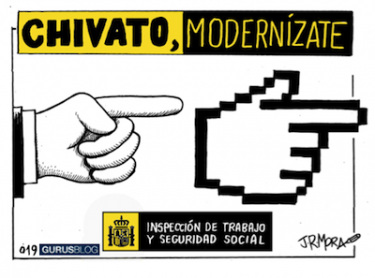
Cartoon by J.R Mora. Used with permission.
"The Spanish Minister of Employment and Social Security,Fátima Bañez, has launched a “complaint box” to combat workplace fraud.
 
The government is encouraging citizens to anonymously report cases of fraud committed by companies and individual workers for further investigation by the Office of Labor Inspection.

The “box” is a publicly accessible online form on the Ministry's website.

The move has sparked controversy in the blogosphere and on social networks, and created a boomerang effect against the Spanish government: the first complaints received through the new system were directed at the government itself and members of the political sphere, not at ordinary citizens as intended. 
 
Once again, the people have demonstrated their wit and humor while responding to government action.

The main criticism of the complaint box is that with it the government aims to make citizens into “snitches,” [or informers] creating an accusatory climate that is more like an authoritarian system than a democracy.
 
Critics also say that its real goal is to persecute the most vulnerable people in society instead of going after the country's wealthiest citizens tax evasion or alleviating unemployment.

The contradiction has not gone unnoticed: that those claiming to combat fraud are part of a government overwhelmed by massive corruption scandals and suspected of illegal financing of its party, the ruling People's Party (PP)."


Read more from Elena Arrontes' article on Global Voices here.

Tuesday, March 26, 2013

The colours of corruption


...from Global Mail's detailed breakdown of the illegal activities and “culture of kickbacks” that have been going on here for some time now.

It makes for deeply disturbing reading.

Thursday, February 21, 2013

Corruption - or just "the way we do things here"?

There are a a couple of things that can be said about this latest reeking, venal scandal in Catalonia.*

The man at the heart of it,  Jordi Pujol is a hero to many people here as he largely seen as the main person responsible for Catalonia's post-Franco autonomous powers.

His son has allegedly been laundering his family's allegedly dirty money from an alleged trunk of an alleged car to an also-alleged bank in Andorra (which is a vile, ultra-consumerist ski-resort city in a tiny principality where people like to drive their big black cars too fast through narrow roads.)

This part of the world (still) has a lot going for it but
institutional honesty is obviously not one of the strong points.

Cheating on your income tax and using the "black" or cash-economy is largely the done thing. In my experience, cheating, in whatever form, is thought to be the clever thing to do.

Children do it from a very young age and at a local (wealthy) private school where I used to work, it was completely standard to cheat in tests and teachers knew about it and did not punish it.

The family is probably
the most important single unit in Mediterranean Europe, so favouring a brother, son or cousin is entirely normal.

It is not just those at the top of the political pyramid who do this. It is a practise that is as ordinary as drinking a glass of wine here. Having connections is called "enchufe" - literally, 'plugged-in.

It is difficult living here without some kinds of connections to help you advance your lot, so the common-place act is the one that scratches a friends back when they will also soon scratch yours.

The latest cases of corruption are logical but
extreme, grotesque extensions of some basic dishonesty.

An edited version of the above text was first published under the same title at the World Voices blog.

[*I strongly suggest reading one of the comments from 'reload' under the original article for an insightful explanation about the surprising use of 500 Euro notes.]