Sunday, October 30, 2022

"Ana Gutiérrez, a forgotten resistance hero"


My friend, the wonderful British writer and journalist David Baird shared his knowledge of the maquis in the 
Frigiliana area of Malaga province (where he has lived since the 1970s) to help with this radio documentary.


From the source:

"The protagonists of history do not always appear in textbooks. Some have joined the ranks of those who anonymously give the best of themselves to change the course of life. This is the case of Ana Gutiérrez, "la Tangerina," tireless fighter for freedom in the darkest of the Francoist night.


RNE [Spain's Radio National] explores her eventful life and her whose determination in the defense of her ideals, like something out of a movie script.

Born in Tangier, Ana Gutiérrez was already a member of the Unified Socialist Youth before she came of age as an adult. For this she was arrested and paid for it with two years in prison and exile.

Forced to leave her hometown, she took refuge in Malaga, where she continued her militancy and took on more risky assignments, including spying and propagandist. Another two years in prison were the price to pay for her insistence on maintaining her struggle.

After being freed, Tangerina returned to the underground, this time as a supporter of the maquis settled in the mountains of the Axarquia in Malaga. There she also experienced a romance with Roberto, the legendary leader of the anti-Francoist guerrillas. For her it meant again two years in jail; but for Roberto, the [execution] wall.

After leaving prison, Ana Gutiérrez, still young, decided to rebuild her life, went into exile in Switzerland, got married and started a family. 

She lived there until, after her retirement, she returned to Spain and went to live in Nerja, in a house whose terrace overlooks the mountains where she risked her life for her ideals.

This documentary, with the agreement of Ricardo Aguilera, has had the invaluable collaboration of Salvador Magaz, son of Ana Gutiérrez, who has preserved a valuable body of documentation, key to the development of our work, and which is already the object of desire of historians. 

We are also accompanied by José María Azuaga, professor and researcher of the anti-Francoist guerrilla. 

In addition, we have counted with neighbors in the area and experts in the history of the maquis, as Adolfo Moyano or the British journalist and writer David Baird, both based in Frigiliana, who expand our knowledge about the guerrilla and its international context. 

The writer Mariví Ledesma, author of "La memoria olvidada" (Forgotten Memory), explains the harshness of those years. Vicky Fernández, neighbor of El Acebuchal, one of the villages that suffered the most repression during the war against the Maquis, gives us her testimony, as well as other elders of the area such as José Ávila, from Cómpeta, and Sebastián Martín, from Frigiliana, who keep a vivid memory of all that.

Thanks to all of them we have been able to recreate the circumstances in which Ana Gutiérrez, the Tangerina, wrote her story of courage and dedication that does not appear in any book."

Saturday, October 29, 2022

Sunday, October 23, 2022

"Early doors day" -- A poem

 (This poem was first published in Burrow here at Old Water Rat’s Publishing )


soft lines of fog trees

not the desert
but quiet like the desert

we look at the stars to see 
what we come from

body not yet the enemy
light slowly befriends you

Monday, October 17, 2022

"It has now come to this" -- My latest opinion column for Catalonia Today magazine


Cars and vans parked in a street. QUIM PUIG.

[This article was first published in Catalonia Today magazine, Oct. 2022.]


The following is based on current and factual information…

How would you fancy sleeping in a car or a van?

Rather than the now antiquated 20th century idea of having your own bed in something as outdated as a house, for the price of two euros a day our new business in Barcelona will fulfill this fantasy for you. And for only 60 euros a month on a prime real-estate public street!

Naturally, there are those in the city council who want to curb your right to get your shut-eye shut out of buildings but they just don’t understand an adventurous spirit. Don’t let them tell you what to do and where you can and can’t do it. You work hard every day and you deserve what we call a “micro space” to match your macro dreams.

We are opening in a small, quiet and almost-deserted square in the Sant Andreu district. In the same location you can rub shoulders with customers of our beehive flats. On top of all that, for a mere 90 euros per month you can go inside, hang out on a plastic chair for the entire day, have a shower, store food, use the complimentary microwave, or even wash your clothes. Now that’s what we call livin’, baby!

Yes, it’s true that those small-minded lefty bureaucrats in the council have assured everybody that our operation won’t actually be legal but in the meantime you can make us your home. We’ve traded in the semi-legal shadows for years so we’re at home with that, even if you’re not!

OK, it’s not exactly what most people call home and it’s temporary but let’s not quibble about semantics. You need a mattress and we can rent you one. That’s just free-market capitalism in operation and who should stand in the way of your good night’s sleep. So, wind up the windows, click the locks on the doors and snuggle up for sweet dreams!

Oh, and another thing that you don’t need to concern yourself with. We admit that municipal tow trucks have already taken some of the sleeper vehicles away but this is just a minor inconvenience. In the unlikely event we are discriminated against again in this way, we’ll refund half of your fee and find you another vehicle to nod off in. You can’t say fairer than that, can you?

As for our premium accommodation we even have a waiting list for others to live in homes that are no bigger than three square metres. We acknowledge that at the moment those are also prohibited in Barcelona but they’ve got them in Japan and “anything-goes Madrid” so why not here too?

I know you’ve heard stories of paper thin walls and hearing other people’s alarms going off and being kept awake by neighbour’s snoring…but just relax. Humans can get used to anything. Eventually.

The truth is as simple. You just don’t have a right to human-sized accommodation anymore. Society can’t deliver this to everyone so some people need to learn that they aren’t lucky enough to be comfortable, secure or well-housed. A lie-down bed isn’t a right, it’s a privilege!

Monday, October 3, 2022

Destinations and returns


In Slow Travels in Unsung Spain, I needed a destination. 

One of the reasons I wrote the book was this man, the great author, Antonio Muñoz Molina. 

In Andalucia's Ubeda, his first hometown, I talked to one of his family then turned and headed to my own home in Catalonia. 

The long way.


(Read more of my latest book here.)

Sunday, September 18, 2022

Baldwin's Barcelona -- My latest article for Catalonia Today magazine

(Photo: Allan Warren)

The book must always come before the author,” said Nobel Prize winner, VS Naipaul. 

Unlike another genius such as James Baldwin, Napaul spent his entire brilliant, vicious life seemingly trying to prove himself wrong.

For Baldwin, words came first. By becoming a child preacher in his native New York City he avoided the Harlem ghetto.

He also soon found the power of images and a sense of himself as gay and American, an American “negro”: the mid 20th century polite English word for “black”.

(I remember the shock of hearing the other, offensive ‘N-word’ when my cousin in Sydney used it as the name for his pet dog. I was seven years old at the time but even then somehow I knew how wrong that was.)

On a wider tour of Iberia, Baldwin (who died in rural France in 1987) came to Barcelona six decades ago last May.

He met the poet Jaime Gil de Biedma and stayed in his basement in Carrer Muntaner – “blacker than my reputation,” he called it – and they spent seven frenzied days together with [current mayor of Hijar] Luis Marquesán.

Biedma wrote in his diary: “Life, since Monday, when I met Jimmy Baldwin, has been so hectic that today I find myself in a state of real moral and physical exhaustion, aggravated by the intellectual dullness that comes with an alcoholic regime such as the one I have been following.”

According to Marquesán’s biographer, Miguel Dalmau, they went to the picnic areas of Montjuïc, “where they saw the landscape of misery, the shantytowns in disarray on the mountainside.” Ultimately it all led to Baldwin’s new friend Biedma questioning himself about whether he was a coward.

Despite the stimulating week, it seems fair to say that the Catalan capital was a place of mixed fortunes for Baldwin.

As reported in this magazine in October 2019, the publisher, Lumen, “had asked Barcelona photographer Oriol Maspons to advise on publishing the book ‘Nothing Personal’ by James Baldwin and Richard Avedon, but his advice was ignored.

Hurt, he and other photographers published a signed ad in the magazine Destino, criticising the indifference shown towards a masterpiece dealing with the US’ racist and classist system.”

Fortunately though, one of Baldwin’s books, ‘Beale Street Blues’ has finally found its way into a Catalan translation, thanks to the publisher Edicions 1984 and the work of Oriol Ampuero.

He launched it along with professor and writer Josep-Anton Fernàndez on June 13 at the Sants bookshop La Inexplicable.

Baldwin’s work, like so many others, was censored in Spain during the Franco years, but Barcelona played another part in his local history when the US writer Nicholas Boggs was a recent writer-in-residence at Jiwar on Carrer Astúries (founded by two Barcelona residents, Mireia Estrada Gelabart and Moroccan-Canadian Ahmed Ghazali). Boggs spent his time co-editing and writing the introduction to a new edition of Baldwin’s ‘Little Man, Little Man: A Story of Childhood.’

He is also continuing work on his manuscript in progress about love and race in Baldwin’s life and work at the Department of English at New York University.

I share Boggs’ fixation. It knocked me sideways when I read Baldwin’s novel, ’Tell Me How Long the Train’s Been Gone’, during lockdown in spring 2020 and I’ve barely left his words untouched since then.

Reading James Baldwin (or listening to his captivating voice) is like having a fogged-up window wiped clean. Now the view can be seen for what it is, whether picturesque or hideous.

Baldwin’s penetrating work, too, is now starting to be seen more and more for what it is, both in Catalonia and across the wider planet.

[This article was first published in Catalonia Today magazine, Sept. 2022.]


Saturday, September 10, 2022

Yet another ⭐⭐⭐⭐⭐ reader review of my latest book


Isidra says:

"This is an unusual travel book...

Being a Spaniard myself, I really enjoyed the mix of literary musings, historical facts and sightseeing that Hetherington offers...

As the title says, it's a slow kind of travel, one that allows for immersion and a nuance, very personal travelogue that mixes reflection, description and awe. 

It made me eager to start traveling by train!"


[Read the full Goodreads reader review here.]


Wednesday, September 7, 2022

"Unlimited Barcelona" -- 360 degree views that show the city from on high


Enjoying the great views (and later a glass of cava sparkling wine) at Unlimited Barcelona in Plaça Urquinaona.

Highly recommended! 

(Full disclosure: We were given a free visit and drink because of my journalism work.)

Saturday, August 27, 2022

El Cid lives on in small-town Catalonia

4 surprising tributes stamped into power-poles next to vines on the edge of town, Sant Cugat Sesgarrigues (where I live.)

El Cid (1045 – July 10, 1099), whose birth name was Rodrigo Díaz de Vivar (or Bibar), is a Spanish national hero, a mercenary soldier who fought for the Spanish king Alfonso VII to liberate parts of Spain from the Almoravid dynasty and eventually captured the Muslim caliphate of Valencia and ruled his own kingdom. 

...He [also] fought for the Huddid dynasty for almost ten years, scoring significant victories against both Muslim and Christian foes."


Monday, August 22, 2022

"So, how was your summer?" -- My latest

A REpost because so little has changed if I am answering the same question this year...

Standing in a Spanish Doorway: "So, how was your summer?" -- My latest opinion co...:   When people ask me this question I’ll be able to say it was unique. I had some novel experiences.  Because the Spanish government doesn’t ...

Sunday, August 14, 2022

New ⭐⭐⭐⭐ reader-review for "Slow Travels in Unsung Spain"


More reader's words I greatly appreciate:
"This is a nicely paced book.
He weaves in some Spanish history, art and modern Spanish literature...He keenly feels how it is for an outsider to be in another culture...
I highly recommend this book not just for travellers."

Slow Travels in Unsung Spain is available at virtually all online book retailers (including here.)

Saturday, August 6, 2022

"Who took away our food?"


"On Monday, the world’s eyes were on a ship leaving the port of Odesa — carrying 26,000 tons of Ukrainian corn, it was the first such shipment since Russia’s invasion of Ukraine in late February.


For months, every magazine and newspaper carried the same headline: A global food-crisis is looming. Record-high food prices had thrust millions into food insecurity and communities into poverty. Soon after Russian troops crossed into Ukraine, the price of wheat surged 70% and western leaders sought to tie the price increases to the war. Russia, in turn, blamed the US and European sanctions imposed against it, and Ukraine and Europe blamed the “blockade” of Ukrainian ports.


But the crisis of hunger predates the conflict. “Nearly one in three people in the world (2.37 billion) did not have access to adequate food in 2020” according to a 2021 report by the UN’s Food and Agriculture Organisation (FAO). But, production and supply, especially of commodities like wheat, had not changed much at all. Well before the grains left the port of Odesa, the soaring wheat prices from February this year had already fallen — in mid-July, they fell to pre-war levels.


We produce more than enough food to feed the world’s entire population. Yet, our people are hungry. The spike in food prices this year, and indeed the years before it, was never about interrupted supply, not exclusively anyway — but about speculation and profiteering in the markets — a fact that has been ignored in all major reports about the food crisis from the World Bank, FAO, and other international institutions.


New data by Lighthouse Reports, a European nonprofit, shows that speculation in commodities markets is the dominant driver of the spike in prices, with speculators responsible for 72% of all buying activity on the Paris wheat market in April.


They create hunger because they can. Each year, tens of millions of subsistence farmers are forced from their land by multinational agribusinesses. This process — in its scale, almost unparalleled in human history — destroys sustainable agricultural production and forces people into slums, where access to food is dependent on prices and incomes. Poverty, not underproduction, causes famine.


They profit from our hunger because they can. The rising food crisis created “62 new food billionaires” in just 24 months since the beginning of the pandemic. These corporate empires do not trade in food — they trade in starvation.


For decades, popular forces like La Via Campesina have been fighting to build a fairer global food system. It can be done: The Indian farmers’ strike of 2020-21, which successfully overturned three neoliberal agricultural laws, gives us confidence about the power of people to resist the global regime of hunger. But to win, popular forces will need to go further — winning state power and wielding it to reclaim food from the jaws of those who profit from our hunger."


From Progressive International


Sunday, July 31, 2022

Claude Lanzmann: "Life at its widest"

[This article was first published under the title "Summer at its widest" in Catalonia Today, July 2022.]

15 summers ago (my first full one here) the CCCB, or Centre de Cultura Contemporània de Barcelona showed French-Jewish filmaker Claude Lanzmann’s “extraordinary diptych of the Holocaust.”

Coming after the critically acclaimed, monumental 9 and a half hour documentary, Holocaust [or “Shoah”] of 1985, the Barcelona screening was titled “Variations of what is real.” It was part of their Xcèntric program for 2006-7.

Led by the academic Jorge Seca, the films were subtitled in Castilian Spanish by a group of translators from the UAB, Autonomous University in Barcelona.

In the first offering, Un vivant qui passe (1997), Lanzmann tells the story of Maurice Rossel, the only representative of the Red Cross to visit the Terezin death camp and wrote a report stating that he had seen “no atrocities.”

In 1944 Rossel reported that it was in fact a “model ghetto” and noticed “nothing terribly wrong”. He also freely and repeatedly expressed his view that Jews had “a passivity that I couldn’t stomach.” 

In the longer follow-up reel, “Sobibor” (2001) Lanzmann examined another episode of the Holocaust: the attempted escape of 600 Jews (also including some Red Army prisoners of war) from a Polish extermination camp.

He did this “through the story of Yehuda Lerner [one of only 60 survivors] who was seventeen years old, when in a meticulous plan of rebellion he ordered a Nazi officer to smash his head with an axe.”

The film “ends with the triumph of the Jews’ murder of their Nazi guards and their succesful flight from Sobibor, but he does not follow the survivors [return] where some were killed.”

Lanzmann himself (who died 4 years ago this July) was often simply called a director.

In truth, he was a film producer in the widest sense of the word.

According to journalist Julia Pascal he was even “the movie-maker-as-spy, the Jew who pretended to be pro-Nazi in order to film the guilty.

In one long sequence, he posed as a Nazi sympathiser and secretly filmed an SS officer who confided his past.” In fact, after their subterfuge was discovered he and a female accomplice were badly beaten and it could have been much worse before they got away. 

Lanzmann created from his will, as a stranger to brevity, stapling it well below accuracy or exhaustive detail.

The memoir he wrote, titled The Patagonian Hare, was no exception. If you’re like me and an hour on the beach (or maximum two) is only doable with a good book and you want something different from the standard lighter or narrower reading, then this book is the polar opposite.

It’s a kind of stretched agony in many places. His battle with what becomes his life’s purpose, the telling of the most stomach-churning truths, is clear.

What shines too from the lines of his memory in top gear is his determination to never be resigned to a great silence, to never taste the poison of passivity. 

His is a reverence for life itself. Seemingly never belittled by doubt, he has made much of the crucial importance of Nazi victims being treated so that in contemporay times “they haven’t died alone.”

My hope for everyone reading this in a season of pure heat is that you find time to relax and enjoy all that you can, living with the spirit of a Lanzmann.

Monday, July 18, 2022

Sunday, July 10, 2022

"Fossil gas labelled green in ‘biggest act of greenwashing in history’"


"European MEPs from the far right, and the majority of the EPP today voted in favor of the EU Commission’s proposal to inexplicably label gas as ‘green’ in the EU’s taxonomy of sustainable investments by 328 to 278. 

Europe’s elected representatives have let citizens down, says Transport & Environment, which has labelled the vote a disaster for the climate and a gift to Putin.

Luca Bonaccorsi, sustainable finance director at T&E, said:“This must be the biggest act of greenwashing in history; enacted by the same people that are supposed to protect us from the climate crisis. The sun won’t set in the east just because a bunch of complicit politicians say so in a law. Nor will gas ever be clean and renewable. The laws of nature don’t lie, but the taxonomy does. This bill will not stand up to the many legal challenges being announced, and it will be shunned by investors.”

The provisions allow all new gas plants to be labelled green under the condition that they will be used ‘sparingly’. This undermines the credibility of sustainable investing, says T&E, since no green fund or green bond includes gas today. At best the EU’s rules will be ignored, at worst it will fuel a whole industry of fake green investments.

Luca Bonaccorsi, concluded: “On top of being environmentally disastrous the bill is also unfair, with almost 75% of the estimated green funds going to France and Germany. The criteria to access green funds have been skillfully designed to steer all funds towards the two member states that co-authored the law. This is a truly sad day for Europe.”


Sunday, July 3, 2022

MOSS Deck Art Show MELBOURNE with BARCELONA


Turning Art Into Water for MOSS Foundation

Melbourne: 6pm – 9:30pm Friday 25TH Nov 2022
Barcelona: 6pm – 9:30pm Thurs 24th Nov 2022

Silent Auction closes 9:30pm Friday Melbourne time & 11:30am Friday Barcelona time
(Same bidding app, same time, different time zones!)
In person and online charity auctions.
Take your decks home on the night (pick up or shipping options too).
(Also check out MOSS shows at Gold Coast in June ‘22 & Sydney/Hawaii in Sept ‘22)
::
INVITE YOUR FRIENDS - AND YOURSELF!
Top artists from around this planet are donating their original one off art works for clean water in Eswatini / Swaziland.
100% TO THE CAUSE!
::
100% of the sale price of every piece goes to funding a life changing MOSS Foundation permanent clean water scheme in southern east Africa.

(No commissions, no admin costs, no gallery commission or artist fees, no food or wine costs. It’s all sponsored.)
Every dollar you spend goes to clean water in Swaziland / eSwatini.
::
Where:
1) Magnet Gallery. SC G19 Wharf St, The District, Docklands, VIC 3008. Australia
2) Base Elements Gallery, Carrer d'Avinyó, 31, 08002 Barcelona, Spain
::

Free entry.
What is MOSS?
https://vimeo.com/295326949
www.mosswater.org
- MOSS Foundation Inc is a 100% volunteer registered charity founded by skateboarders, musicians, artists and surfers.
- MOSS Foundation has been building life changing permanent water schemes in Eswatini (formerly Swaziland), southern east Africa since 2006.
MOSS Foundation - Clean Water Saving Lives
www.facebook.com/MossFoundationSkaters
www.instagram.com/MossFoundationSkaters
www.MossWaterProject.com
#MossJam
#MossDeckArtShow
#MossFoundationSkaters
@MossFoundationSkaters 


https://www.youtube.com/watch?v=DNPRBw93R2g&list=LL&index=2

Sunday, June 26, 2022

"Donald Trump doesn't like to read" [but some of the rest of us do...]


In a period of weeks where blind ignorance and Islamaphobia have been tragically demonstrated around the globe, it's apparent that the act of reading (and here I don't mean skimming racist Tweets) is more important than ever but some of the most powerful people are against it...

"The Trump statement [in the blogpost title] was used in an ad campaign ("World, stay awake") by the German bookstore chain "Thalia" to attract attention; according to former Secretary of State Rex Tillerson, it is true (cf. The Washington Post, Dec. 7, 2018).
The publisher Jordi Nadal used the same slogan for the title of an op-ed piece published in La Vanguardia newspaper in which he gave good reasons for reading, of which some excerpts read as follows:
[...] reading is growing, is feeding curiosity, is giving our minds and emotions more circuits and ressources. The biggest difference between the mind of a child educated in a rich family and that of poor one lies in the words he/she knows. A poor mind doesn't have words. A rich mind has got a universe of words that, in turn, combined and made their own, turn into the master key that will open a good part of the doors and situations present along life.
Juan José Millás reminded us that reality is made of words, which means who dominates words dominates reality. Thus, we consider it an absolute gift to have discovered books and reading. For very many reasons: we can read, because we want to feed our curiosity, because we want to grow, because we want to evade ourselves [?], because we want to understand other things and other people and cultures, because we want to listen to other lives.
[...] Without reading there is no depth of field, nor contrast, nor nuances. Without reading we easily fall into fanatism. You know, a fanatic is the one who doesn't want to change neither the topic nor the opinion. Fanatics read little or badly. Without reading, there triumph naturally the tweet and hate.
What is more, reading is healing and healthy. Reading --every day there are more scientific studies that avail it-- is good for your health. Readers on average live two years more.
Reading is a clean way of enjoying life. Enjoying it as a superior form of research to learn to govern a little better, with humility and gratitude, a life that's one's own in freedom. A PISA study revealed that, beyond the indicators of place, country, etc. and levels of reading competence, a home with less than 20 books is a reliable indicator of a more than nearly assured school failure, and, on the other hand, a home with more than 200 books is a near guarantee for academic success.
[...] Every reader has got the unique and non-transferable opportunity to be the master of a world when he/she dives into the intimacy of reading, and, as was said masterfully by the great author C.S. Lewis [at least in William Nicholson's Shadowlands]: "We read to know we are not alone."
Another statement [from] the Thalia campaign: "The world has got more secrets than those known by Siri."
SOURCE: La Vanguardia, Feb. 2, 2019, p. 26 [printed edition]; horizont.net [images]
Found at Literary Rambles here.


Sunday, June 19, 2022

"Wine and a whine" – My latest opinion column for Catalonia Today magazine


As a reptile – I like to think of myself as one of those lizards that runs across the hottest desert sands with a high knee action like an Olympic hurdler, though in reality I’m probably more of a slow-moving komodo dragon – waking up to yet another spring morning with a sky the colour of an iron lung is all too much.


Most likely, you’re reading this with summer’s heat well underway but I actively resent the idea that most foreigners have moved to Mediterranean countries solely for solar delight. 

Not true. 

Speaking only for myself, there’s plenty of other reasons to live here long-term and I’ve written in detail about them in this column over the years.

But yes, I admit, I don’t remember a spring here in the last decade and a half that was so bloody gloomy. 

Apparently, March had the least number of sunlight hours in 50 years and April/early May didn’t feel much better. 

I want my money back. I didn’t sign up for these relentless, grim overhead conditions and general damp.

Simon Winder in his book Germania, makes an argument (with Germany as the exception) that “one very odd aspect of European countries is that if you start in their north-wests they are generally unattractive, harsh places but if you head south-east life gets better.” 

He goes on to put this down to fairly obvious factors like the existence of more sun, olives, melons and an outdoor life including wine and vineyards.

Then the author uncorks some wider history, quoting a British wine-merchant who maintains that for most people in England until the First World War, “wine meant drinking ‘hock’ (German Rhine/Mosel white) or [what was popularly called] ‘claret’ (French Bordeaux red). 

Following this, post-war, the German drop “tasted too much of steel-helmet” and apart from the sweeter “Blue Nun” it largely disappeared from many British tables.

It seems to me that a lot of 21st-century Europeans, including Catalans and Spanish of course, take good wine slightly for granted. 

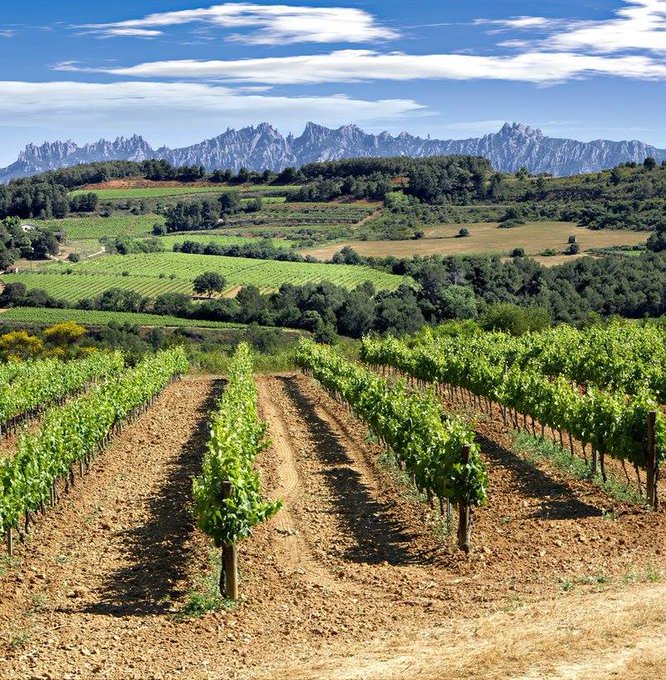
In some areas, the geography supports that. Just travel [I almost remember what that verb means] down the roads or look out the train window between Martorell and down the line through the Penedès to near the coast at Sant Vicenç de Calders. 

The landscape is a non-religious hymn to the grape.

That great truth-teller Eduardo Galeano wrote, “We are all mortal until the first kiss and the second glass of wine.” 

Personally, I can’t remember ever having anything better than an ice-cold Chilean dry white called Concha y Toro in a Canberra restaurant called El Rincon Latino.

With the recent scarcity of a penetrating heat and further east a war that must’ve taken any warmth out of any scattering of sun, I hope that rays of natural serotonin are soon seeping into our souls like “that first swallow of wine… after you’ve just crossed the desert.”

Now I’m reminded of the basic and essential difference between climate and weather, though I doubt Leonard Cohen was thinking about that when he wrote, “Springtime starts and then it stops in the name of something new.” 

What else is new apart from the season? Anything? Something?


[This article was first published in Catalonia Today magazine, June 2022.]